
Personal Finance
Stocks have touched record highs despite Iran war. Here’s why

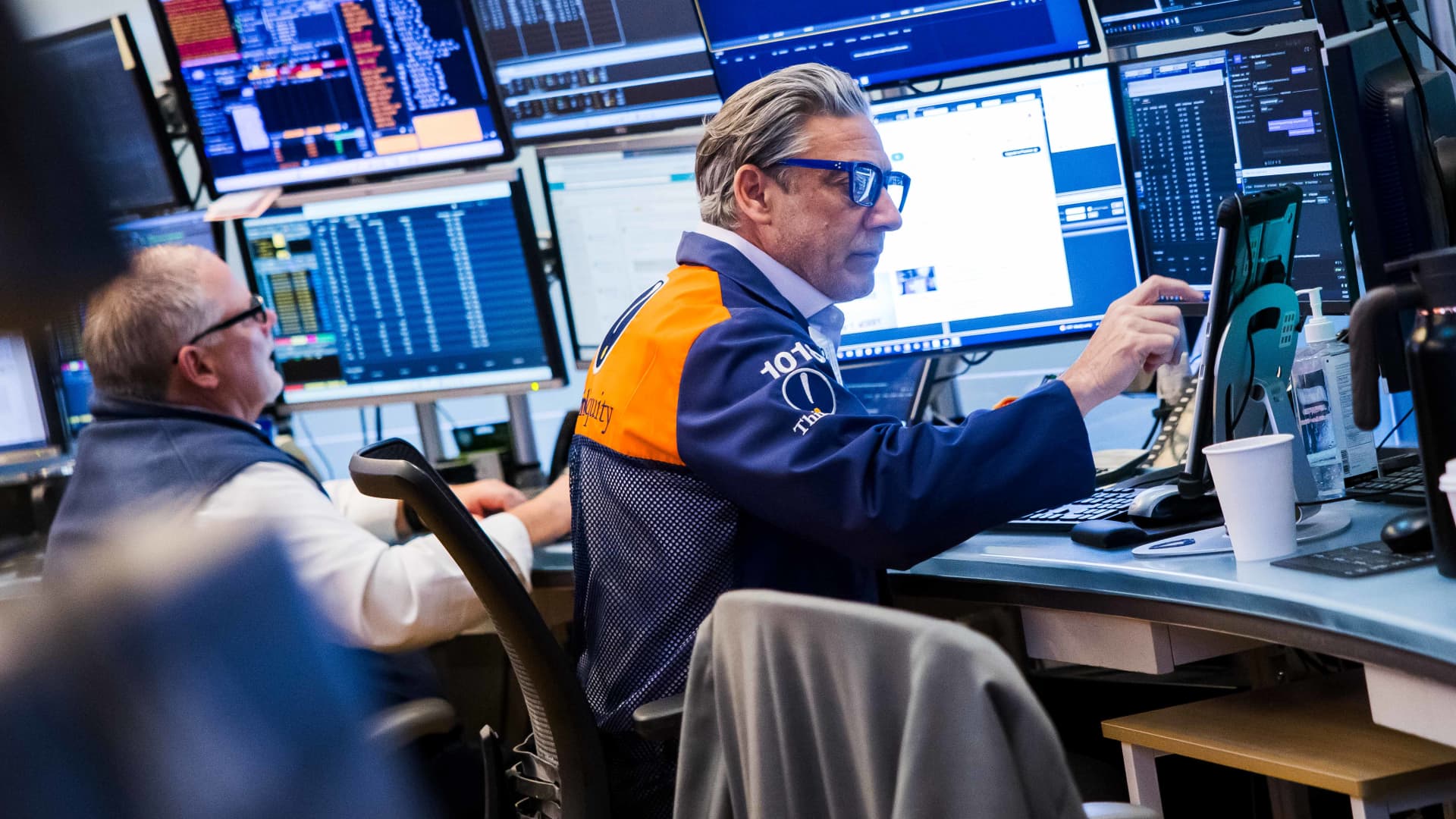
Traders work at the New York Stock Exchange on April 16, 2026.
NYSE
U.S. stocks climbed to record highs on Thursday against a backdrop of war, an oil supply shock and economic forecasts warning of stunted growth amid a protracted conflict.
Many investors may be thinking: Why?
Largely, it’s because the stock market is a barometer of what investors think will happen in the future, rather than an assessment of the present day, according to economists and market analysts.
Investors are essentially shrugging off the Middle East conflict as a blip that will be resolved relatively quickly, they said.
“The stock market isn’t trying to price what’s happening today,” said Joe Seydl, a senior markets economist at J.P. Morgan Private Bank. “The stock market is always trying to price what the world is going to look like six to 12 months from now.”
Why stocks have been ‘resilient’
The S&P 500, a U.S. stock index, fell about 8% in the initial weeks of the Iran war, from the start of the conflict on Feb. 28 to a recent low on March 30.
But stocks have rebounded since then, erasing all losses since the beginning of the war. The S&P 500 closed at an all-time high on Thursday — about 11% higher than its nadir at the end of March. That followed a record close on Wednesday.
“The market has remained very resilient in the face of the war and has rallied strongly on the prospect that it will be resolved,” said Mark Zandi, chief economist at Moody’s.

A ship waits to pass through the Strait of Hormuz following the two-week temporary ceasefire between the US and Iran, which is conditional on the opening of the strait, in Oman on April 8, 2026.
Shady Alassar | Anadolu | Getty Images
And while investors cheered the possibility of a diplomatic off-ramp to the conflict, the temporary ceasefire has appeared tenuous, with the U.S. and Iran each accusing the other of breaking the agreement.
Nations haven’t been able to reach a peace deal ahead of the ceasefire’s end. Vice President JD Vance said U.S. officials left peace talks in Pakistan over the weekend after the Iranian delegation refused to agree to American demands not to develop a nuclear weapon.
The markets ‘have memory’
Ultimately, the stock market is signaling a collective belief that tensions will ratchet down, the war will end in the near term and oil flows through the Strait of Hormuz will normalize, economists said.
That’s largely because investors have been conditioned to believe that President Donald Trump will back off if the economic pain becomes too intense, economists said — the so-called “TACO” trade, shorthand for “Trump always chickens out.”
“Investors strongly believe — and have been conditioned to believe — he’s going to stand down, find a way to pivot, declare victory and move on,” Zandi said.
Trump has pushed back on the notion of backing down, framing his brinkmanship as a savvy negotiating tactic.
Economists pointed to a recent example of this dynamic: in April 2025 during so-called liberation day, when the Trump administration levied a host of tariffs on U.S. trading partners.
Within days — after the stock market had cratered more than 12% — Trump announced a 90-day pause on those tariffs. Stocks then saw one of their biggest daily rallies in history following Trump’s reversal.
Investors remember that Trump often de-escalates geopolitical shocks — which is why they’ve seized on positive headlines that hint at progress in peace talks, for example, Seydl said.
“The markets have memory,” Seydl said.
AI stocks and the ‘tech boom’
Traders celebrating at the New York Stock Exchange on April 15, 2026, as the S&P 500 closed above the 7,000 level for the first time.
NYSE
There are other factors underpinning market resilience during wartime, economists said.
One is the investors’ enthusiasm for artificial intelligence and technology stocks, which account for almost half of the S&P 500’s market capitalization, Zandi said.
“Those stocks run on their own dynamic independent of anything, including the war in Iran,” Zandi said. “I think we would have been down a lot more and it would have been harder for us to recover had it not been for the very, very optimistic perspectives on AI.”
We’re in the middle of a “tech boom” — and investors are likely to remain optimistic until they think the tech cycle has run its course, Seydl said.

More broadly, stock investors are essentially making a bet on the future earnings growth of a company — and the earnings backdrop has been “pretty solid,” Seydl said.
Consumer spending appears to be stable, for example, economists said. And companies are getting a boost to their after-tax earnings from the GOP’s so-called “big beautiful bill,” which, among other things, made it easier to write off investments upfront and therefore reduce their tax liability, Zandi said.
Going forward
Experts said there will be an economic hit from the Iran war, though.
“Despite the recent news of a temporary ceasefire, some damage is already done, and the downside risks remain elevated,” Pierre-Olivier Gourinchas, director of research at the International Monetary Fund, wrote Tuesday.
A protracted conflict risks deep and global economic pain, he wrote.
Even if the conflict is short-lived — as the broad market expects — stocks are unlikely to march much higher until it’s clear the U.S. is on the other side of the war and its economic fallout, Zandi said.
If investors are incorrect, and President Trump doesn’t back down or quickly extricate the U.S. from the war, the stock market may see a “full-blown correction” or worse, Zandi said. A stock market correction is a decline of at least 10% from recent highs.
“Everyone thinks they know what the script is,” Zandi said. “Now they just need to follow the script. If they don’t, the market will have some real problems.”
The uncertainty provides yet another example of why the average investor with a long time horizon should stick to their investment plan and ignore the noise, experts said.
“Trying to time the market is very difficult if not impossible for the average investor,” Seydl said. “It’s better to take a long-term perspective and ride out bouts of volatility.”
Personal Finance
Next-Generation Retirement Planning: Managing Longevity Risk and Variable Income Streams


AI Infrastructure Boom Hits Physical Limits: Power, Financing, and Supply Chain Strain

Nvidia Q2 FY2027 Earnings beats Wall Street Expectation with Record $96.2 Billion Revenue

Treasury Bond Volatility Forces Bessent to Double Debt Buyback Size as Yields Swing

Armanino adds Strategic Accounting Outsourced Solutions

New 2023 K-1 instructions stir the CAMT pot for partnerships and corporations

Tax Strategy: Employee Retention Credit update
-

 Economics1 week ago
Top 10 Largest Economies by 2030: IMF & World Bank GDP Projections for Global Powerhouses
-

 Stock News5 days ago
Nvidia Earnings Preview: What Wall Street Expects From the AI Bellwether’s Q2 Report
-
 Stock News1 week ago
How to understand Intel $15B Stock Offering
-

 Economics1 week ago
Economic Profile of the United States of America (2026–2030 Horizon)
-

 Leaders1 week ago
Jackson Hole 2026: What the First Symposium Under Fed Chair Kevin Warsh Means for Markets
-
 Economics1 week ago
U.S. National Debt Surpasses $40 Trillion for the First Time: What It Means for the Economy
-

 Accounting5 days ago
SEC’s Semiannual Reporting Proposal Faces Investor Pushback: What CFOs Need to Know
-
 Finance5 days ago
Treasury Bond Volatility Forces Bessent to Double Debt Buyback Size as Yields Swing