
Finance
Markets rethink December rate cut amid Fed doubts

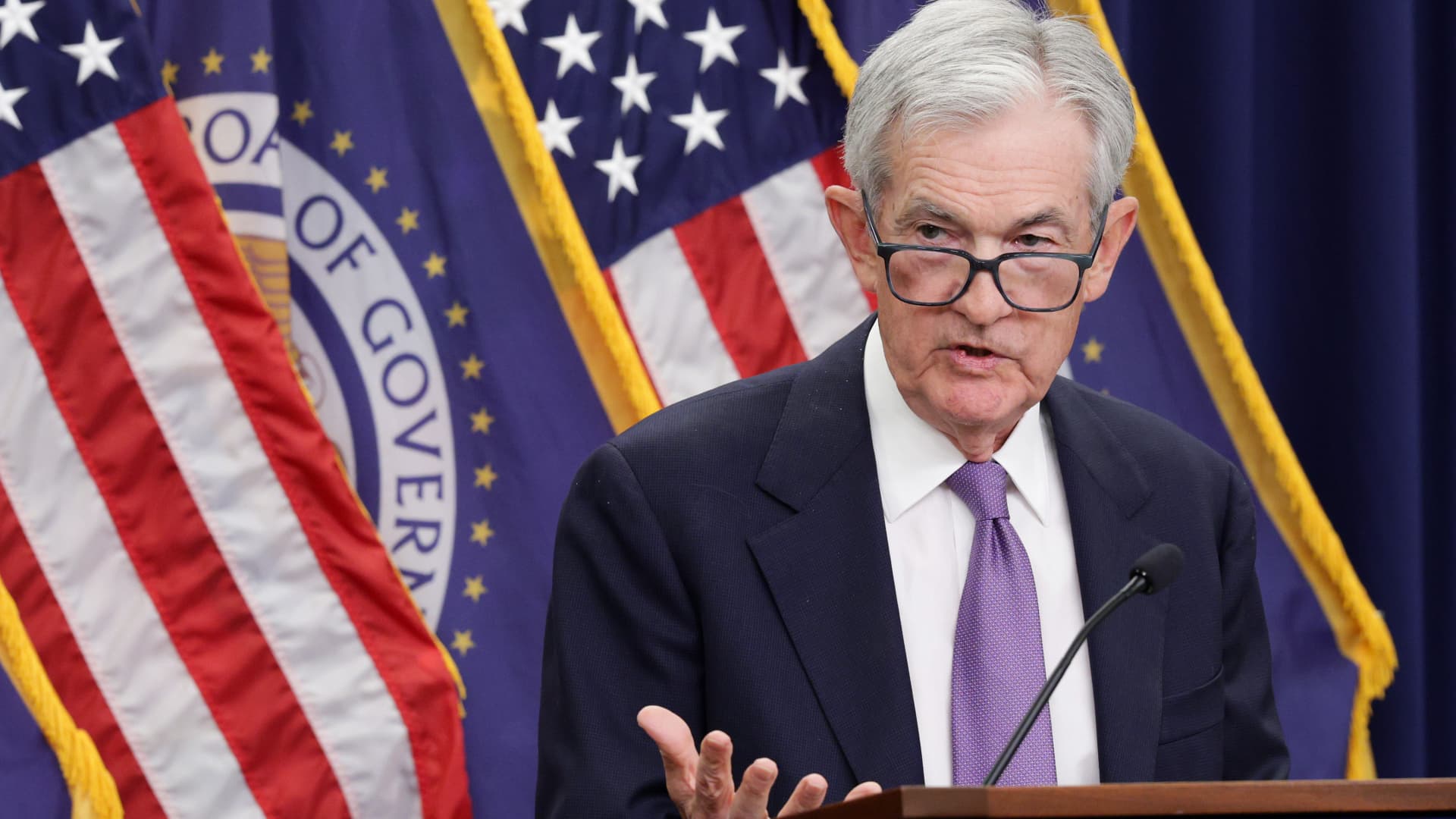
Federal Reserve Chair Jerome Powell speaks during a news conference following a meeting of the Federal Open Market Committee at the Federal Reserve on Oct. 29, 2025 in Washington, DC.
Alex Wong | Getty Images
Federal Reserve Chair Jerome Powell wasn’t kidding a couple weeks ago when he said a December rate cut wasn’t in the bag.
Recent remarks from Powell’s colleagues point to plenty of apprehension over whether the central bank should deliver its third consecutive easing of policy when it meets Dec. 9-10.
As a result, markets have recalibrated their expectations. Whereas traders as recently as a few days ago were pricing in at least a 2-to-1 probability of a quarter percentage point cut, that’s now flipped to a coin toss, according to futures markets readings tabulated by the CME Group in its FedWatch tool.
“These developments chip away at our confidence the Fed will cut in [December] without giving us any more confidence a skip to [January] is a better bet,” Krishna Guha, head of global policy and central bank strategy at Evercore ISI, said in a note. “This leaves us still seeing a [December] cut more likely than not but only 55-60 per cent.”
As of Thursday afternoon, the implied probability of a rate cut was at 49.4%, according to the CME gauge that uses prices on 30-day fed funds futures contracts to interpolate probabilities for rate moves. Futures prices pointed to a funds rate of 3.775% by the end of 2025, compared to the current level of 3.87%.
A month ago, the market was assigning a 95% probability of a reduction.
So what changed? Primarily, uncertainty at a time when the official data flow came to a halt due to the now-resolved government shutdown. Some Fed officials worry about flying blind on data at a time when the most recent readings point to a softening labor market but inflation that, while ebbing slightly, is still considerably above the Fed’s 2% target. Moreover, White House press secretary Karoline Leavitt said Wednesday that some of the data, particularly for October, may never come out.
An unexpected voice
Those reservations showed up in an uncharacteristically blunt assessment Wednesday from Boston Fed President Susan Collins.
During her time with the Fed, Collins has used cautious language to express her opinion on policy. But a speech she delivered in her home district left little doubt regarding her misgivings about inflation and the importance of the Fed to hold steady, at least for now, until there’s greater economic clarity.
“Given my baseline outlook, it will likely be appropriate to keep policy rates at the current level for some time to balance the inflation and employment risks in this highly uncertain environment,” Collins said. “I see several reasons to have a relatively high bar for additional easing in the near term.”

A central part of her case is that the economy generally looks solid even with the slowdown in hiring. Cutting rates more, Collins reasoned, risks pushing inflation higher at a time when the impact from tariffs is still uncertain.
“The current level of policy rates, in my view, leaves policy well positioned to address a range of potential outcomes and balance risks on both sides of our mandate,” she said, referring to the Fed’s dual mandate to maximize employment and keep prices stable.
Collins’ position puts her in a hawkish group that includes regional presidents Jeffrey Schmid of Kansas City who, unlike Collins, voted against the October cut, along with Beth Hammack of Cleveland and possibly Alberto Musalem of St. Louis and Lorie Logan in Dallas.
On the opposite side of the rate fence are Governors Stephen Miran who, in his two meetings, has voted against quarter-point cuts in favor of half-point reductions, as well as Christopher Waller and Michelle Bowman.
Chair Powell, then, is left to build consensus following his comments after the October rate cut that “a further reduction in the policy rate at the December meeting is not a foregone conclusion—far from it.” There is no Fed policy meeting in November.
Taking sides
As markets grew less confident about a December cut, stocks slumped Thursday while Treasury yields moved higher.
Powell’s dilemma at a time of uncharacteristic dissent on the Federal Open Market Committee is intensifying.
“We do not think Powell wants the Committee to break apart deeply and publicly with mass hawkish
dissents at this institutionally perilous moment,” Guha said. “This in our view is why he and his top deputies [FOMC Vice Chair Philip] Jefferson and [New York Fed President John] Williams have adopted a conciliatory posture, respecting hawks’ arguments and insisting the market view [December] as a 50-50 call.”
One middle ground for the Powell would be a “hawkish cut,” in which the committee would agree to one more reduction while the chair communicates that further moves lower are unlikely. The FOMC’s makeup changes in January when a new crop of regional presidents will move into voting roles, and as Powell’s term as chair nears its end in May. Gone will be hawks like Collins and Schmid, though both Hammack and Logan will move into voting roles.
“With all this in mind, we think that it is possible that Powell is forced into a compromise by which the Fed either (1) stays on hold in December, or (2) if it does cut, is obligated subsequently to signal that the rate cutting cycle may be over,” wrote Thierry Wizman, global FX and rates strategist at Macquarie Group.
Traders are anticipating the committee softens its stance come January. Futures pricing indicates about a 70% probability of a cut to kick off the new year should the FOMC decide to skip December.






U.S.- Canada Trade Talks Collapse; Carney Says Retaliatory Tariffs Begin September 8

Flock Cameras and the Future of Public Security

AI Infrastructure Boom Hits Physical Limits: Power, Financing, and Supply Chain Strain

Armanino adds Strategic Accounting Outsourced Solutions

New 2023 K-1 instructions stir the CAMT pot for partnerships and corporations

Tax Strategy: Employee Retention Credit update
-

 Stock News1 week ago
Nvidia Earnings Preview: What Wall Street Expects From the AI Bellwether’s Q2 Report
-

 Accounting1 week ago
SEC’s Semiannual Reporting Proposal Faces Investor Pushback: What CFOs Need to Know
-

 Stock News1 week ago
Nvidia Q2 FY2027 Earnings beats Wall Street Expectation with Record $96.2 Billion Revenue
-

 Finance1 week ago
Treasury Bond Volatility Forces Bessent to Double Debt Buyback Size as Yields Swing
-
 Technology5 days ago
AI Infrastructure Boom Hits Physical Limits: Power, Financing, and Supply Chain Strain
-
 Technology3 days ago
Flock Cameras and the Future of Public Security
-
 Economics3 days ago
U.S.- Canada Trade Talks Collapse; Carney Says Retaliatory Tariffs Begin September 8