
Personal Finance
Medicaid work requirements would reduce health coverage: Senator

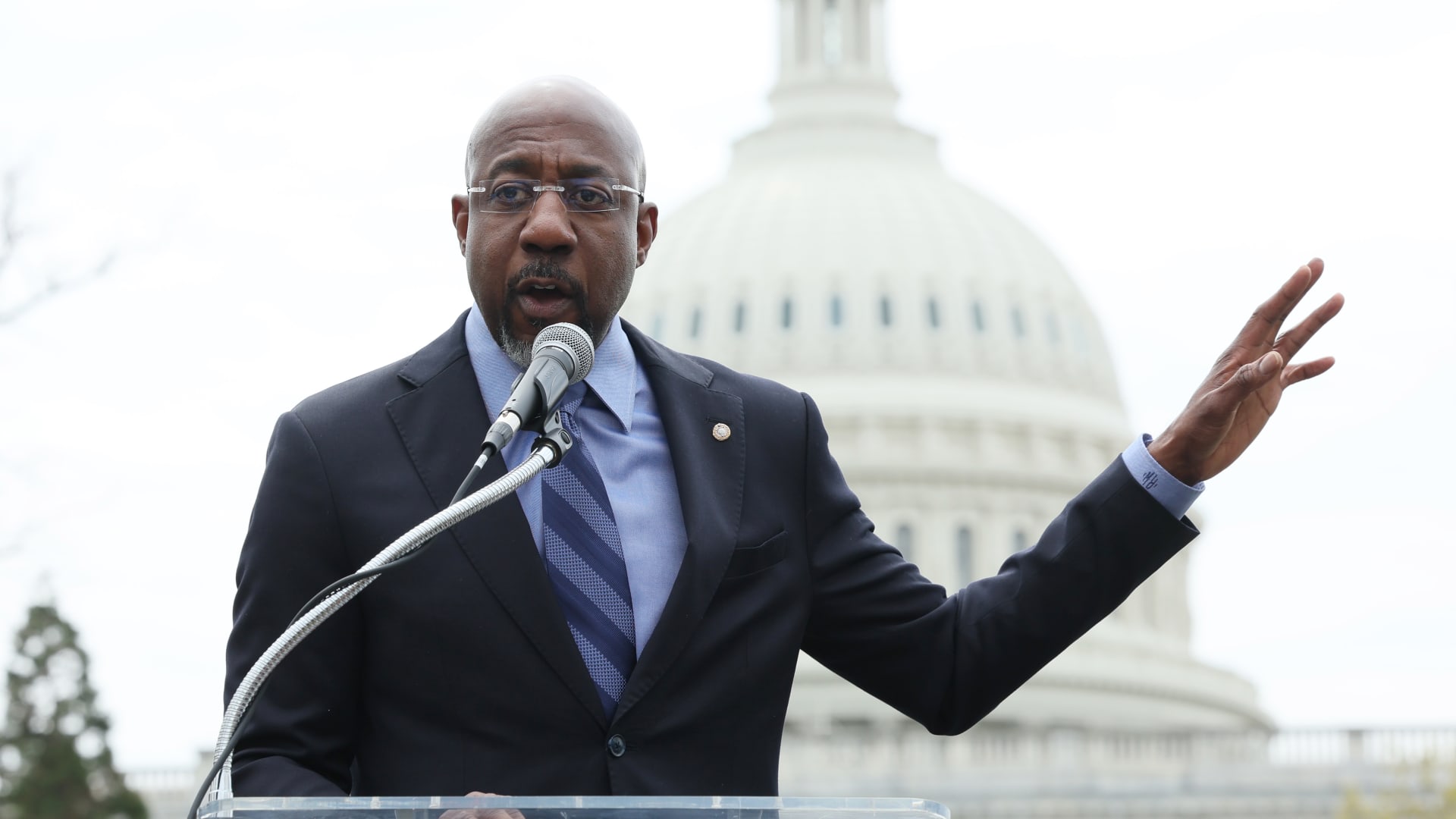
U.S. Senator Raphael Warnock speaks at the Capitol on April 10 in Washington, D.C.
Jemal Countess | Getty Images Entertainment | Getty Images
Republican lawmakers may be looking at substantial cuts to Medicaid in upcoming reconciliation legislation.
But one method of restricting access to coverage — work requirements — could have disastrous results for Americans, based on efforts in Arkansas and Georgia to implement such policies, according to a new report issued by Sen. Raphael Warnock, D-Ga. Those rules typically require people to meet certain thresholds, such as a set number of hours of work per month, to qualify for Medicaid coverage.
While labeled as “work requirements,” they would be more correctly called “work reporting requirements” because they involve so many rules, forms and other red tape that they can prevent working Americans from accessing coverage, according to Warnock.
“These work reporting requirements are not incentivizing work; there’s no evidence of that,” Warnock said in an interview with CNBC.com.
“What we see is that this is a good way to kick a lot of people off of their health care — hardworking everyday Americans who are struggling,” Warnock said.

A Republican House budget resolution included about $880 billion in spending cuts through 2034 from the House Energy and Commerce Committee. In a March report, the Congressional Budget Office found Republicans cannot achieve their budget goals without cutting Medicaid.
House Republicans on Sunday released draft legislative language of the reconciliation bill. Work requirements are among the eligibility policies on the table.
Based on the current proposal, 9.7 million to 14.4 million people would be at risk for losing Medicaid coverage in 2034 if they are unable to show they meet the work requirements, according to a new report from the Center on Budget and Policy Priorities.
Rep. Brett Guthrie, R-Ky., who is chairman of the House Committee on Energy and Commerce, wrote an op-ed for The Wall Street Journal in support of the work hurdles.
“When so many Americans who are truly in need rely on Medicaid for life-saving services, Washington can’t afford to undermine the program further by subsidizing capable adults who choose not to work,” Guthrie wrote in the op-ed published on Sunday.
“That’s why our bill would implement sensible work requirements,” Guthrie wrote.
Those requirements would be in line with current policies, according to Guthrie, where working adults, seniors on Medicare and veterans have all worked in exchange for health coverage eligibility.
However, Warnock argues that thinking is backwards. By providing health care coverage without those requirements, that will then help encourage people to work because they are getting the care they need to be healthy, he said.
“If you provide basic health care to the people who are eligible, you actually have more people working,” Warnock said. “You have a stronger economy.”
Expanding ‘failed experiment’ is a ‘bad idea’
Two states — Arkansas and Georgia — have tested work reporting requirements for Medicaid, with subpar results, according to Warnock’s report.
“These are two cautionary tales, and the idea of now expanding a failed experiment nationwide is a bad idea,” Warnock said.
Georgia, Warnock’s home state, is currently the only one in the country that has Medicaid work reporting requirements in place. The state’s program, Georgia Pathways to Coverage, lets adults qualify if they have 80 hours of qualifying work per month, have income below the federal poverty line and pay mandatory premiums.
The program, which was implemented on July 1, 2023, has lackluster enrollment, according to Warnock’s report. Twenty months in, the program has only enrolled around 7,000 people, while nearly 500,000 people need health care coverage in Georgia, according to Warnock.
“It gets a big fat ‘F,'” Warnock said of the program. “It’s failed.”
Georgia Gov. Brian Kemp and some other state Republicans have spoken about the program as a success.
Georgia is among the states that opted not to expand Medicaid, and therefore make coverage more accessible, following the passage of the Affordable Care Act.
Meanwhile, Arkansas did implement Medicaid expansion in 2014 and subsequently put work requirements in place from 2018 to 2019. However, those efforts failed, with 18,000 people losing Medicaid coverage in the first seven months and only a small share of people able to get coverage back the following year, according to a 2023 report from the Center on Budget and Policy Priorities.
More from Personal Finance:
Two key issues to watch in House Republican tax debate
As student loan collections resume, credit scores tumble
Stagflation is a looming economic risk. What it means for your money
Low compliance with work requirements may come from a variety of factors that have nothing to do with employment, according to research from the Urban Institute. That may include limited access to the internet or transportation, health limitations or disabilities and low education levels.
Others may simply not quite meet the requirements their states have set out.
That is the case for Heather Payne, 52, of Dalton, Georgia, who suffered a series of strokes in 2022. As a result, Payne can no longer work as a traveling nurse and has opted to enroll in graduate school to become a nurse practitioner, a role that will be less physically grueling.
“I really do love nursing so much, and I cannot continue to do it the same way that I used to do it since my strokes,” Payne said.
While Payne is considered a full-time student, she is just short of the hours to qualify for Medicaid under Georgia’s work requirements. As a result, she is paying for private health care coverage with her tuition, which is adding to the debts she will have to pay off once she graduates.
Because her health insurance plan doesn’t cover all her care, she estimates she’s incurred “tens of thousands of dollars” in medical debt.
Payne, who said she is “not very savvy on politics,” attended President Joe Biden’s 2024 State of the Union Address in Washington, D.C., as Warnock’s guest in an effort to draw attention to the coverage gap.
The U.S. is one of the few industrialized countries without universal health coverage, which is “really kind of embarrassing,” Payne said.
“And instead of trying to go toward that, we’re trying to yank it away from everyone possible,” Payne said.


Personal Finance
Next-Generation Retirement Planning: Managing Longevity Risk and Variable Income Streams


U.S.- Canada Trade Talks Collapse; Carney Says Retaliatory Tariffs Begin September 8

Flock Cameras and the Future of Public Security

AI Infrastructure Boom Hits Physical Limits: Power, Financing, and Supply Chain Strain

Armanino adds Strategic Accounting Outsourced Solutions

New 2023 K-1 instructions stir the CAMT pot for partnerships and corporations

Tax Strategy: Employee Retention Credit update
-

 Stock News1 week ago
Nvidia Earnings Preview: What Wall Street Expects From the AI Bellwether’s Q2 Report
-

 Accounting1 week ago
SEC’s Semiannual Reporting Proposal Faces Investor Pushback: What CFOs Need to Know
-

 Stock News1 week ago
Nvidia Q2 FY2027 Earnings beats Wall Street Expectation with Record $96.2 Billion Revenue
-

 Finance1 week ago
Treasury Bond Volatility Forces Bessent to Double Debt Buyback Size as Yields Swing
-
 Technology5 days ago
AI Infrastructure Boom Hits Physical Limits: Power, Financing, and Supply Chain Strain
-
 Technology3 days ago
Flock Cameras and the Future of Public Security
-
 Economics3 days ago
U.S.- Canada Trade Talks Collapse; Carney Says Retaliatory Tariffs Begin September 8