
Personal Finance
Miami is ‘ground zero’ for climate risk. People move there, build there anyway

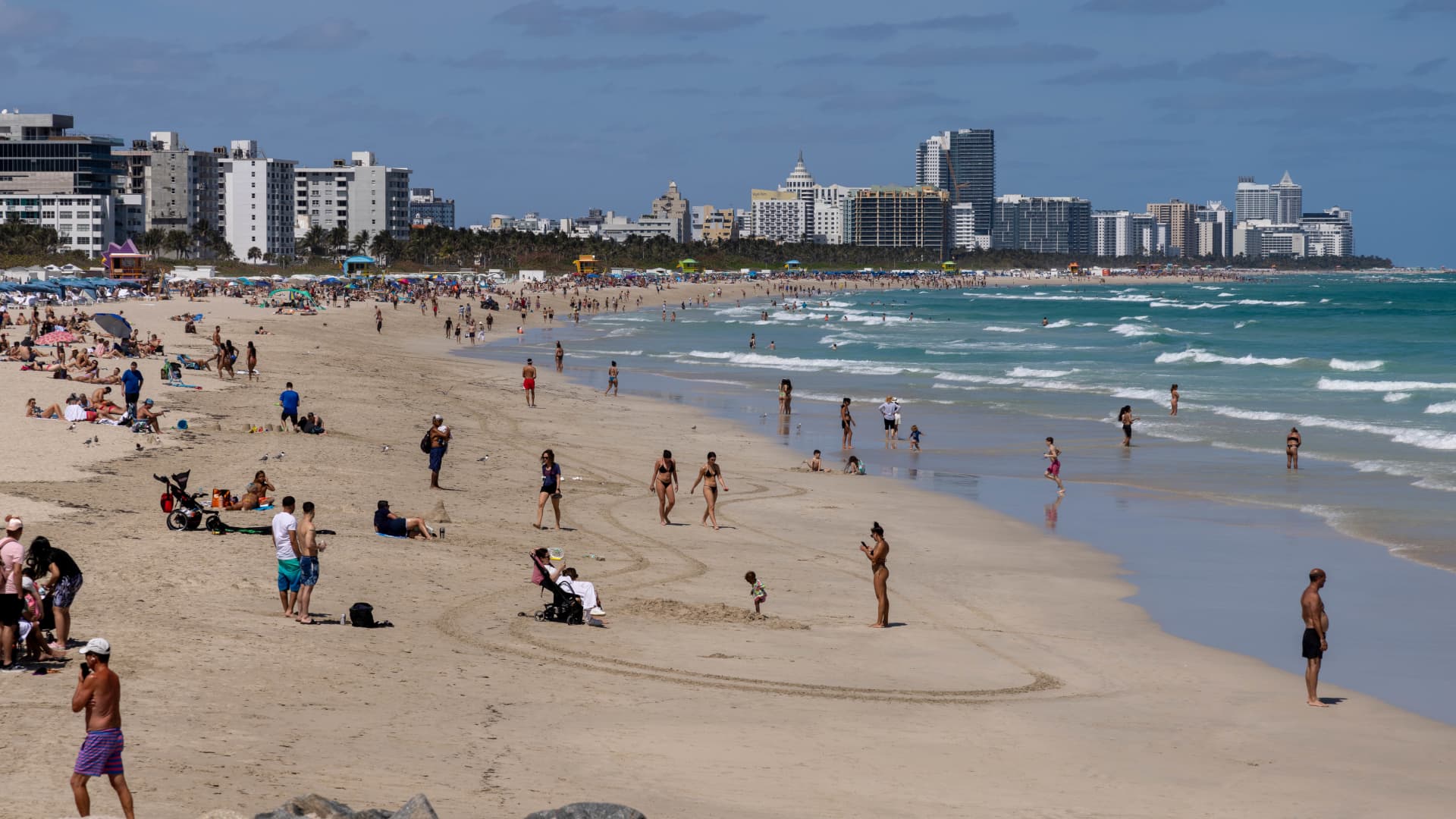
South Pointe Beach in Miami Beach, Florida.
Greg Iacurci
MIAMI — Daniel Habibian worries about climate change.
His clothing boutique in Miami Beach’s iconic South Beach neighborhood sits just a few blocks inland from the Atlantic Ocean.
Rising seas threaten to swallow much of the Miami metro area in the coming decades as the world continues to warm and faraway ice sheets melt. By 2060, about 60% of Miami-Dade County will be submerged, estimates Harold Wanless, a professor of geography and sustainable development at the University of Miami.
Yet people keep moving there. The city’s skyline has grown in tandem.
Miami’s boom runs headlong into a harsh yet inescapable truth: It’s “ground zero for climate change,” said Sonia Brubaker, chief resilience officer for the City of Miami.
Climate risk is “always on our thoughts,” said Habibian, 39, who moved to Miami-Dade County about six years ago.
Daniel Habibian stands outside his store, Studio 26, a clothing boutique in South Beach.
Greg Iacurci
“[Miami] is almost at sea level, so a bit of water can take it underwater,” he told CNBC inside his store, Studio 26.
Outside, sun-kissed tourists and locals trickled by on their way back from the nearby ocean as reggaeton pulsed from flashy convertibles. The March air, a perfect 75 degrees, mixed with a gentle breeze that caressed palm fronds and passersby in a warm embrace.
Such weather is what drew Habibian to the area from New York.
“We like living here,” he said. “So we’ll see what happens.”
More people ‘moving into risky areas’ than leaving
The Miami metro area — including Miami, Fort Lauderdale and West Palm Beach — is a low-lying swath of South Florida that is home to more than 6 million people.
Its urban sprawl juts abruptly from the Atlantic shoreline like a vertical spike of glass, metal and concrete.
Construction volume in the greater Miami metro area hit $27.4 billion in 2023, up 73% from $15.8 billion in 2014, according to an analysis by Cumming Group, a project management and cost consulting firm.
It projects that those values, which are adjusted for inflation, will rise to about $29 billion in 2024 and 2025.
The Miami area population has also ballooned, growing by more than 660,000 people from 2010 to 2020 — the most of any other Florida metropolis and nearly twice the tally of No. 2 Tampa-St. Petersburg, according to the Florida Department of Transportation.
The Bentley Residence condominium complex, center, under construction in Miami, Florida, in September 2022.
Saul Martinez/Bloomberg via Getty Images
The trend shows how many Americans are ultimately willing to overlook environmental risks, even though most acknowledge its presence — a choice that could later devastate them financially.
Across the U.S., people are still moving into areas increasingly prone to natural disasters, according to Andrew Rumbach, a senior fellow at the Urban Institute.
“We have a lot more people moving into risky areas than moving out, which is kind of counterintuitive,” Rumbach said.
The contradictory forces at play in Miami foreshadow the financial hardship many other Americans will likely face, too.
Rising seas and a sinking city
A flooded street in Miami after a tropical storm in June 2022. The system dumped at least six to 10 inches of rain in the area.
Joe Raedle | Getty Images News | Getty Images
Miami’s average elevation is six feet — the same amount of sea-level rise expected in Southeast Florida by the end of the century. The ocean has already risen by about six inches since 2000.
The city is simultaneously sinking. It sits on porous limestone rock, which some engineers have likened to Swiss cheese; in other words, water can easily seep from underground.
These dynamics exacerbate flooding from rising seas, storm surge, torrential rains and so-called “king tides,” which are periodic exceptionally high tides. The frequency of flooding from high tides — known as “sunny day” flooding — is up over 400% in Miami Beach since 2006.
Researchers at the Organisation for Economic Co-operation and Development listed Miami as one of the 10 most vulnerable cities worldwide relative to the number of people at risk of coastal inundation. It’s the most vulnerable when judged by the total value of assets such as buildings and infrastructure at risk.
Meanwhile, Miami residents are also confronted by more extreme heat and intensifying storms such as hurricanes, experts said.
Volunteers clear debris from a Florida Keys home damaged by a six-foot storm surge during Hurricane Irma.
Al Diaz/Miami Herald/Tribune News Service via Getty Images
The financial threats of such climate disasters are numerous: property damage, higher insurance premiums and medical bills, lost earnings, falling real estate values, declining tourism, forgone business profits and displacement costs such as temporary housing or relocation, among others.
Despite that risk, 66% of Miami-Dade County residents said they’d never leave, according to a study published in the journal Climate Risk Management.
It is not that they deny climate change: More than three-quarters, 77%, of Miami-Dade County residents say global warming is happening, 5 percentage points above the 72% national average, according to a poll by Yale University’s School of the Environment.
More from Personal Finance:
Why climate change may cost you big bucks
What the SEC vote on climate disclosures means for investors
8 easy — and cheap — ways to cut your carbon emissions
“I do believe we’re going to be in danger of losing land in the near future — maybe 50 years, 100 years — because of sea-level rise,” said Steven Bustamante, 32, a Miami Beach resident.
But it’s not something that would push him to leave.
Bustamante, who works at a market in South Beach, has lived here all his life and loves the subtropical climate.
In multiple street interviews CNBC conducted with Miami residents, weather was almost universally cited as the top draw.
“I wouldn’t leave,” Bustamante said. “I wouldn’t leave for anything.”
CEO says Miami is the ‘future of America’
Jeff Greenberg | Universal Images Group | Getty Images
The “breakneck pace” at which high-rise condos, hotels and offices have popped up has quickly made Miami’s skyline “one of the largest and tallest in the country,” according to Cumming Group.
Miami still has the feel of a city under construction as developers scramble to meet housing demand. Cranes pepper the horizon next to the hollow husks of future high rises.
The City of Miami issued roughly 10 permits to build new residential and mixed-use buildings in 2014, according to a CNBC analysis of city data. By 2019, that figure had ballooned to more than 150 — an increase of well over 1,000%.
“There’s been a fairly strong development boom for quite some time,” said David Arditi, a founding partner of Aria Development Group, a residential real estate developer.
The Covid-19 pandemic “turbocharged” the city’s growth, said Arditi, who leads Aria’s Miami office.
The number of people who moved to the Miami metro area increased by nearly 60% between 2019 and 2022, more than any other major U.S. metro hub, according to the National Association of Realtors.
Office workers in the financial district of downtown Miami, Florida.
Saul Martinez/Bloomberg via Getty Images
With the freedom to work from anywhere, many people sought out better quality of life, including warm weather, relatively low taxes and ample job opportunity, Arditi said from Aria’s sales office for 2200 Brickell, a new residential building slated for completion around early 2026. Half of its 105 available condos are already sold. Prices start at $1 million.
A large share of recent migration is from California, New York and New Jersey, relatively high-tax states, according to a Miami Realtors analysis.
“Climate is only one thing people are thinking about when they’re making these decisions,” said Rumbach, of the Urban Institute.
In hot spots such as Miami, shorter-term interests can trump climate risk, he said.
Billionaires such as Amazon founder Jeff Bezos and Goldman Sachs Managing Director Douglas Sacks have relocated to Miami in recent years. Companies such as Citadel, a financial firm, and SH Hotels & Resorts also recently moved their global headquarters to the city, known as a “gateway” to Latin America and the Caribbean.
Ken Griffin, Citadel’s billionaire CEO, told Bloomberg News in November that Miami “represents the future of America.”
Such company and worker relocations have helped boost the local economy, said Brubaker, the city official.
Miami-Dade County’s 1.6% unemployment rate in February 2024 is near its lowest on record and is substantially lower than the national average of 3.9% that month.
“And you know, people get to enjoy year-round, beautiful weather,” Brubaker added. “Unless there’s a disaster.”
‘I hope the city doesn’t disappear’
Contractors work at a Miami office tower under construction in September 2022.
Saul Martinez/Bloomberg via Getty Images
Downtown Miami will soon host the tallest residential building south of New York City — the Waldorf Astoria Hotel and Residences, a 100-story monolith under construction on the shore of Biscayne Bay. Miami Worldcenter, a forthcoming 27-acre mixed-use complex, will be the second-largest urban development in the U.S. behind New York City’s Hudson Yards.
Developers and city officials tell CNBC they think a booming city can continue to thrive alongside climate change.
They tout Miami’s stringent building codes and infrastructure enhancements — such as higher elevation and more permeable ground for new construction, and higher roads and sea walls — as evidence of its resilience.
The City of Miami has a $400 million bond dedicated to investing in climate resilience projects.
“The city actively plans for it,” said Brubaker, who became the City of Miami’s chief resilience officer in 2022. “There’s a lot of preparation going into this.”
South Pointe Park in the City of Miami Beach is a green buffer between the water and the South of Fifth neighborhood.
Greg Iacurci
But some scientists and other experts see a misalignment when it comes to developers’ interests: Are they capitalizing on today’s hot real estate market with short-term investments and planning to offload properties before climate change threatens their long-term value? In that case, condo owners and other buyers may be left holding the bag.
From start to finish, Aria typically exits its real-estate projects after about five years, for example, said Arditi. It depends on the building — condominium projects may be on the short end of that range, while multifamily rentals are generally longer-term, he said.
“We try to be smart about it, try to be proactive as best we can,” Arditi said of climate risk. “It’s clearly top of mind.”
“But I hope the city doesn’t disappear anytime soon,” he added.
Rain storms can induce ‘trauma’
A woman walks in flooded water during a heavy rainfall in Miami on May 26, 2020.
Chandan Khanna | Afp | Getty Images
The risks of climate change are already a part of life in Miami.
“Every time it rains, I basically suffer a bit of a trauma,” said Dion Williams, a clothing designer with a storefront on Collins Avenue in South Beach, close to Habibian’s shop.
Williams moved to Miami eight years ago. His business, Dion Atelier, is on the ground floor a few streets from the ocean.
During big rain storms “the swell comes up, and the first thing that happens is the whole entire floor terrace floods,” said the proprietor, standing amid neatly styled displays and mannequins draped in high-end fashion.
Sometimes, the flooding is so bad it’s “almost like a lake,” Williams said.
He pointed out sections of the baseboard that had to be ripped out and replaced. Just an inch of flood water can cause $25,000 of property damage, according to the Federal Emergency Management Agency.
Now, as a precaution, Williams covers his merchandise in plastic when it rains.
About 70% of the 597 Miami-Dade County residents polled for a study published in the Climate Risk Management journal experienced rainfall-related flooding between 2017 and 2022, about 60% were affected by floodwater from hurricanes and tropical storms, and 16% were affected by tidal flooding.
The financial impacts were broad. Among them, 34% couldn’t commute to work, a dynamic that can reduce household earnings, experts said.
About 22% said their property and car insurance rates increased. Average property-casualty insurance premiums in the Sunshine State have risen to more than $4,200 a year, triple the national average, according to the Insurance Information Institute.
When underground water can be lethal
Water can also pose more insidious risks than flooding.
Saltwater intrusion is one dangerous example, said Todd Crowl, director of the Florida International University Institute of Environment and a science advisor for the mayor of Miami-Dade County.
This happens when salt water moves inland into freshwater reserves. That threatens drinking water and coastal infrastructure, since salt water can eat away certain building materials, Crowl said.
“And you know, people get to enjoy year-round, beautiful weather — unless there’s a disaster.”
Sonia Brubaker
chief resilience officer for the City of Miami
Saltwater intrusion is being exacerbated by Miami’s growth.
Inhabitants are drawing increasing amounts of water from freshwater aquifers. The Everglades, which replenishes local aquifers, has lost more than 70% of its water flow over the years, for example. Meanwhile, rising seas push salt water further inland.
It’s a “3,000-pound gorilla in the room,” Crowl said.
Saltwater intrusion was “almost certainly” a contributing factor in the 2021 collapse of a condo building in nearby Surfside, Florida, that killed 98 people, he said. An investigation into the cause of the collapse is ongoing.
“We’re losing a [water] pressure battle,” Crowl said. “We can’t build these big buildings on the coast if they’ll start getting inundated with salt water under their footings.”
The rich can absorb financial loss …
Florida is also the hurricane capital of the country.
Hurricanes can bring about a kind of “urban renewal,” meteorologist Erik Salna said from the control room for the Wall of Wind, a facility that simulates the turbulent conditions of a Category 5 hurricane.
As older, outdated dwellings get damaged, destroyed or blown away, new and more expensive buildings remain, he explained.
Twelve massive intake fans are stacked in an open-air hangar adjacent to the Wall of Wind control room. Each is roughly six feet in diameter and weighs 15,000 pounds, about the weight of a mature African elephant. Together, they help generate top wind speeds of 157 miles per hour.
Erik Salna at the Wall of Wind facility, which simulates conditions of a Category 5 hurricane.
Greg Iacurci
A bigger wind facility in development will create maximum speeds of 200 miles an hour. The so-called “Category 6” project is a recognition of a future with more-intense storms.
The financial burden of hurricanes falls hardest on lower-income households, according to researchers at the University of Pennsylvania.
“If you’re a high-wealth individual, it doesn’t matter,” said Salna, the associate director for education and outreach at the International Hurricane Research Center.
“They’re millionaires,” he said. “They can handle that loss.”
… but they’re increasing their exposure to risk
Mansions along Biscayne Bay. As the area has been developed, the number of mangroves has significantly declined.
Greg Iacurci
Indeed, the ultrarich have flocked to South Florida, driving a mansion boom.
Many wealthy homeowners have increased their climate risk by cutting mangroves on their property — often to create oceanfront views and make room for boat slips, said Chris Baraloto, who heads the Institute of Environment’s land and biodiversity unit.
Mangroves are dense, coastal shrubs and trees that grow in the tropics and subtropics. They’re ecological wonders, forming a natural, frontline defense against flooding and storm surge, and helping dissipate wave and wind energy.
Baraloto estimates just 2% of mangroves are left in the peninsular City of Miami.
Todd Crowl and Rita Teutonico of Florida International University look toward Biscayne Bay. At left is one of the City of Miami’s few remaining stands of mangroves.
Greg Iacurci
“This is the view everyone wants,” he said from behind the wheel of a golf cart, as we rolled toward a thin shoreline outcropping of Bermuda grass in The Kampong, a botanical garden in Coconut Grove. A palm tree stood at its point and a sweeping vista of Biscayne Bay lay beyond.
Juxtaposed at left was one of the last remaining patches of mangroves in the urban Miami area, a living memorial to a once-thriving population.
Mansions flanked it on each side.
Trying to make Miami livable
Meanwhile, Miami Beach recently planted 680 mangroves in Brittany Bay Park, an effort to create a “living shoreline,” said Amy Knowles, the municipality’s chief resilience officer.
Knowles, also the director of environment and sustainability, was strolling the boardwalk of South Pointe Park, a 19-acre green buffer built between the water and the South of Fifth neighborhood.
“We’re aware of the science; we’re aware of the risks,” Knowles said.
But it’s not as if officials can just move Southeast Florida, she added.
“It’s very hard for residents, businesses, people to just kind of forget the beauty and the history and acknowledge the risk and maybe just leave,” Knowles said.
Amy Knowles, chief resilience officer and director of environment and sustainability for the City of Miami Beach
Greg Iacurci
Miami-Dade County’s resilience plan — Resilient305, a reference to its area code — aims to help the area both “survive” and “thrive” despite climate risk.
Knowles and Brubaker of the City of Miami cited a litany of projects planned or underway: Public infrastructure improvements such as elevated roads, upgraded storm-water and sewer systems and higher seawalls; and urban redesign with more green space and tree canopy cover, for example. Salinity control structures have been installed near major canals to separate fresh and saltwater, to prevent saltwater intrusion.
Miami Beach introduced a grant program that offers up to $20,000 per household to incentivize homeowners to reduce their flood risk, Knowles said.
Brittany Bay Park, City of Miami Beach.
City of Miami Beach
Officials’ efforts appear to have borne some fruit. For example, the Sunset Harbour neighborhood has experienced about 175 fewer sunny-day flood events after a 2017 project that raised streets two or more feet and added stronger storm-water pumps, Knowles said.
While such resilience efforts are helpful, Crowl, the Institute of Environment director, worries about the area’s livability a few decades from now.
“This gets worse and worse and worse and worse,” he said. “That’s the rub. I think it’s kind of getting close to being too late.”
In this new series, CNBC will examine what climate change means for your money, from retirement savings to insurance costs to career outlook.
Has climate change left you with bigger or new bills? Tell us about your experience by emailing me at [email protected].
Personal Finance
Next-Generation Retirement Planning: Managing Longevity Risk and Variable Income Streams


U.S.- Canada Trade Talks Collapse; Carney Says Retaliatory Tariffs Begin September 8

Flock Cameras and the Future of Public Security

AI Infrastructure Boom Hits Physical Limits: Power, Financing, and Supply Chain Strain

Armanino adds Strategic Accounting Outsourced Solutions

New 2023 K-1 instructions stir the CAMT pot for partnerships and corporations

Tax Strategy: Employee Retention Credit update
-

 Stock News1 week ago
Nvidia Q2 FY2027 Earnings beats Wall Street Expectation with Record $96.2 Billion Revenue
-
 Technology5 days ago
AI Infrastructure Boom Hits Physical Limits: Power, Financing, and Supply Chain Strain
-
 Technology3 days ago
Flock Cameras and the Future of Public Security
-
 Economics3 days ago
U.S.- Canada Trade Talks Collapse; Carney Says Retaliatory Tariffs Begin September 8