Connect with us

Finance

NewJeans, Hybe and Coachella shows to lead turnaround in Kpop

Published

on

CHICAGO, ILLINOIS – AUGUST 03: (L – R) Danielle, Hyein, Hanni, Minji and Haerin of NewJeans perform in concert during Lollapalooza at Grant Park on August 03, 2023 in Chicago, Illinois.

Gary Miller | Filmmagic | Getty Images

It hasn’t been an easy start to the year for investors in the K-pop sector as lower fourth-quarter sales and profits, as well as dating scandals, hit stock prices.

Goldman Sachs, however, expressed optimism for the industry in a March 14 report, saying the K-pop sector is “misunderstood.”

Shares of K-pop’s “big four” companies have all fallen since the start of the year. JYP Entertainment’s stock has plunged over 37% year to date, while YG Entertainment shed nearly 17%. Kospi-listed Hybe, home of superstars BTS, saw a smaller drop of about 4.5%.

Shares of SM Entertainment have plunged over 17%. The decline comes as one of the agency’s artists was embroiled in a dating scandal that drew widespread international and domestic coverage.

In February, the stock fell for five straight sessions to its lowest level since October 2022 following the drama surrounding Karina, the leader of girl group Aespa. The sell-off wiped $50 million off SM’s market value as Chinese fans threatened to boycott the group’s albums.

Nonetheless, Goldman Sachs said it sees a “high potential for valuation re-rating,” as companies still continue to deliver multi-year earnings growth. For 2023, all four companies posted higher full-year revenue and net profits.

A superior valuation metric

Goldman said the sell-off is tied to markets focusing on album sales, which has historically been considered a key proxy for the number of fans and, by extension, prospects for the companies.

“We challenge this mainstream mindset, arguing that offline concert audience… is the superior metric to measure the growing reach of K-pop,” the analysts wrote. They explained album sales can be tainted by wallet share, where one fan can buy multiple albums — a common occurrence among the K-pop fanbase.

The analysts also said album sales spiked during the pandemic due to the lack of offline interactions, which distorted the metric in relation to fans.

Japan to power short-term growth

When evaluating the industry by in-person concert attendance, Goldman said “growth has not stopped scaling at a rapid pace,” and “in the near term, we see audience growth in Japan as the key growth driver.”

The analysts see a substantial fanbase growth opportunity for K-pop companies in the near-term in Japan, “which we believe is being overlooked by the market.”
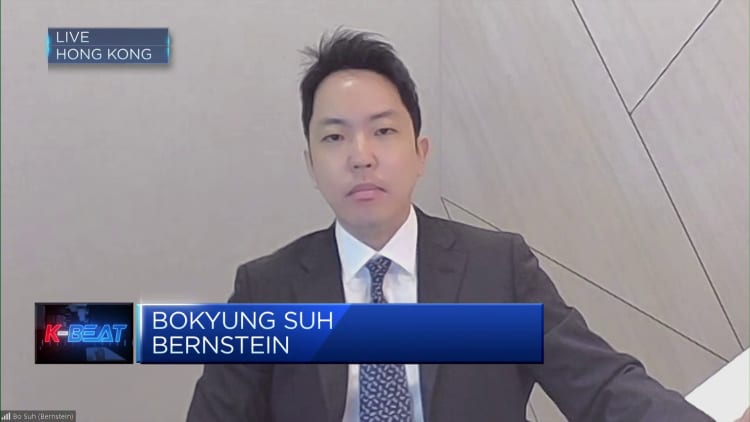
Hybe is the only company that has successfully developed its IP diversification in K-pop: Analyst

They note Japan has been one of the largest overseas fanbases for K-pop, with Hybe, SM and JYP taking a combined 7% of the live music market in Japan. Goldman pointed out that Japan’s top talent agency Johnny & Associates has been mired in a major scandal, leading to the industry turning more favorable to K-pop artists.

In 2023, Kouhaku Uta Gassen, the largest music show in Japan, invited five K-pop artists and two localized groups produced by K-pop companies. It was the first time the show has featured male K-pop artists since 2011 and the largest number of K-pop groups ever featured in its line up.

Goldman estimated Japan concert audiences will grow at a 24% compounded annual growth rate from 2023 to 2026, with the combined share for Hybe, JYP and SM doubling from 7% to 14%.

Catalysts for growth in Japan include SM’s newest Japanese boy group NCT Wish as well as JYP’s upcoming boy group NEXZ.

The global fanbase

Goldman is also bullish on K-pop’s global fanbase growth, especially in markets like the U.S.

Here's why America is suddenly obsessed with BTS

The report pointed to the success of Hybe-managed girl group NewJeans on U.S. charts. In a March 27 report, analysts noted NewJeans’ most recent album hit No. 1 on the U.S. Billboard 200. The group’s lead single, “Super Shy,” charted at No. 2 on the Billboard Global 200.

The group also was the first South Korean girl group to perform at Lollapalooza. The Chicago Sun Times reported the group may have managed to draw the biggest audience ever for the festival’s 5 p.m. slot.

Le Sserafim, managed by Hybe subsidiary Source Music, also made their debut at the Coachella music festival on April 13, with another show scheduled for April 20.

Hybe also recently announced that it will expand its partnership with Universal Music Group, including exclusive distribution rights for Hybe’s artists and labels. UMG’s roster includes Taylor Swift, Ariana Grande and Justin Bieber.

Goldman said the announcement is a visible sign that K-pop is becoming mainstream globally, leading to a competitive position that allows stronger bargaining power in business relationships.

The analysts concluded there’s “a long runway of growth ahead” for the sector, adding that “further downside for wallet share, which has normalized close to pre-Covid levels, seems limited, in our view.”


Continue Reading

Finance

Tokenized Debt Shifts How Corporate Manage Short Term Liquidity

Published

on

Tokenized Debt Shifts Corporate Liquidity

The landscape of institutional debt markets is undergoing a profound structural shift on July 21, 2026, as major corporate issuers and commercial banks rapidly accelerate the deployment of tokenized debt instruments. Data published by leading capital market consortiums indicates that primary issuances of digital commercial paper and tokenized corporate bonds have reached record volumes this month. By moving legacy debt origination, underwriting, and secondary distribution onto permissioned distributed ledgers, corporate treasurers are unlocking unprecedented operational flexibility and instantaneous cross-border liquidity.

The adoption of tokenized debt is fundamentally altering how enterprise balance sheets manage short-term liquidity needs. Traditional corporate bond settlement cycles historically required multi-day clearing processes involving numerous intermediaries, custodial entities, and clearinghouses. Through programmable smart contracts on distributed ledgers, issuers can now execute atomic settlement—enabling continuous, 24/7 access to institutional capital pools. This instantaneous clearing mechanism drastically reduces counterparty risk, eliminates costly settlement friction, and allows treasury teams to dynamically optimize working capital in real time.

A major catalyst driving this institutional migration is the establishment of comprehensive digital asset regulatory frameworks across major financial hubs. Clear legal guidelines regarding ledger-based securities ownership have provided institutional compliance officers with the regulatory confidence necessary to transition multi-billion-dollar liquidity facilities onto digital platforms. Furthermore, the integration of automated regulatory reporting directly into token smart contracts simplifies ongoing compliance audits, ensuring that secondary market trades automatically enforce investor accreditation limits and tax withholding requirements.

For chief financial officers and institutional portfolio managers, tokenized debt represents a fundamental evolution in fixed-income strategy. Companies that embrace ledger-based debt structures gain direct access to a broader, global base of digital-native institutional investors while substantially reducing borrowing overhead. As ledger interoperability continues to improve across global exchanges, tokenized debt is poised to become the standard infrastructure for global corporate finance.

Continue Reading

Finance

Private Credit Expansion: How Alternative Lending Platforms Are Reshaping Corporate Liquidity

Published

on

How Alternative Lending Platforms Are Reshaping Corporate Liquidity

Private credit has firmly established itself as a foundational pillar of global financial markets in 2026, transitioning from an alternative asset class into a dominant mechanism for middle-market corporate financing. Reports published in mid-July 2026 show that direct lending assets under management have expanded significantly, as corporate borrowers increasingly bypass traditional syndication desks in favor of customized private debt solutions. This structural migration has fundamentally altered corporate liquidity dynamics, providing middle-market enterprises with reliable access to tailored capital packages even during periods of regulatory bank tightening.

The primary driver of this continued growth is the structural flexibility inherent in private debt agreements. Unlike public bond markets or conservative commercial bank loans—which often carry rigid covenants and slow underwriting timelines—private credit funds offer speed of execution, flexible payment-in-kind structures, and customized debt-service frameworks. For companies undertaking strategic acquisitions, capital expenditures, or complex balance sheet recapitalizations, the ability to negotiate directly with a unified syndicate of private lenders provides significant certainty and confidentiality.

However, the expansion of private credit is attracting heightened regulatory attention and risk scrutiny. Financial regulatory bodies are closely evaluating the lack of secondary market price discovery and the potential concentration of illiquidity risks within non-bank financial institutions. Because private debt instruments are held to maturity and marked to model rather than marked to market, evaluating real-time enterprise valuations during economic shifts requires robust internal credit assessment standards. Analysts note that as loan portfolios mature, performance variations between disciplined lenders and aggressive underwriters will become increasingly apparent.

For corporate financial officers and institutional portfolio managers, private credit represents both a powerful strategic tool and a vital diversification strategy. Borrowers must weigh the higher nominal coupon rates of private debt against the tangible value of operational flexibility and execution certainty. Meanwhile, investors must maintain rigorous credit due diligence, prioritizing funds with proven restructuring capabilities and deep operational expertise in underwriting resilient middle-market businesses.

Continue Reading

Finance

Tokenized Real-World Assets: Institutional Ledger Adoption Achieves Scale in July 2026

Published

on

Institutional Ledger Adoption Achieves Scale in July 2026

The integration of blockchain technology with legacy financial markets has reached a decisive tipping point in July 2026, driven by the rapid scaling of Real-World Asset (RWA) tokenization. Major global investment banks, custodial entities, and asset managers are actively shifting sovereign debt, commercial paper, and private fund shares onto permissioned distributed ledgers. Recent industry data confirms that the aggregate market capitalization of tokenized treasury products and private credit funds has surged past major milestones, illustrating that ledger-based settlement is no longer experimental, but core financial infrastructure.

The fundamental value proposition of asset tokenization rests on operational efficiency, continuous liquidity, and automated compliance execution. By embedding regulatory checks, investor accreditation limits, and automated coupon distributions directly into smart contract code, financial institutions eliminate vast amounts of manual back-office reconciliation. Furthermore, fractionalized ownership structures allow high-value asset classes—such as prime commercial real estate and private equity funds—to be split into accessible units, significantly expanding liquidity pools and enabling real-time collateral optimization.

A key catalyst behind this institutional momentum is the establishment of comprehensive regulatory clarity across major financial jurisdictions. The implementation of standardized digital asset frameworks in the United States and Europe has provided institutional compliance officers with the legal certainty required to deploy capital on-chain. As a result, premier custodian banks are now offering unified digital asset custody, seamlessly bridging traditional securities depositories with programmable ledger ecosystems.

Looking forward, the maturation of tokenized assets will continue to transform secondary market trading and treasury management. Corporate treasurers can now yield-optimize idle cash in real time by moving into tokenized money market instruments that settle instantaneously on a 24/7 basis. To remain competitive, financial leaders must ensure their institutional architectures are interoperable with modern digital ledger protocols, positioning their organizations at the forefront of modern capital market efficiency.

Continue Reading

Trending