
Accounting
Oracle NetSuite boosts AI capacity across product suite, announced at SuitWorld


Business solutions provider
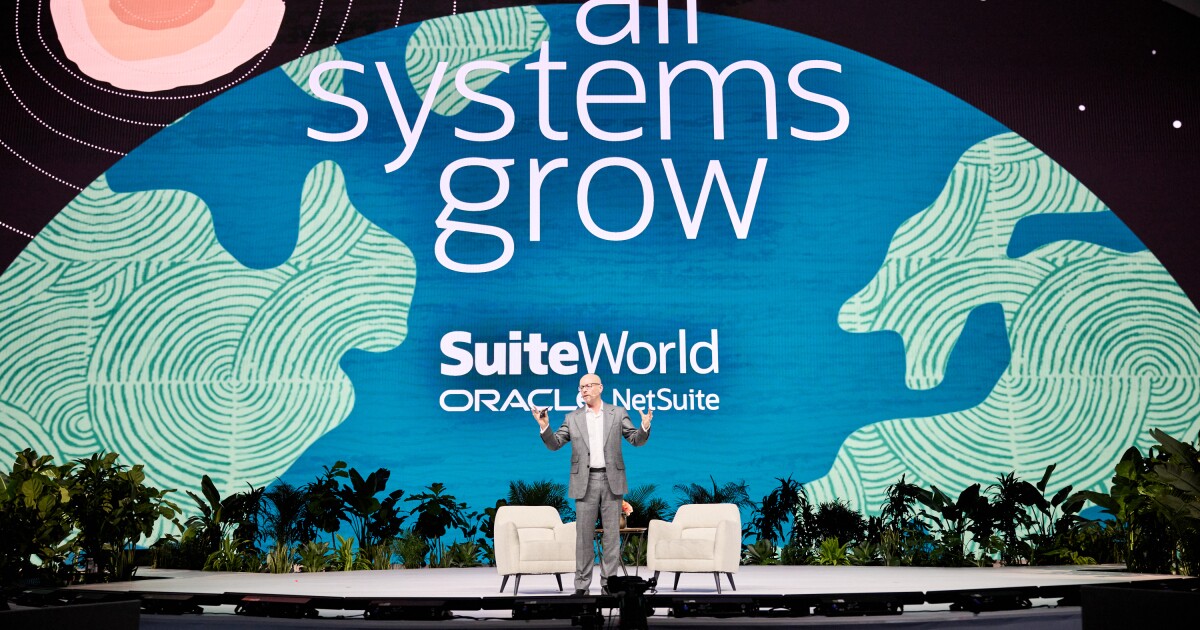
“We are embedding AI-powered capabilities across the suite so customers are benefiting from it as soon as they log in. By ensuring AI is built into existing business processes and not bolted on, we are helping our customers achieve immediate value from the latest AI innovations at no additional cost,” said Evan Goldberg, founder and executive vice president of Oracle NetSuite, during the SuiteWorld conference in Las Vegas on Monday. “The latest updates build on the hundreds of new generative AI use cases we have added in the last year and will help our customers further increase productivity and gain more value from the suite.”
These AI updates give users the ability to automatically detect financial exceptions (NetSuite Financial Exception Management), query data via a generative AI interface (NetSuite Suite Analytics Assistant), gain more control over generative AI prompt configuration along the lines of format, tone and creativity (NetSuite Prompt Studio), embed generative AI capabilities into NetSuite extensions and customizations, build extensions and customizations through an AI code compassion (Oracle Code Assist SuiteScript optimization), and configure, optimize and create new AI-powered capacities throughout the suite.
Oracle noted that no customer data is shared with large language model providers or seen by other customers. To further protect sensitive information, role-based security is embedded directly into NetSuite workflows and only recommends content that end users are entitled to view.
NetSuite Analytics Warehouse updates
Oracle NetSuite also announced a bevy of AI-related updates for its Analytics Warehouse solution. The latest updates provide new AI tools and models to help customers analyze data more efficiently and gain predictive insights to improve forecasting. Customers can now generate data visualizations and natural language insights based on a dataset’s attributes, measures and other points of interest; identify meaningful business drivers, contextual insights, and data anomalies through AI; directly query data through conversational interactions to produce insights and data visualizations; automate analysis through no-code models built for specific use cases that can predict scenarios, such as customer churn and inventory stockouts; automate algorithm selection and customizing modeling workflows; and access a collaborative interface to explore data visually and tailor machine learning models to address unique business needs.
“For growing businesses, making sense of data can be a time-consuming process that may require advanced data science and coding skills. With limited resources, many businesses are not able to invest in these skills and miss out on valuable data insights,” said Goldberg. “We’re dedicated to helping businesses of all sizes unlock the full potential of their data. The latest updates to NetSuite Analytics Warehouse will help customers automate data analysis and leverage AI to produce fast and meaningful insights that can help improve decision-making.”
Most of these new capacities are now available. The no-code AI models to automate analysis are planned to be available within the next 12 months.
NetSuite Enterprise Performance Management (EPM) updates
Oracle NetSuite also announced new AI-powered updates to
Users can create AI-powered narratives, explanations and visuals from financial and transactional data; identify patterns, trends, and anomalies and deliver detailed AI-generated commentary and narratives with the Intelligent Performance Management (IPM) Insights feature; quickly and easily understand the key factors behind AI-generated forecasts; and accomplish a variety of tasks using natural language conversations via an AI-driven interface.
“Finance teams often spend a significant amount of time gathering data and creating narratives to explain financial results, justify important decisions and forecast future growth. This can be a labor-intensive process that often diverts time away from more strategic analysis and slows down decision-making,” said Goldberg. “To address this challenge, the latest updates to NetSuite EPM help finance teams leverage powerful AI innovations to help increase efficiency, expand insights and enable more time to be spent on value-added activities.”
NetSuite SuiteProjects Pro planned updates
In addition, Oracle NetSuite plans to deliver a new AI-powered extension to its project management solution, NetSuite SuiteProjects.
Aimed mainly at project managers, the new capacities will include the ability to monitor the health of projects, anticipate and mitigate issues, and prevent delays by proactively calculating and analyzing project risks based on historical data and key metrics; access AI-powered staffing recommendations; use global search, role-specific and actionable task lists, and a visually engaging home page for key metrics, KPIs and charts; and provide a complete project-focused solution and per-user pricing.
“As businesses expand, their needs become more complex, and projects require more intentional monitoring and resourcing to maintain project profitability and meet key milestones,” said Goldberg. “NetSuite SuiteProjects Pro enables project-based businesses to take advantage of the latest advancements in AI to improve the speed of workflows and increase efficiency by automating staffing, scheduling, budget tracking, and billing.”
NetSuite SuiteProjects Pro enhancements are planned to be available within the next 12 months. Current OpenAir customers will automatically experience the benefits of SuiteProjects Pro.
Oracle Fusion Cloud Applications Suite updates
Finally, Oracle NetSuite outlined major new AI capacities to the Oracle Fusion Cloud Applications Suite which are intended to help organizations optimize finance, supply chain, HR, sales, marketing and service. Oracle Cloud ERP now features predictive cash forecasting capabilities using AI models to create prescriptive and continuous daily, weekly or monthly cash forecasts; new narrative reporting capabilities through AI-generated financial performance narratives, variance explanations and commentary on trends impacting the business; and new automated transaction records in Oracle Fusion Cloud Sustainability which enable business leaders to use AI, classification rules, and sustainability metadata attributes to automatically create activity records and add transactions to a sustainability ledger.
Oracle Cloud HCM now features a “bespoke skills inventory” that lets users gain a complete catalog of their organization’s skills that is always kept up to date and can be modified or refined. HR leaders can also combine enriched skills data with data from across the enterprise and third-party sources.
Oracle Cloud SCM features a new smart operations workbench that helps organizations focus on issues impacting production goals by providing real-time insight into work orders and generative AI-powered shift reporting. In addition, new assisted authoring in Oracle Order Management enables users to leverage generative AI to develop order acknowledgement emails and order change history notes.
Finally, the new AI innovations in Oracle Cloud CX includes assisted authoring capabilities in Oracle Cloud CX, which helps sales teams efficiently engage with buyers by providing AI-generated answers to contract-related questions, emails and activity summaries, and executive summaries for quotes and proposals. In addition, new AI capabilities in Oracle CX Unity detect signals, based on role, title, and aggregated topic engagement, and provide next best action recommendations.
“We are the only enterprise vendor to offer a complete suite of business applications on a fully integrated technology stack — from hardware to database to applications — and an infrastructure that is trusted by leading AI providers and the world’s leading large language models,” said Steve Miranda, executive vice president of applications development, Oracle. “This puts us in unique position to help our customers quickly and easily take advantage of the latest AI innovations. The new AI capabilities in Fusion Applications, embedded at no extra cost, will help our customers increase the speed and accuracy of business processes, accelerate decision-making and drive more revenue.”





U.S. Inflation Outlook for 2027

S&P 500 September Outlook: Tech Rally Holds Index at 7,600

India Unveils ‘Saptadhara’ Reform Agenda Targeting Technology, Youth Skilling, and Growth

Armanino adds Strategic Accounting Outsourced Solutions

New 2023 K-1 instructions stir the CAMT pot for partnerships and corporations

Tax Strategy: Employee Retention Credit update
-

 Technology1 week ago
AI Infrastructure Boom Hits Physical Limits: Power, Financing, and Supply Chain Strain
-
 Stock News4 days ago
S&P 500 September Outlook: Tech Rally Holds Index at 7,600
-

 Economics1 week ago
U.S.- Canada Trade Talks Collapse; Carney Says Retaliatory Tariffs Begin September 8
-

 Finance4 days ago
S&P 500 Outperforms Amid Strong Corporate Earnings as Treasury Yields Cap Equity Multiples
-

 Technology1 week ago
Flock Cameras and the Future of Public Security
-

 Insights4 days ago
Climate Resilience and Offshore Wind and Land Restoration Milestones
-

 Accounting4 days ago
Mandatory ESG Reporting Standards Demand Standardized Non-Financial Audit Trails
-
 Leaders4 days ago
India Unveils ‘Saptadhara’ Reform Agenda Targeting Technology, Youth Skilling, and Growth