Connect with us

Finance

Powell says slowing labor market prompted rate cut, sees ‘challenging situation’ ahead

Published

on

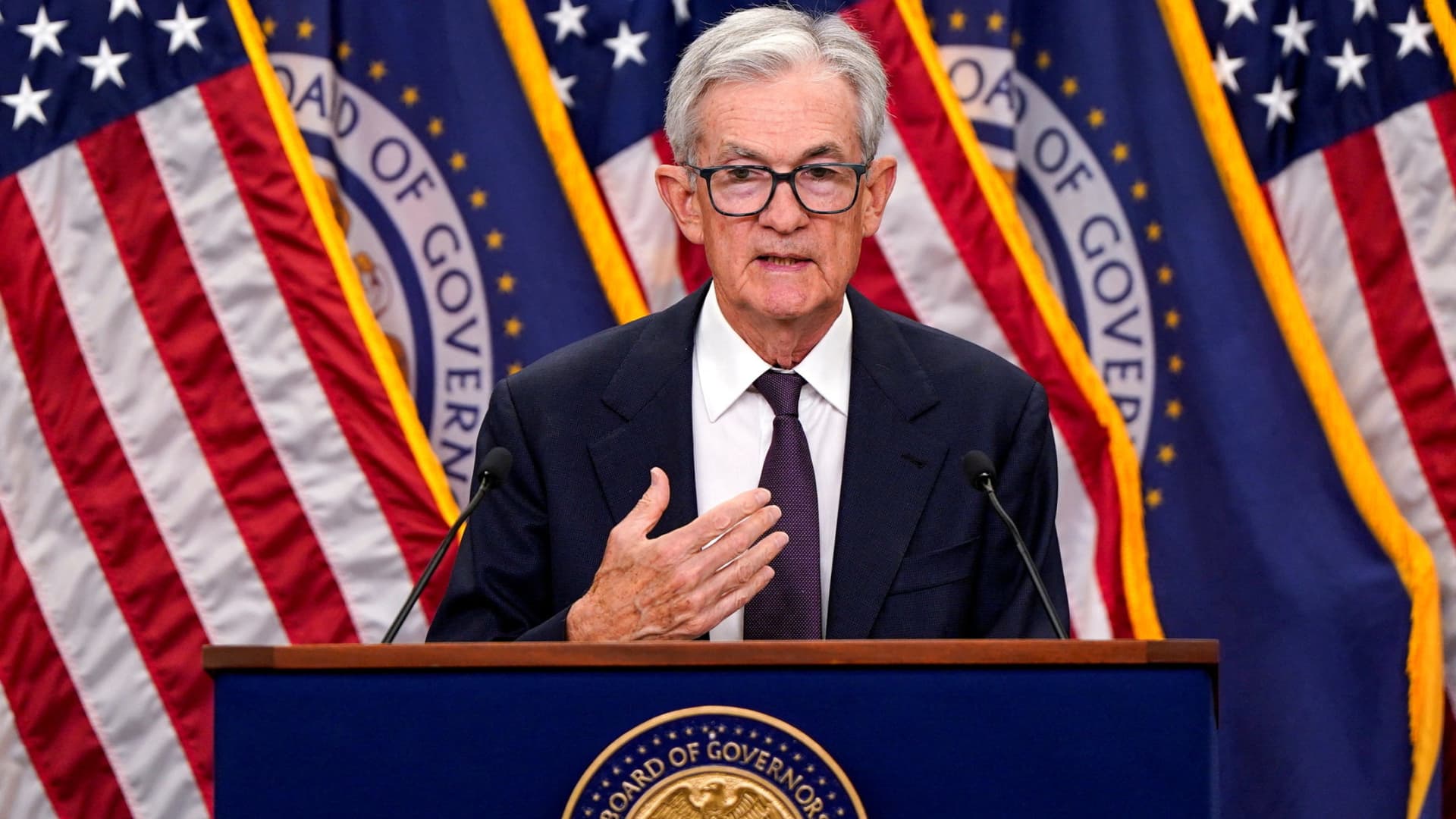
U.S. Federal Reserve Chair Jerome Powell speaks during a press conference, following the issuance of the Federal Open Market Committee’s statement on interest rate policy, in Washington, D.C., U.S., Sept. 17, 2025.

Elizabeth Frantz | Reuters

Federal Reserve Chair Jerome Powell said Tuesday that weakness in the labor market is outweighing concerns about stubborn inflation, leading to a decision he backed to lower the central bank’s key interest rate last week.

The Federal Open Market Committee’s first cut of the year came amid signs that both supply and demand of workers is waning at the same time that near-term impact from tariffs has pushed inflation higher.

At such times, Powell said, during a speech to business leaders in Providence, R.I., the Fed’s job is to “balance both sides of our dual mandate” for stable prices and low unemployment.

“Near-term risks to inflation are tilted to the upside and risks to employment to the downside — a challenging situation,” he said. “Two-sided risks mean that there is no risk-free path.”

The conditions Powell described in the speech are consistent with stagflation, in which growth slows and inflation is high. While the current situation is far less severe than what the U.S. encountered in the 1970s and early ’80s, it nonetheless has presented a policy challenge for the Fed.

Powell, however, said he is comfortable with the central bank’s current policy path though he indicated the possibility of additional cuts should the FOMC see the need to be more accommodative.

“The increased downside risks to employment have shifted the balance of risks to achieving our goals,” he said. “This policy stance, which I see as still modestly restrictive, leaves us well positioned to respond to potential economic developments.”

Stocks reacted little to Powell’s comments though Treasury yields edged lower.

Watching jobs, inflation

On the labor market, Powell noted “a marked slowdown” in supply and demand. “In this less dynamic and somewhat softer labor market, the downside risks to employment have risen,” he said.

Indeed, payroll growth has slowed dramatically, averaging below 30,000 during the summer months while benchmark revisions showed nearly a million fewer jobs created in the 12 months prior to March 2025.

At the same time, inflation has cooled substantially since hitting a more than 40-year peak in 2022 but is still considerably above the Fed’s 2% goal. Commerce Department data to be released Friday is expected to indicate that personal consumption prices rose 2.7% on an annual all-items basis and 2.9% when excluding food and energy, Powell said.

Adding to uncertainty is the impact of President Donald Trump’s tariffs. The president continues to negotiate with major U.S. trading partners about the ultimate level for the duties, with a key deadline with China coming up in early November. Fed economists for now are viewing the tariffs as mostly a temporary rise in prices, though that could change.

“Uncertainty around the path of inflation remains high,” Powell said. “We will carefully assess and manage the risk of higher and more persistent inflation. We will make sure that this one-time increase in prices does not become an ongoing inflation problem.”

Powell is presiding over a Fed that has come under intense criticism from the White House and is seeing an unusually wide dispersion in views among officials. The FOMC meeting concluding with participants narrowly split, 10-9, over whether one or two more quarter-point cuts would be appropriate this year. Trump appointee Stephen Miran has pushed for a much more aggressive course, but his term as governor ends in January.

Earlier Tuesday, Governor Michelle Bowman warned about the dangers of moving too slow to address the labor market. Bowman, also a Trump appointee, said “we are at serious risk of already being behind the curve in addressing deteriorating labor market conditions.”

“I am concerned that the labor market could enter into a precarious phase and there is a risk that a shock could tip it into a sudden and significant deterioration,” she said.

While Powell has not provided his expectations for future rate moves, Bowman said she hopes the recent action is “the first step” in an ongoing move back to a neutral interest rate level.

Continue Reading

Finance

Private Credit Expansion Transforms Corporate Loans

Published

on

Private Credit Expansion Transforms Corporate Loans

Private credit markets reached a pivotal milestone during the week ending July 25, 2026, as non-bank direct lending consortiums captured a record share of middle-market corporate debt originations. With commercial banks maintaining conservative credit standards and public bond yields remaining elevated, corporate borrowers are increasingly turning to private fund managers for customized capital solutions. This expansion marks a permanent structural shift in enterprise finance, establishing private credit as a primary pillar of institutional corporate liquidity.

The acceleration of private credit deals is driven by speed, deal certainty, and flexible terms. Unlike traditional syndicated bank loans that require lengthy underwriting, credit rating approvals, and public roadshows, private direct lenders can structure tailored financing packages within days. Middle-market firms facing upcoming debt maturities are utilizing private debt facilities to execute recapitalizations, strategic acquisitions, and growth capital deployments without risking execution delay in public markets.

However, financial regulators and central bank supervisors are scrutinizing the sector’s rapid growth. Supervisory agencies are evaluating potential systemic risks associated with non-bank leverage, valuation transparency, and liquidity mismatches during economic downturns. Despite regulatory interest, major pension funds, insurance firms, and sovereign wealth entities continue to expand capital allocations to private credit funds, attracted by reliable floating-rate yields that outperform public fixed-income benchmarks.

As private credit matures into a dominant asset class, corporate chief financial officers must evaluate non-bank lenders alongside traditional banking relationships. Direct lending partnerships provide valuable balance sheet resilience, enabling companies to secure flexible financing terms even during periods of public market turbulence.

Continue Reading

Finance

Tokenized Debt Shifts How Corporate Manage Short Term Liquidity

Published

on

Tokenized Debt Shifts Corporate Liquidity

The landscape of institutional debt markets is undergoing a profound structural shift on July 21, 2026, as major corporate issuers and commercial banks rapidly accelerate the deployment of tokenized debt instruments. Data published by leading capital market consortiums indicates that primary issuances of digital commercial paper and tokenized corporate bonds have reached record volumes this month. By moving legacy debt origination, underwriting, and secondary distribution onto permissioned distributed ledgers, corporate treasurers are unlocking unprecedented operational flexibility and instantaneous cross-border liquidity.

The adoption of tokenized debt is fundamentally altering how enterprise balance sheets manage short-term liquidity needs. Traditional corporate bond settlement cycles historically required multi-day clearing processes involving numerous intermediaries, custodial entities, and clearinghouses. Through programmable smart contracts on distributed ledgers, issuers can now execute atomic settlement—enabling continuous, 24/7 access to institutional capital pools. This instantaneous clearing mechanism drastically reduces counterparty risk, eliminates costly settlement friction, and allows treasury teams to dynamically optimize working capital in real time.

A major catalyst driving this institutional migration is the establishment of comprehensive digital asset regulatory frameworks across major financial hubs. Clear legal guidelines regarding ledger-based securities ownership have provided institutional compliance officers with the regulatory confidence necessary to transition multi-billion-dollar liquidity facilities onto digital platforms. Furthermore, the integration of automated regulatory reporting directly into token smart contracts simplifies ongoing compliance audits, ensuring that secondary market trades automatically enforce investor accreditation limits and tax withholding requirements.

For chief financial officers and institutional portfolio managers, tokenized debt represents a fundamental evolution in fixed-income strategy. Companies that embrace ledger-based debt structures gain direct access to a broader, global base of digital-native institutional investors while substantially reducing borrowing overhead. As ledger interoperability continues to improve across global exchanges, tokenized debt is poised to become the standard infrastructure for global corporate finance.

Continue Reading

Finance

Private Credit Expansion: How Alternative Lending Platforms Are Reshaping Corporate Liquidity

Published

on

How Alternative Lending Platforms Are Reshaping Corporate Liquidity

Private credit has firmly established itself as a foundational pillar of global financial markets in 2026, transitioning from an alternative asset class into a dominant mechanism for middle-market corporate financing. Reports published in mid-July 2026 show that direct lending assets under management have expanded significantly, as corporate borrowers increasingly bypass traditional syndication desks in favor of customized private debt solutions. This structural migration has fundamentally altered corporate liquidity dynamics, providing middle-market enterprises with reliable access to tailored capital packages even during periods of regulatory bank tightening.

The primary driver of this continued growth is the structural flexibility inherent in private debt agreements. Unlike public bond markets or conservative commercial bank loans—which often carry rigid covenants and slow underwriting timelines—private credit funds offer speed of execution, flexible payment-in-kind structures, and customized debt-service frameworks. For companies undertaking strategic acquisitions, capital expenditures, or complex balance sheet recapitalizations, the ability to negotiate directly with a unified syndicate of private lenders provides significant certainty and confidentiality.

However, the expansion of private credit is attracting heightened regulatory attention and risk scrutiny. Financial regulatory bodies are closely evaluating the lack of secondary market price discovery and the potential concentration of illiquidity risks within non-bank financial institutions. Because private debt instruments are held to maturity and marked to model rather than marked to market, evaluating real-time enterprise valuations during economic shifts requires robust internal credit assessment standards. Analysts note that as loan portfolios mature, performance variations between disciplined lenders and aggressive underwriters will become increasingly apparent.

For corporate financial officers and institutional portfolio managers, private credit represents both a powerful strategic tool and a vital diversification strategy. Borrowers must weigh the higher nominal coupon rates of private debt against the tangible value of operational flexibility and execution certainty. Meanwhile, investors must maintain rigorous credit due diligence, prioritizing funds with proven restructuring capabilities and deep operational expertise in underwriting resilient middle-market businesses.

Continue Reading

Trending