
Finance
Santander doubles down on UK presence amid Spain’s banking M&A turmoil

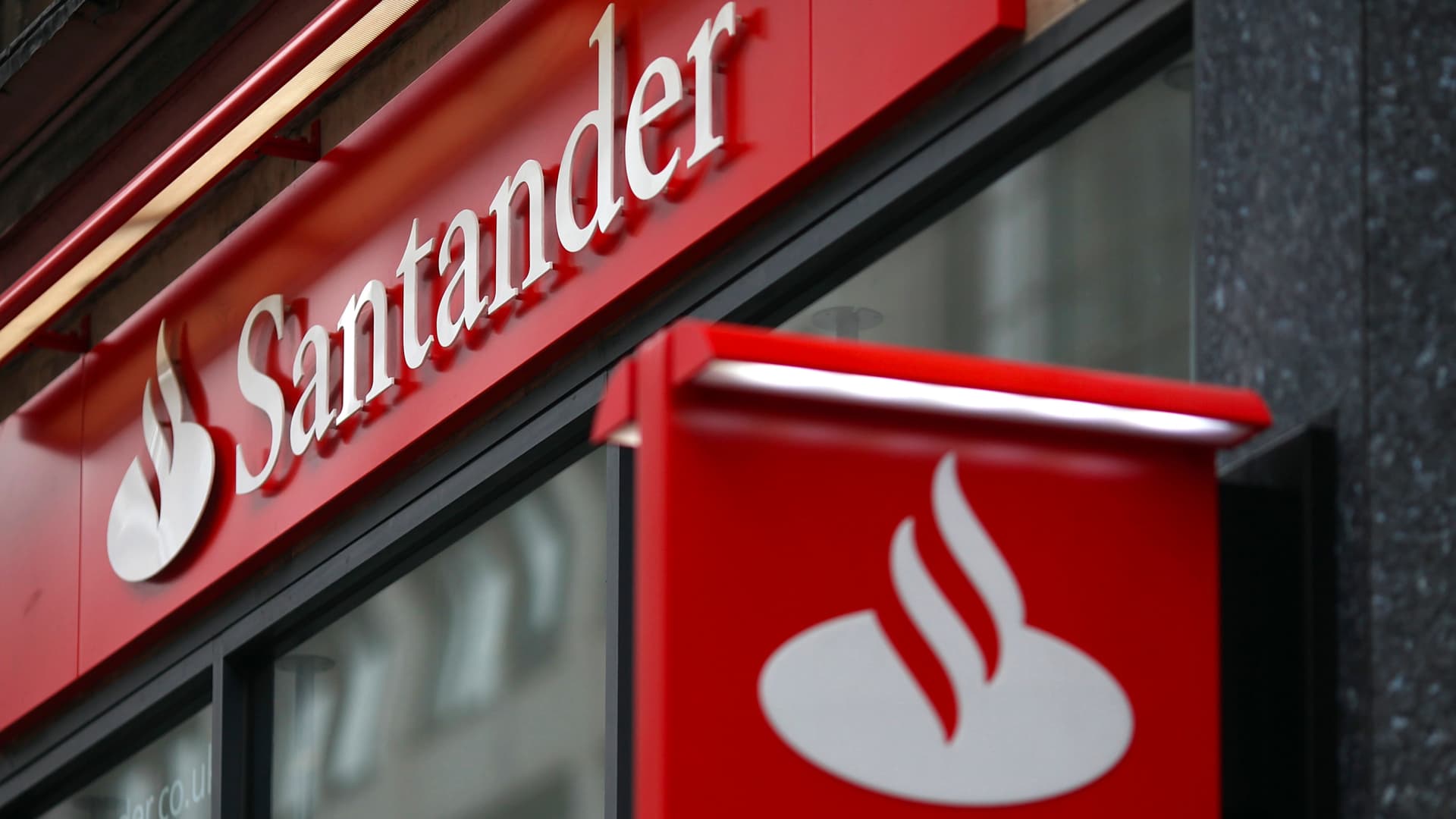
A sign hangs from a branch of Banco Santander in London, U.K., on Wednesday, Feb. 3, 2010.
Simon Dawson | Bloomberg via Getty Images
In one move, Santander has silenced months of speculation over it’s allegiance to the British high street – and complicated a year-long consolidation saga in Spain’s banking sector.
On Tuesday, Spain’s largest lender said it agreed to buy British high street lender TSB for £2.65 billion ($3.6 billion) from Catalonia’s Sabadell in an all-cash deal subject to approval. The transaction will generate a return on invested capital of more than 20%, bringing its return on tangible equity in the U.K. from 11% last year to 16% by 2028, Santander said.
Acquisitions have been at the heart of Santander’s British expansion after it entered the market in 2004 through the purchase of Abbey National. But the profitability of the U.K. branch has faltered — with pre-tax profit down by an annual 38% last year — sparking questions over Santander’s long-term presence in Britain. A March announcement of potential layoffs and 95 branch closures did little to abate the rumors despite CEO Ana Botin’s frequent denials.
“We never thought of leaving the U.K. The U.K. is very important for us,” Santander Chief Financial Officer Jose Garcia Cantera told CNBC’s “Squawk Box” on Wednesday. “It’s actually the largest balance sheet of all the countries [where] we operate. It’s a high quality, low-risk business, predictable returns, in hard currency, in sterling, and this helps to stabilize our risk-return profile.”
He added that the U.K. has “always been a very important and core component of Santander’s diversification strategy.”
The TSB acquisition, meanwhile, “not only makes sense strategically, as I said, the U.K. helps with our risk-return profile, but it’s also financially very, very compelling.”
The deal could work as a defensive play from Sabadell, which only took over TSB from Lloyds in 2015 and seeks to stop a takeover bid from Spanish peer BBVA. The two banks have been locked at odds since Sabadell rejected BBVA’s initial all-share merger offer in May last year, on grounds of it undervaluing the acquisition target.
Now entrenched in a potential 14-billion-euro hostile takeover, BBVA has decided to keep its bid alive despite a recent condition from the Spanish government that the takeover may only proceed if the two banks do not integrate their operations for at least three years.
Over this period, “both entities maintain [must] separate judicial identity and assets, as well as autonomy in the management of their activities,” Spanish Economist Minister Carlos Cuerpo said during a press briefing, according to a CNBC translation.
Spanish banking competition ‘toughest in Europe’
Madrid — whose government under Prime Minister Pedro Sanchez depends on parties in Sabadell’s home base of Catalonia — has long opposed the deal amid concerns over job losses, received a late-May caution from the European Commission against hindering the merger unduly.
“It is important that banking sector consolidation can take place without undue or inappropriate obstacles being imposed,” said Olof Gill, the European Commission’s spokesperson for financial services, according to Reuters. Spain’s antitrust watchdog has already cleared the acquisition.

It remains to be seen whether the TSB sale will dull BBVA Chairman Carlos Torres Vila’s appetite to press ahead with submitting a merger offer to Sabadell shareholders once permissions come through.
RBC analysts on Wednesday assessed that Santander’s acquisition of TSB “seems to be a last major effort to convince [Sabadell]’s shareholders to not accept BBVA’s offer during the upcoming take-up period” and would “likely further complicate” BBVA’s takeover.
“We are completely neutral on the Sabadell-BBVA transaction,” Santander’s Garcia Cantera told CNBC. “This is an asset that becomes available in one of the countries where we operate, and it’s our fiduciary duty to look at all these opportunities and try to do our best for our shareholders.”
Yet he recognized that competition in Spanish banking at present is “probably the toughest in Europe,” citing the weak price of domestic mortgages.
“I don’t think this is going to make banking in Spain more comfortable. Probably the opposite,” Garcia Cantera said.



Dario Amodei’s Call to Pace the AI Frontier and Its Market Ripple Effects

Rising Oil Prices And Persistent Inflation Complicate Fed Decision

Bridging the AI Skills Gap: How Gen Z Youth Demographics Are Transforming the Workforce

Armanino adds Strategic Accounting Outsourced Solutions

New 2023 K-1 instructions stir the CAMT pot for partnerships and corporations

Tax Strategy: Employee Retention Credit update
-
 Economics1 week ago
U.S. Inflation Outlook for 2027
-

 Economics5 days ago
Economic Profile of the superpower of western Europe
-
 Economics5 days ago
Sovereign Bond Yield Volatility and Inflationary Shocks Challenge Global Central Banks
-

 Finance5 days ago
Big Tech Enterprise Borrowing Reaches $135 Billion as Hyperscalers Fund AI Infrastructure
-
 Economics2 days ago
Rising Oil Prices And Persistent Inflation Complicate Fed Decision
-

 Accounting2 days ago
Embedded AI and Automated Anomaly Detection Reshape Modern Corporate Accounting Frameworks
-
 Insights2 days ago
Bridging the AI Skills Gap: How Gen Z Youth Demographics Are Transforming the Workforce
-
 Leaders22 hours ago
Dario Amodei’s Call to Pace the AI Frontier and Its Market Ripple Effects