Connect with us

Finance

Scott Bessent calls Moody’s a ‘lagging indicator’ after U.S. credit downgrade

Published

on

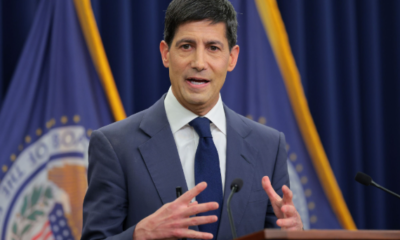
Treasury Secretary Scott Bessent said in an interview on NBC News’ “Meet the Press” that Moody’s Ratings were a “lagging indicator” after the group downgraded the U.S.’ credit rating by a notch from the highest level.

“I think that Moody’s is a lagging indicator,” Bessent said Sunday. “I think that’s what everyone thinks of credit agencies.”

Moody’s said last week that the downgrade from Aaa to Aa1 “reflects the increase over more than a decade in government debt and interest payment ratios to levels that are significantly higher than similarly rated sovereigns.”

The treasury secretary asserted that the downgrade was related to the Biden administration’s spending policies, which that administration had touted as investments in priorities, including combatting climate change and increasing health care coverage.

“Just like Sean Duffy said with our air traffic control system, we didn’t get here in the past 100 days,” Bessent continued, referring to the transportation secretary. “It’s the Biden administration and the spending that we have seen over the past four years.”

The U.S. has $36.22 trillion in national debt, according to the Treasury Department. It began growing steadily in the 1980s and continued increasing during both President Donald Trump’s first term and former President Joe Biden’s administration.

Bessent also told moderator Kristen Welker that he spoke on the phone with the CEO of Walmart, Doug McMillon, who the treasury secretary said told him the retail giant would “eat some of the tariffs, just as they did in ’18, ’19 and ’20.”

Walmart CFO John David Rainey previously told CNBC that Walmart would absorb some higher costs related to tariffs. The CFO had also told CNBC separately that he was “concerned” consumers would “start seeing higher prices,” pointing to tariffs.

Trump said in a post to Truth Social last week that Walmart should “eat the tariffs.” Walmart responded, saying the company has “always worked to keep our prices as low as possible and we won’t stop.”

“We’ll keep prices as low as we can for as long as we can given the reality of small retail margins,” the statement continued.

When asked about his conversation, Bessent denied he applied any pressure on Walmart to “eat the tariffs,” noting that he and the CEO “have a very good relationship.”

“I just wanted to hear it from him, rather than second-, third-hand from the press,” Bessent said.

McMillon had said on Walmart’s earnings call that tariffs have put pressure on prices. Bessent argued that companies “have to give the worst case scenario” on the calls.

The White House has said that countries are approaching the administration to negotiate over tariffs. The administration has also announced trade agreements with the United Kingdom and China. 

Bessent said on Sunday that he thinks countries that do not negotiate in good faith would see duties return to the rates announced the day the administration unveiled across-the-board tariffs.

“The negotiating leverage that President Trump is talking about here is if you don’t want to negotiate, then it will spring back to the April 2 level,” Bessent said.

Bessent was also asked about Trump saying the administration would accept a luxury jet from Qatar to be used as Air Force One, infuriating Democrats and drawing criticism from some Republicans as well. 

The treasury secretary called questions about the $400 million gift an “off ramp for many in the media not to acknowledge what an incredible trip this was,” referring to investment commitments the president received during his trip last week to Saudi Arabia, Qatar and the United Arab Emirates.

“If we go back to your initial question on the Moody’s downgrade, who cares? Qatar doesn’t. Saudi doesn’t. UAE doesn’t,” he said. “They’re all pushing money in.”

When asked for his response to those who argue that the jet sends a message that countries can curry favor with the U.S. by sending gifts, Bessent said that “the gifts are to the American people,” pointing to investment agreements that were unveiled during Trump’s Middle East trip. 

Sen. Chris Murphy, D-Conn., criticized Bessent’s comments about the credit downgrade, saying in a separate interview on “Meet the Press.”

“I heard the treasury secretary say that, ‘Who cares about the downgrading of our credit rating from Moody’s?’ That is a big deal,” Murphy said.

“That means that we are likely headed for a recession. That probably means higher interest rates for anybody out there who is trying to start a business or to buy a home,” he continued. “These guys are running the economy recklessly because all they care about is the health of the Mar-a-Lago billionaire class.”

Continue Reading

Finance

Treasury Yields Rise as Fed Cut Expectations Shift

Published

on

Treasury Yields Rise as Fed Cut Expectations Shift

Fixed-income markets recorded significant re-pricing during the week ending July 25, 2026, as a convergence of strong labor market metrics and surging energy costs drove U.S. Treasury yields higher across all maturities. The benchmark 10-year Treasury yield climbed toward 4.70%, reaching its highest point in several months. Institutional bond investors rapidly adjusted portfolio durations as expectations for near-term interest rate cuts by the Federal Reserve faded in response to inflation concerns.

The upward shift in sovereign yields reflects a broader fundamental reassessment of global monetary policy. Earlier in the quarter, money markets had priced in a series of rate reductions designed to support economic activity. However, with initial jobless claims falling to 187,000 and crude oil breaching $100 per barrel, fixed-income traders are pricing in a ‘higher-for-longer’ interest rate environment. The inversion between short-term Treasury bills and long-term bonds narrowed, indicating a shift toward term premium expansion.

Rising Treasury yields present both challenges and opportunities for institutional wealth managers. While commercial lenders and mortgage origination volumes face headwinds from elevated borrowing costs, fixed-income investors are locking in attractive real yields on high-quality sovereign and investment-grade corporate bonds. Institutional debt issuers, conversely, are recalibrating their capital structures, opting for shorter-term refinancing instruments or private credit facilities to avoid committing to elevated long-term coupon rates.

Navigating the current bond market landscape demands strict duration management and credit selection. Wealth advisors recommend maintaining flexible fixed-income allocations, combining short-duration Treasuries with inflation-protected securities (TIPS) to shield capital against potential energy-driven inflation spikes while earning dependable nominal income.

Continue Reading

Finance

Private Credit Expansion Transforms Corporate Loans

Published

on

Private Credit Expansion Transforms Corporate Loans

Private credit markets reached a pivotal milestone during the week ending July 25, 2026, as non-bank direct lending consortiums captured a record share of middle-market corporate debt originations. With commercial banks maintaining conservative credit standards and public bond yields remaining elevated, corporate borrowers are increasingly turning to private fund managers for customized capital solutions. This expansion marks a permanent structural shift in enterprise finance, establishing private credit as a primary pillar of institutional corporate liquidity.

The acceleration of private credit deals is driven by speed, deal certainty, and flexible terms. Unlike traditional syndicated bank loans that require lengthy underwriting, credit rating approvals, and public roadshows, private direct lenders can structure tailored financing packages within days. Middle-market firms facing upcoming debt maturities are utilizing private debt facilities to execute recapitalizations, strategic acquisitions, and growth capital deployments without risking execution delay in public markets.

However, financial regulators and central bank supervisors are scrutinizing the sector’s rapid growth. Supervisory agencies are evaluating potential systemic risks associated with non-bank leverage, valuation transparency, and liquidity mismatches during economic downturns. Despite regulatory interest, major pension funds, insurance firms, and sovereign wealth entities continue to expand capital allocations to private credit funds, attracted by reliable floating-rate yields that outperform public fixed-income benchmarks.

As private credit matures into a dominant asset class, corporate chief financial officers must evaluate non-bank lenders alongside traditional banking relationships. Direct lending partnerships provide valuable balance sheet resilience, enabling companies to secure flexible financing terms even during periods of public market turbulence.

Continue Reading

Finance

Tokenized Debt Shifts How Corporate Manage Short Term Liquidity

Published

on

Tokenized Debt Shifts Corporate Liquidity

The landscape of institutional debt markets is undergoing a profound structural shift on July 21, 2026, as major corporate issuers and commercial banks rapidly accelerate the deployment of tokenized debt instruments. Data published by leading capital market consortiums indicates that primary issuances of digital commercial paper and tokenized corporate bonds have reached record volumes this month. By moving legacy debt origination, underwriting, and secondary distribution onto permissioned distributed ledgers, corporate treasurers are unlocking unprecedented operational flexibility and instantaneous cross-border liquidity.

The adoption of tokenized debt is fundamentally altering how enterprise balance sheets manage short-term liquidity needs. Traditional corporate bond settlement cycles historically required multi-day clearing processes involving numerous intermediaries, custodial entities, and clearinghouses. Through programmable smart contracts on distributed ledgers, issuers can now execute atomic settlement—enabling continuous, 24/7 access to institutional capital pools. This instantaneous clearing mechanism drastically reduces counterparty risk, eliminates costly settlement friction, and allows treasury teams to dynamically optimize working capital in real time.

A major catalyst driving this institutional migration is the establishment of comprehensive digital asset regulatory frameworks across major financial hubs. Clear legal guidelines regarding ledger-based securities ownership have provided institutional compliance officers with the regulatory confidence necessary to transition multi-billion-dollar liquidity facilities onto digital platforms. Furthermore, the integration of automated regulatory reporting directly into token smart contracts simplifies ongoing compliance audits, ensuring that secondary market trades automatically enforce investor accreditation limits and tax withholding requirements.

For chief financial officers and institutional portfolio managers, tokenized debt represents a fundamental evolution in fixed-income strategy. Companies that embrace ledger-based debt structures gain direct access to a broader, global base of digital-native institutional investors while substantially reducing borrowing overhead. As ledger interoperability continues to improve across global exchanges, tokenized debt is poised to become the standard infrastructure for global corporate finance.

Continue Reading

Trending