
Accounting
Senate begins putting stamp on Trump tax bill

Significant changes are in store for President Donald Trump’s signature $3.9 trillion tax-cut bill as the Senate begins closed-door talks this week on legislation that squeaked through the House by a single vote.
Senate Republican leaders are aiming to make permanent many of the temporary tax cuts in the House bill, a move that would increase the bill’s more than $2.5 trillion deficit impact. But doing so risks alienating fiscal hawks already at war with party moderates over the bill’s safety-net cuts.
It amounts to a game of chess further complicated by the top Senate rules-keeper, who will decide whether some key provisions violate the chamber’s strict rules. Jettisoning those provisions — which include gun silencer regulations and artificial intelligence policy — could sink the bill in the House.
House Republicans’ top tax writer, Representative Jason Smith, on Friday said that senators need to leave most of the bill untouched in order to ensure it can pass the House in the end.
“I would encourage my counterparts, don’t be too drastic, be very balanced,” he said.
The wrangling imperils Republicans’ goal of sending the “Big, Beautiful Bill” to Trump’s desk by July 4. But the real deadline is sometime in August or September, when the Treasury Department estimates the US will run out of borrowing authority.
The House bill would raise the government’s legal debt ceiling by $4 trillion, which the Senate wants to increase to $5 trillion in order to push off the next fiscal cliff until after the 2026 congressional elections.
That’s just one of the major changes the Senate will weigh in the coming weeks. Here are others:
Permanent business breaks
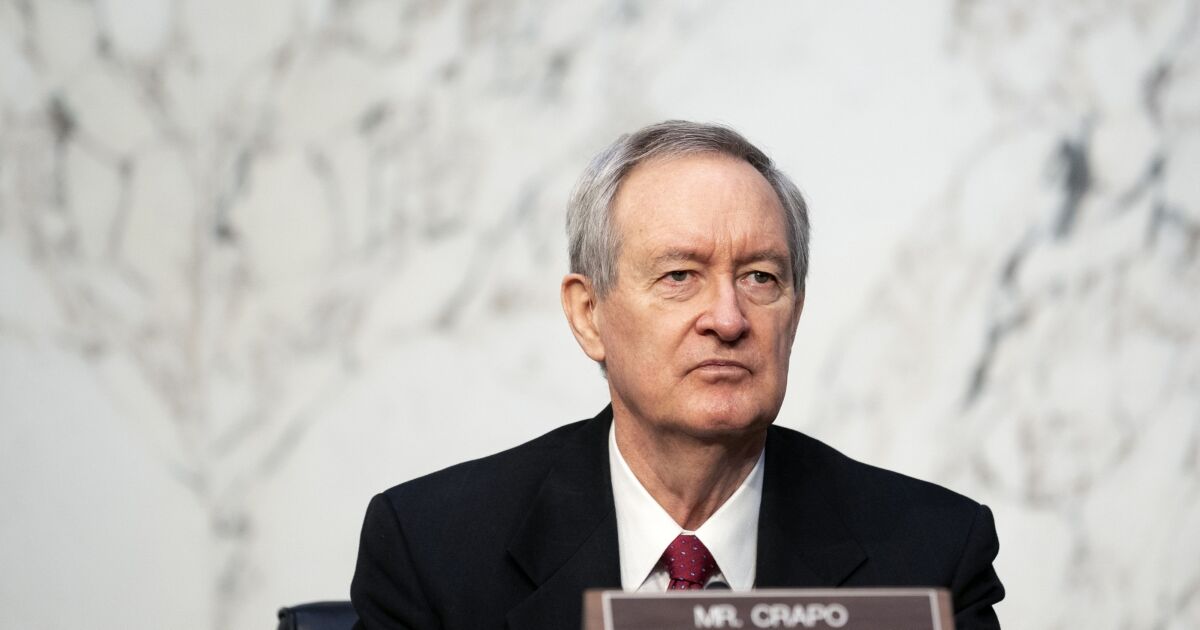
Senate Finance Chairman Mike Crapo’s top priority is making permanent the temporary business tax cuts that the House bill sunsets after 2029. These are the research and development tax deduction, the ability to use depreciation and amortization as the basis for interest expensing, and 100% bonus depreciation of certain property, including most machinery and factories.
Senate Republicans plan to use a budget gimmick that counts the extension of the individual provisions in the 2017 Trump tax bill as having no cost. That gives them room to make the additional business tax cuts and possibly extend some of the new four-year individual cuts in the House bill like those on tips and overtime.
Deficit hawks could demand new offsets, however, either in the form of spending cuts or ending tax breaks like one on carried interest used by private equity.

Stefani Reynolds/Bloomberg
The SALT cap
The House expanded the state and local tax deduction limit from $10,000 to $40,000 to get blue-state Republicans behind the bill. But SALT isn’t an issue in the Senate, where high-tax states like California, New York and New Jersey are represented by Democrats.
“I can’t think of any Senate Republicans who think more than $10,000 is needed and I can think of several who think the number should be zero,” said Rohit Kumar, a former top Senate staffer now with Big Four firm PwC.
That includes deficit hawks like Louisiana’s John Kennedy, who has balked at the House’s SALT boost.
Senators could propose keeping the current $10,000 SALT cap as a low-ball counter, forcing the House to settle from something in the ballpark of a $30,000 cap, Kumar said.
The Senate could also change new limits on the abilities of passthrough service businesses to claim SALT deductions.
Green energy tax credits
Moderate Republicans in the Senate are pushing back on provisions in the House bill that gut tax credits for solar, wind, battery makers and several other clean energy sectors.
Senator Lisa Murkowski of Alaska said she’s seeking to soften aggressive phaseouts of tax credits for clean electricity production and nuclear power. She has the backing of at least three other Republicans, giving her enough leverage to make demands in a chamber where opposition from four GOP senators would kill the bill.
Their demands will run headlong into ultraconservatives, who already think the House bill doesn’t get rid of tax benefits for clean energy fast enough.
Medicaid, Food Stamps
Senators Rand Paul of Kentucky, Rick Scott of Florida, Mike Lee of Utah and Ron Johnson of Wisconsin say they’re willing to sink the bill if it doesn’t cut more spending.
“I think we have enough to stop the process until the president gets serious about reductions,” Johnson said recently on CNN.
They haven’t made specific demands yet, but they could start off where the House Freedom Caucus fell short — cutting the federal matching payment for Medicaid for those enrolled under Obamacare and further limiting federal reimbursement for Medicaid provider taxes charged by states.
Conservatives’ demands are in stark contrast to Republican senators already uncomfortable with the new Medicaid co-pays and state cost-sharing for Medicaid and food stamps in the House bill. Senators Josh Hawley of Missouri, Susan Collins of Maine, and Jim Justice and Shelley Moore Capito of West Virginia join Murkowski in this camp.
Boosting their case is Trump, who told the Freedom Caucus to stop “grandstanding” on more Medicaid cuts.
Regulatory matters
There’s an extensive list of regulatory matters in the House bill that could be struck if they are found to break Senate rules for averting a filibuster and passing the legislation by a simple majority.
Provisions likely to be challenged for not being primarily budgetary in nature include a repeal of gun silencer regulations, preemption of state artificial intelligence regulations, staffing regulations for nursing homes and abolishing the Direct File program at the Internal Revenue Service.
The House bill’s provisions limiting the ability of federal judges to hold administration officials in contempt, ending funding for Planned Parenthood, requiring congressional review of new regulations and easing permitting of fossil fuel projects are also vulnerable.
The biggest Senate rules fight will be over using the “current policy” budget gimmick to lower the cost of the bill. Senate Republican leaders could explore bypassing rules keeper Elizabeth MacDonough if she finds the accounting move breaks the rules.
Battles over these provisions could take weeks.
“I think it would be very difficult to get it out of the Senate quickly,” said Bill Hoagland, a former top Republican Senate budget staffer now with the Bipartisan Policy Center.
Spectrum sales as pay-fors
A major auction of government radio spectrum that would generate an estimated $88 billion in revenue is another unresolved fight.
Ted Cruz of Texas, the Senate Commerce chair, backs the spectrum sale but Senator Mike Rounds of South Dakota has vowed to protect the Defense Department, which has warned auctioning off its spectrum would degrade its capabilities and cost hundreds of billions for retrofits.
The proposal would free up key spectrum for wireless broadband giants like Verizon and Elon Musk’s Starlink.
The estate tax
Majority Leader John Thune and 46 other Republican senators back a total repeal of the estate tax, which would likely cost several hundred billion dollars over a decade, benefiting the heirs of the richest 0.1%. That could make it too pricey for the Senate to include.
The House bill permanently increases the estate tax exemption to $15 million for individuals and $30 million for married couples, with future increases tied to inflation.





Nvidia Q2 FY2027 Earnings beats Wall Street Expectation with Record $96.2 Billion Revenue

Treasury Bond Volatility Forces Bessent to Double Debt Buyback Size as Yields Swing

Nvidia Earnings Preview: What Wall Street Expects From the AI Bellwether’s Q2 Report

Armanino adds Strategic Accounting Outsourced Solutions

New 2023 K-1 instructions stir the CAMT pot for partnerships and corporations

Tax Strategy: Employee Retention Credit update
-

 Economics1 week ago
Nvidia’s Potential $3 Billion SB Energy Investment Could Reshape AI Infrastructure
-

 Economics4 days ago
Top 10 Largest Economies by 2030: IMF & World Bank GDP Projections for Global Powerhouses
-

 Stock News4 days ago
How to understand Intel $15B Stock Offering
-

 Technology1 week ago
U.S.-China AI Competition Intensifies as Washington Pushes Allies to Choose Sides
-
 Stock News1 day ago
Nvidia Earnings Preview: What Wall Street Expects From the AI Bellwether’s Q2 Report
-

 Economics4 days ago
Economic Profile of the United States of America (2026–2030 Horizon)
-
 Leaders3 days ago
Jackson Hole 2026: What the First Symposium Under Fed Chair Kevin Warsh Means for Markets
-

 Economics3 days ago
U.S. National Debt Surpasses $40 Trillion for the First Time: What It Means for the Economy