
Personal Finance
Senate GOP ‘big beautiful’ bill gives tax break on car loan interest

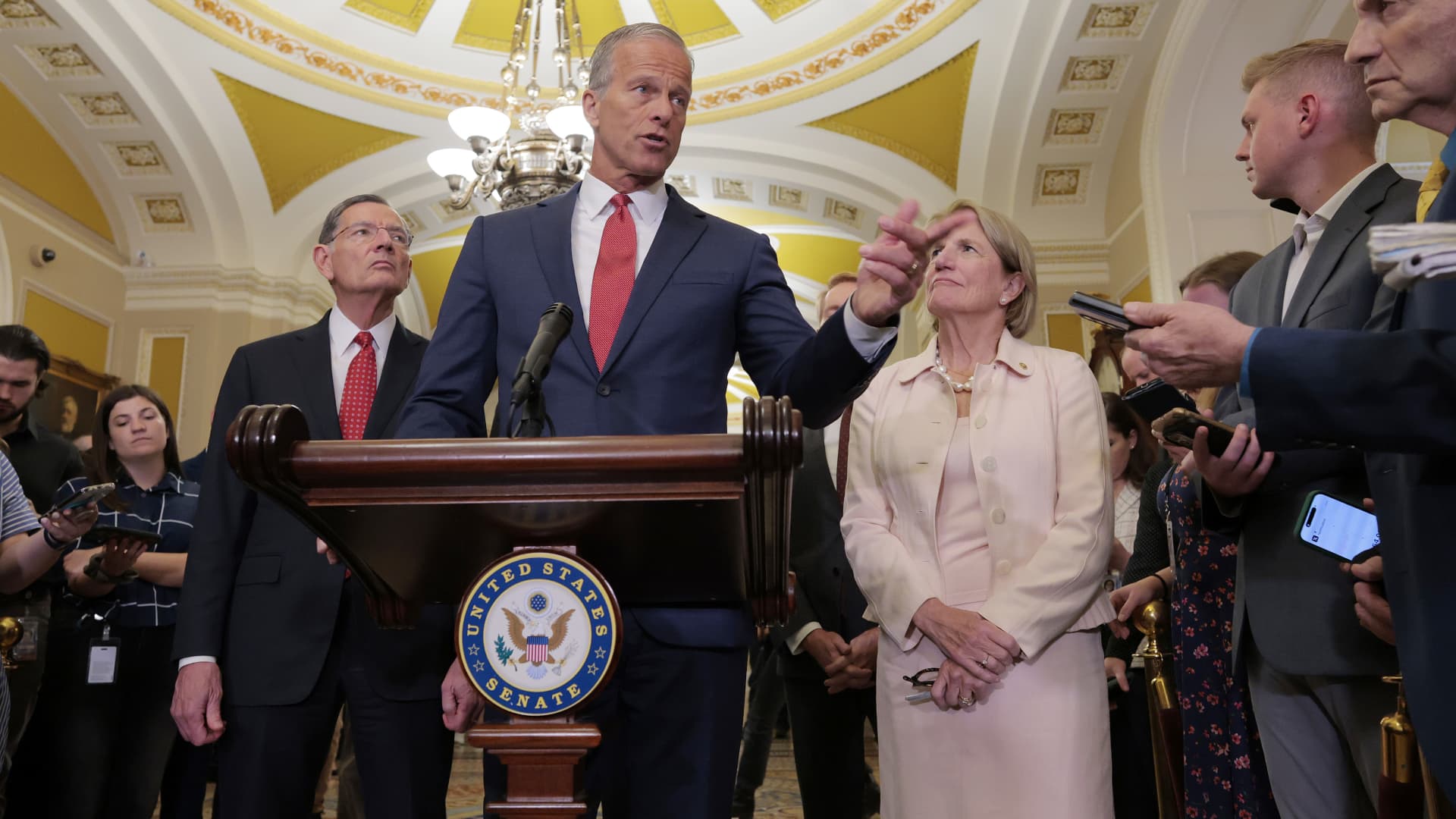
Senate Majority Leader John Thune (R-SD) speaks during a news conference following the weekly Senate Republican policy luncheon at the U.S. Capitol on June 17, 2025.
Anna Moneymaker | Getty Images News | Getty Images
A multitrillion-dollar tax package issued Monday by the Senate Finance Committee would offer a tax break for drivers on auto loan interest, but it doesn’t seem to be available for used cars, tax experts said.
The Senate GOP tax plan is part of a broader domestic policy bill that Republicans are trying to get to President Trump’s desk by the Fourth of July, and aims to partially fund tax cuts by slashing spending on health programs like Medicaid and the Affordable Care Act. The House passed its version — the “One Big Beautiful Bill Act” — in May.
One of the legislation’s many provisions would let taxpayers deduct up to $10,000 of auto loan interest from their taxable income in any given year. The average driver paid $1,332 of annual loan interest charges on new cars bought in 2024, according to AAA.
The tax break — which President Trump proposed when campaigning for president last year — would be available from 2025 through 2028.
Which vehicles may qualify for the tax break
Qualifying vehicles must be U.S.-assembled cars, minivans, vans, sport utility vehicles, pickup trucks, or motorcycles for personal use.
The Senate legislation excludes all-terrain vehicles, trailers and campers, which the House bill had included.
The deduction would only be available for loans secured after after December 31, 2024, according to the Senate legislation. It must also be the first loan on the vehicle.

Unlike a tax plan passed by the House in May, Senate Republicans appear to limit the tax deduction to new — and not used — passenger cars, tax experts said.
The Senate limits the tax break to vehicles for which “the original use … commences with the taxpayer,” according to the legislative text.
That phrasing is “pretty clear” in its meaning that only loans on new cars are eligible for the tax deduction, said Matt Gardner, senior fellow at the Institute on Taxation and Economic Policy.
“They don’t say the word ‘new cars’ but I don’t see another way of interpreting that language,” Gardner said.
Which car owners may benefit
That would limit the usefulness of the tax break for low- and middle-income taxpayers, who more often buy used cars, Gardner said.
A survey of low- and middle-earning households published in 2023 by researchers at the University of California, Los Angeles, showed 61% had bought a used vehicle, while 39% bought a new one.
Average household income was $115,000 for new-vehicle buyers in 2023, compared to $96,000 for a used-car buyer, according to Cox Automotive.
Cox estimates more than 20 million households will buy a used car in 2025. In March, it forecast about 16 million new-vehicle sales this year, though said tariffs levied by the Trump administration cloud the sales outlook.
Higher earners tend to get more value from tax deductions than low and middle earners, Gardner said. Deductions reduce the amount of taxable income that households pay, and high earners generally pay a higher federal tax rate than lower-earning households.
“The more you earn, the higher the tax rate you pay, meaning the more benefit you get from this thing,” Gardner said.
More from Personal Finance:
How child tax credit would change under GOP spending bills
How Senate GOP ‘no tax on tips’ proposal works
Who would qualify for $1,000 baby bonus in ‘Trump accounts’
However, the auto loan interest deduction starts to lose value when a taxpayer’s annual income exceeds $100,000. The threshold is $200,000 in the case of a joint tax return filed by married couples.
The deduction’s value falls by $200 for each $1,000 of income over those thresholds.
Meanwhile, the Trump administration put 25% tariffs on imported cars and car parts. Those tariffs are expected to push up car prices, and in turn erode the deduction’s value for households, Gardner said.
“Tariffs will completely eat up the value of this deduction for a lot of people,” he said.
William McBride, chief economist at the Tax Foundation, said he thinks the “biggest change” from the House version of the legislation is “to prevent loans against used cars.”


Personal Finance
Next-Generation Retirement Planning: Managing Longevity Risk and Variable Income Streams


U.S.- Canada Trade Talks Collapse; Carney Says Retaliatory Tariffs Begin September 8

Flock Cameras and the Future of Public Security

AI Infrastructure Boom Hits Physical Limits: Power, Financing, and Supply Chain Strain

Armanino adds Strategic Accounting Outsourced Solutions

New 2023 K-1 instructions stir the CAMT pot for partnerships and corporations

Tax Strategy: Employee Retention Credit update
-

 Stock News1 week ago
Nvidia Earnings Preview: What Wall Street Expects From the AI Bellwether’s Q2 Report
-

 Accounting1 week ago
SEC’s Semiannual Reporting Proposal Faces Investor Pushback: What CFOs Need to Know
-

 Stock News1 week ago
Nvidia Q2 FY2027 Earnings beats Wall Street Expectation with Record $96.2 Billion Revenue
-

 Finance1 week ago
Treasury Bond Volatility Forces Bessent to Double Debt Buyback Size as Yields Swing
-
 Technology5 days ago
AI Infrastructure Boom Hits Physical Limits: Power, Financing, and Supply Chain Strain
-
 Technology3 days ago
Flock Cameras and the Future of Public Security
-
 Economics3 days ago
U.S.- Canada Trade Talks Collapse; Carney Says Retaliatory Tariffs Begin September 8