
Personal Finance
Social Security Administration leadership changes may impact benefits

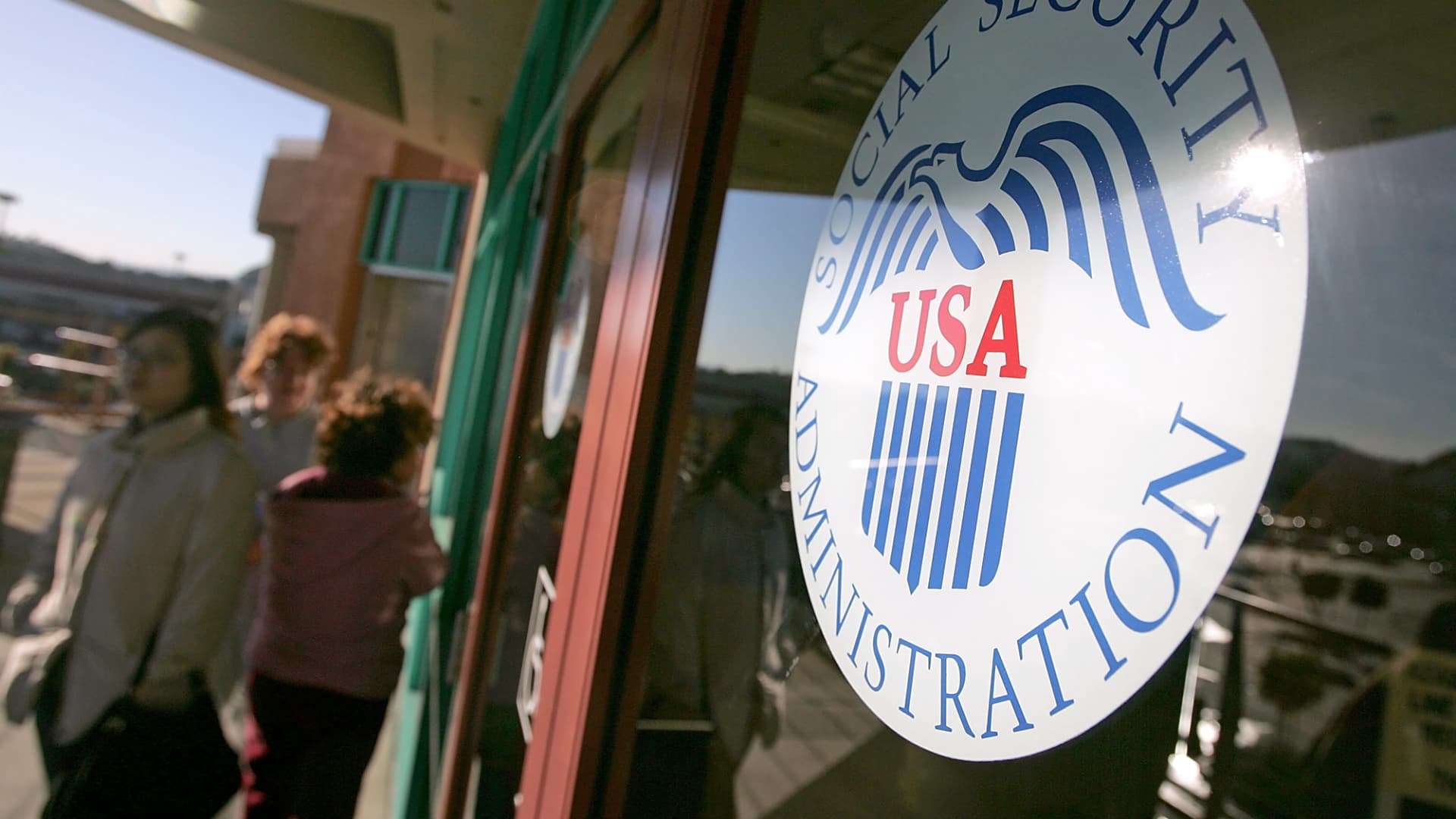
People line up outside the Social Security Administration office in San Francisco.
Getty Images
New leadership at the Social Security Administration tied to the Trump administration’s so-called Department of Government Efficiency has implemented swift changes.
Many experts say Americans will notice a difference when seeking help from the agency following staff cuts, regional office closures and new service policies.
The Social Security Administration is currently under the temporary leadership of acting commissioner Lee Dudek, who was assumed that role in February after acting commissioner Michelle King stepped down over DOGE privacy concerns. Dudek had previously publicly stated he had been placed on administrative leave for cooperating with DOGE, according to reports.
More from Personal Finance:
DOGE layoffs may ‘overwhelm’ unemployment system for federal workers
Education Dept. staff cuts leave student loan borrowers in the dark
What potential FHA layoffs could mean for homebuyers in the U.S.
As a temporary leader, Dudek does not have the obligation to answer to Congress.
“When you are a confirmed commissioner, you get called up to the Hill to testify on various issues that are operating for the agency,” Jason Fichtner, a former Social Security Administration executive, said during a National Academy of Social Insurance panel last week.
“It’s a check and balance that we currently don’t have,” Fichtner said.
As DOGE’s actions have upended the status quo at the Social Security Administration, former agency leaders, retirement experts and Democratic lawmakers have raised concerns about its new policies.
Meanwhile, Republicans in Congress last week praised DOGE for increasing the agency’s efficiency since President Donald Trump took office.
The Social Security Administration did not respond to a request from CNBC for comment by press time.
‘Economic security of millions of Americans is at stake’
Last week, the National Academy of Social Insurance, a non-profit, nonpartisan organization, released a statement signed by recipients of its award named on behalf of former Social Security Administration Commissioner Robert M. Ball, who served in that role from 1962 to 1973.
“The economic security of millions of Americans is at stake,” the signees wrote of the “major, destabilizing changes” the Social Security Administration has recently undergone.
Among those to sign the statement include former acting Social Security Administration commissioner Kilolo Kijakazi, former Treasury Secretary Jacob Lew and former Social Security Administration chief actuary Stephen Goss.
The statement lists “unprecedented actions” recently undertaken by the Social Security Administration, including:
- staff reductions of about 7,000 of the agency’s 57,000 employees while the agency already has an employee shortage and hiring freeze;
- the closure of 10 field offices, which may limit access to benefits;
- a reorganized leadership structure that will have just five deputy commissioners, who will now be political appointees;
- the closure of the Office of Civil Rights and Office of Transformation in an effort to cut costs; and
- the termination of research focused on how to improve Social Security, both from administrative and legislative standpoints.

“Getting benefits to the currently and newly eligible, and accurately determining how much those benefits should be, requires the work of current SSA staff and more,” the NASI statement reads.
Among those most vulnerable to longer wait times for benefits are the 2 million disability benefit applicants who are currently waiting on decisions. An estimated 10 million individuals have died in recent years while still waiting for disability benefits, the statement notes.
The customer service crisis faced by the Social Security Administration, including record initial disability backlog and customer service wait times, existed before DOGE, House Ways and Means Committee Chairman Jason Smith, R-Mo., said during a March 12 committee hearing.
The Trump administration has said the president “will always protect” Social Security and will not cut benefits.
“Any American receiving Social Security benefits will continue to receive them,” White House Press Secretary Karoline Leavitt said via email Monday when asked about the NASI statement. “The sole mission of DOGE is to identify waste, fraud, and abuse only.”
Confirmation process ‘needs to move along quickly’
Trump has nominated Frank Bisignano, chief executive of payments and financial technology company Fiserv, to serve as commissioner of the agency.
Bisignano’s Senate confirmation hearing is expected to take place in the coming weeks.
Former Social Security Administration Commissioner Michael Astrue, who led the agency from 2007 to 2013, said last week during a panel hosted by the National Academy of Social Insurance that while he doesn’t know Bisignano, “he can’t possibly be worse than what we have now.”
While the confirmation process has moved slowly in the past, it would be better to move swiftly and find a suitable leader for the agency, Astrue said.
“The process needs to move along quickly,” Astrue said.

When Bisignano does sit before the Senate, he will have to answer “a lot of questions in the confirmation process, beginning with, what did you know and when did you know it?” former Social Security Administration Commissioner Martin O’Malley, who led the agency from 2023 to 2024, said during the NASI panel.
Senators may want to know whether Bisignano “approved and blessed” changes after his nomination such as cutting staff, eliminating offices and closing regional headquarters, O’Malley said.
Last week, Democratic Sens. Elizabeth Warren of Massachusetts and Ron Wyden of Oregon sent a letter to Bisignano emphasizing that he will be responsible for any benefit interruptions that may be prompted by sweeping changes at the agency. In the letter, they also included questions on his views on DOGE access to sensitive data, further staff cuts or other possible future plans for the agency.
Bisignano was not available for comment by press time.
Smith: Seniors ‘already seeing the benefit’
A new law that President Joe Biden signed on Jan. 5 — the Social Security Fairness Act — has made it so more than 3.2 million individuals who are eligible for public pensions will receive increased Social Security checks.
In addition, affected beneficiaries also stand to receive payments dating back to January 2024.
The Social Security Administration said in January it would take 1,000 work hours to send those back payments, much of which had to be done manually on a case-by-case basis, House Ways and Means Committee Chairman Smith said during a March 12 committee hearing.
However, that outlook has changed under Trump’s leadership, according to Smith.
“Seniors are already seeing the benefit of doing things differently,” Smith said.
The agency has already sent more than 71% of all back payments to affected beneficiaries, he said.
“The Trump administration’s embrace of automation and technology has made a night and day difference for those affected seniors,” Smith said.
“This is how the agency should work,” he said.


Personal Finance
Next-Generation Retirement Planning: Managing Longevity Risk and Variable Income Streams


U.S.- Canada Trade Talks Collapse; Carney Says Retaliatory Tariffs Begin September 8

Flock Cameras and the Future of Public Security

AI Infrastructure Boom Hits Physical Limits: Power, Financing, and Supply Chain Strain

Armanino adds Strategic Accounting Outsourced Solutions

New 2023 K-1 instructions stir the CAMT pot for partnerships and corporations

Tax Strategy: Employee Retention Credit update
-

 Stock News1 week ago
Nvidia Q2 FY2027 Earnings beats Wall Street Expectation with Record $96.2 Billion Revenue
-
 Technology5 days ago
AI Infrastructure Boom Hits Physical Limits: Power, Financing, and Supply Chain Strain
-
 Technology3 days ago
Flock Cameras and the Future of Public Security
-
 Economics3 days ago
U.S.- Canada Trade Talks Collapse; Carney Says Retaliatory Tariffs Begin September 8