
Personal Finance
S&P 500 index investors may want to diversify now, experts say

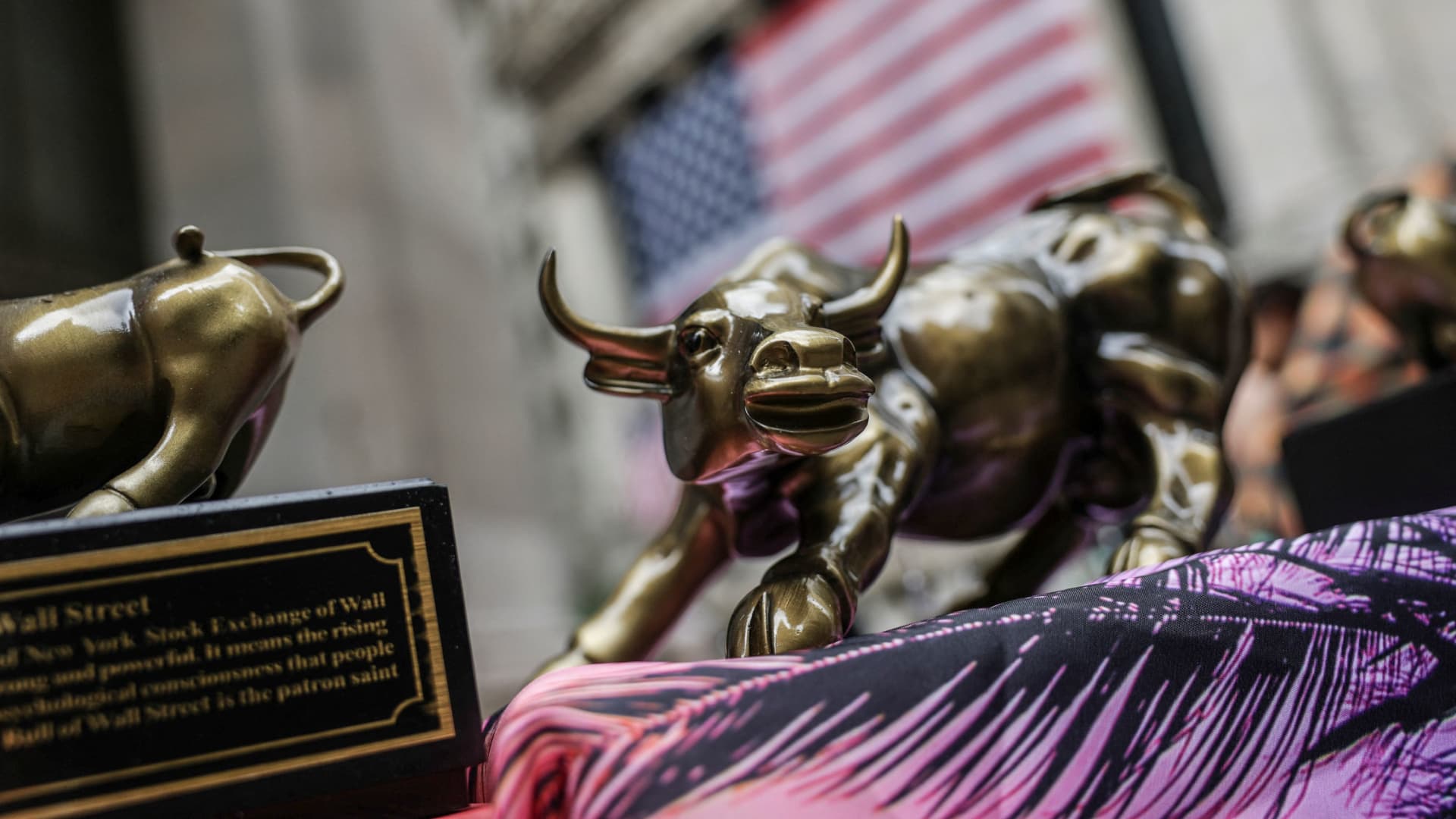
A small replica of the Charging Bull statue is seen on a street vendor stall outside the New York Stock Exchange on July 11, 2025.
Jeenah Moon | Reuters
The S&P 500 index has bounced back from its April lows.
Yet experts say investors would be wise to watch the risks before pursuing an investment strategy concentrated in the large-cap company-focused S&P 500 index, which represents about 80% of market capitalization.
“Our advice for people who are looking at their performance on a one-year or three-year horizon is no, we don’t think that the set-it-and-forget-it, S&P 500-only strategy is the right strategy,” said Lisa Shalett, chief investment officer at Morgan Stanley Wealth Management.
Yet that doesn’t mean the long-run index investing strategy famously touted by Berkshire Hathaway Chairman Warren Buffett or Vanguard founder Jack Bogle is no longer a good strategy, according to Shalett.
Those investors may put the S&P 500 in their 401(k) and not look at it for 30 years.
The problem is that most humans are highly sensitive to losses and check their accounts frequently, which makes it difficult not to touch their investments for decades, she said.
“That’s not how most human beings actually invest,” Shalett said.
‘You’re buying tech and AI’
Having an investment strategy concentrated in the S&P 500 index is also problematic now for another reason.
The S&P 500 had a good second quarter, where profits and margins in aggregate expanded, Shalett said.
But the Magnificent Seven — technology stocks including Alphabet, Amazon, Apple, Meta Platforms, Microsoft, Nvidia and Tesla — represented 26% of the earnings growth, she said. Meanwhile, 493 companies had 3% profit growth.
“That’s not a healthy market,” Shalett said. “That’s a very narrow market.”

When looking at the S&P today, it’s important to realize that what you’re buying now, versus what you were buying 10 years ago, has changed, said John Mullen, managing director and president at Parsons Capital Management.
The top 10 holdings currently represent approximately 40% of the index.
“If you’re buying the S&P, to a large extent, you’re buying these 10 names and, even more so, you’re buying tech and AI,” Mullen said.
The only top 10 exception that’s not a tech or artificial intelligence-related play is Berkshire Hathaway, he said.
What generative AI means for the market
For the top 10 company names in the market, the potential for generative AI is in the “sixth or seventh inning of being fully priced,” Shalett said.
Consequently, Morgan Stanley is looking to untapped opportunities where productivity can benefit from generative AI, such as in business services, financials and health care, she said.
“We’d much rather be in those places where the potential for the Gen AI story to be an upside surprise,” Shalett said.
Morgan Stanley is encouraging clients to be active stock pickers, according to Shalett.
Today’s investors may take another cue tied to Buffett, she said. In June, Berkshire Hathaway bought a $1.6 billion stake in health insurance company UnitedHealth.
The bet shows the belief in an upside margin potential in generative AI in the insurance industry, which is a highly manual, bureaucratic industry that is likely to be transformed, she said.
Where to look to diversify
Megacap stocks may continue to perform well from here, according to Joseph Veranth, chief investment officer of Dana Investment Advisors. The firm ranked No. 4 on the 2024 CNBC Financial Advisor 100 list.
But for investors who hold the S&P 500 or ETFS that are concentrated in the biggest stocks in that index, their concentration has increased as those companies have outperformed, unless they have rebalanced, Veranth said.
Consequently, it may make sense now to adjust those holdings to include smaller stocks, he said.
Morgan Stanley is also encouraging clients to diversify into other sectors and to look to international and emerging markets for opportunities, according to Shalett. The firm is also pointing investors to the equal-weight index for the S&P 500, where each company represents the same percentage.
An equal-weight index is the easiest way to diversify, Mullen said. But investors may also consider factor ETFs that put caps on weightings or emphasize certain sectors, he said. Or they may diversify into mid-cap, small-cap or the Russell 1000, which tracks the highest ranking 1,000 stocks in the Russell 3000 index, he said.

Personal Finance
Next-Generation Retirement Planning: Managing Longevity Risk and Variable Income Streams


U.S.- Canada Trade Talks Collapse; Carney Says Retaliatory Tariffs Begin September 8

Flock Cameras and the Future of Public Security

AI Infrastructure Boom Hits Physical Limits: Power, Financing, and Supply Chain Strain

Armanino adds Strategic Accounting Outsourced Solutions

New 2023 K-1 instructions stir the CAMT pot for partnerships and corporations

Tax Strategy: Employee Retention Credit update
-

 Stock News1 week ago
Nvidia Earnings Preview: What Wall Street Expects From the AI Bellwether’s Q2 Report
-

 Accounting1 week ago
SEC’s Semiannual Reporting Proposal Faces Investor Pushback: What CFOs Need to Know
-

 Stock News1 week ago
Nvidia Q2 FY2027 Earnings beats Wall Street Expectation with Record $96.2 Billion Revenue
-

 Finance1 week ago
Treasury Bond Volatility Forces Bessent to Double Debt Buyback Size as Yields Swing
-
 Technology5 days ago
AI Infrastructure Boom Hits Physical Limits: Power, Financing, and Supply Chain Strain
-
 Technology3 days ago
Flock Cameras and the Future of Public Security
-
 Economics3 days ago
U.S.- Canada Trade Talks Collapse; Carney Says Retaliatory Tariffs Begin September 8