
Personal Finance
Stockpiling ahead of higher tariffs is a big mistake, experts say


Many consumers are rightfully concerned about escalating trade tensions.
President Donald Trump on Saturday said he would impose 25% tariffs on goods from Mexico and Canada, and 10% tariffs on goods imported from China. He also signaled that tariffs on the European Union could be next.
While Trump has agreed to halt the implementation of tariffs against Canada for at least 30 days and he paused the duty on Mexican goods for one month, China already retaliated with additional tariffs of up to 15% on some U.S. imports.
A recent consumer survey found that 86% of Americans said tariffs are likely to hit their wallets and 12% are already stockpiling items over potential tariff concerns.
More from Personal Finance:
Tariffs are a wake-up call for individual investors
How tariffs on Canada, China and Mexico may impact you
Tariffs ‘slammed shut’ the window for interest rate cuts in 2025
Many businesses will funnel those extra costs to customers — either directly or indirectly — which is why tariffs generally trigger higher prices for consumers, economists say.
Specifically, higher tariffs on goods traded between China and the U.S. may lead to higher prices on apparel, appliances, toys and electronics. Meanwhile, Mexico and Canada tariffs could put pressure on already high grocery prices, which are up 28% over the last five years, according to the Bureau of Labor Statistics.
‘Tariffs are taxes paid by Americans’
“Tariffs are taxes paid by Americans, and any new tariff tax increases should be methodically and effectively deployed toward only the most strategic goods,” David French, the National Retail Federation’s executive vice president of government relations, said in a statement.
This also comes at a time when many households already feel financially stretched.
Five years after Covid’s supply-and-demand logistics crisis drove up prices for many consumer staples, many Americans are still wrestling with higher costs.
Overall, the U.S. economy has notched steady progress in lowering inflation. The consumer price index, a key inflation measure that tracks average prices across a broad basket of consumer goods and services, increased 2.9% in December relative to a year earlier, according to the Bureau of Labor Statistics. That’s down from a pandemic-era peak of 9.1% in June 2022.
But in most cases price increases are only slowing — not falling outright.
Why stockpiling can backfire
“Sudden surges in demand can disrupt supply chains, leading to shortages and hoarding behavior — issues we experienced firsthand during the pandemic,” said Amir Mousavian, professor of supply chain management at the University of New England’s College of Business.
“The psychological impact of such behavior ripples through the supply chain, reinforcing inefficiencies rather than addressing them,” Mousavian said.
Any potential consumer savings from stockpiling now would likely be insignificant in the long run, he explained.
“Moreover, the overall harm to the majority of consumers — caused by disruptions, shortages, and likely artificially inflated prices due to shortages — far outweighs the potential minimal savings that some individuals may experience by stockpiling,” Mousavian added.
How to save money as prices rise
There are, however, savings benefits to buying in bulk, said Steven Conners, founder and president of Conners Wealth Management in Scottsdale, Arizona.
“Anything imported could be more expensive in the future,” he said. “If you have expenditures that are larger in nature, you might want to do that now as opposed to delaying.”
But, “stockpiling is another story,” he added. “Having healed so much of the supply chain, this could throw us back.”
In many cases, stockpiling just isn’t practical, added Sunderesh Heragu, president-elect of the Institute of Industrial and Systems Engineers and a professor at Oklahoma State University.
“It is not easy for individual consumers or households to stockpile,” he said.
Goods that will see a significant price increase quickly are groceries, electronics, cars and gas, according to Heragu.
“Consumers may want to consider purchasing big ticket items such as electronics and automobiles, but the prices of these may already have gone up,” he added.
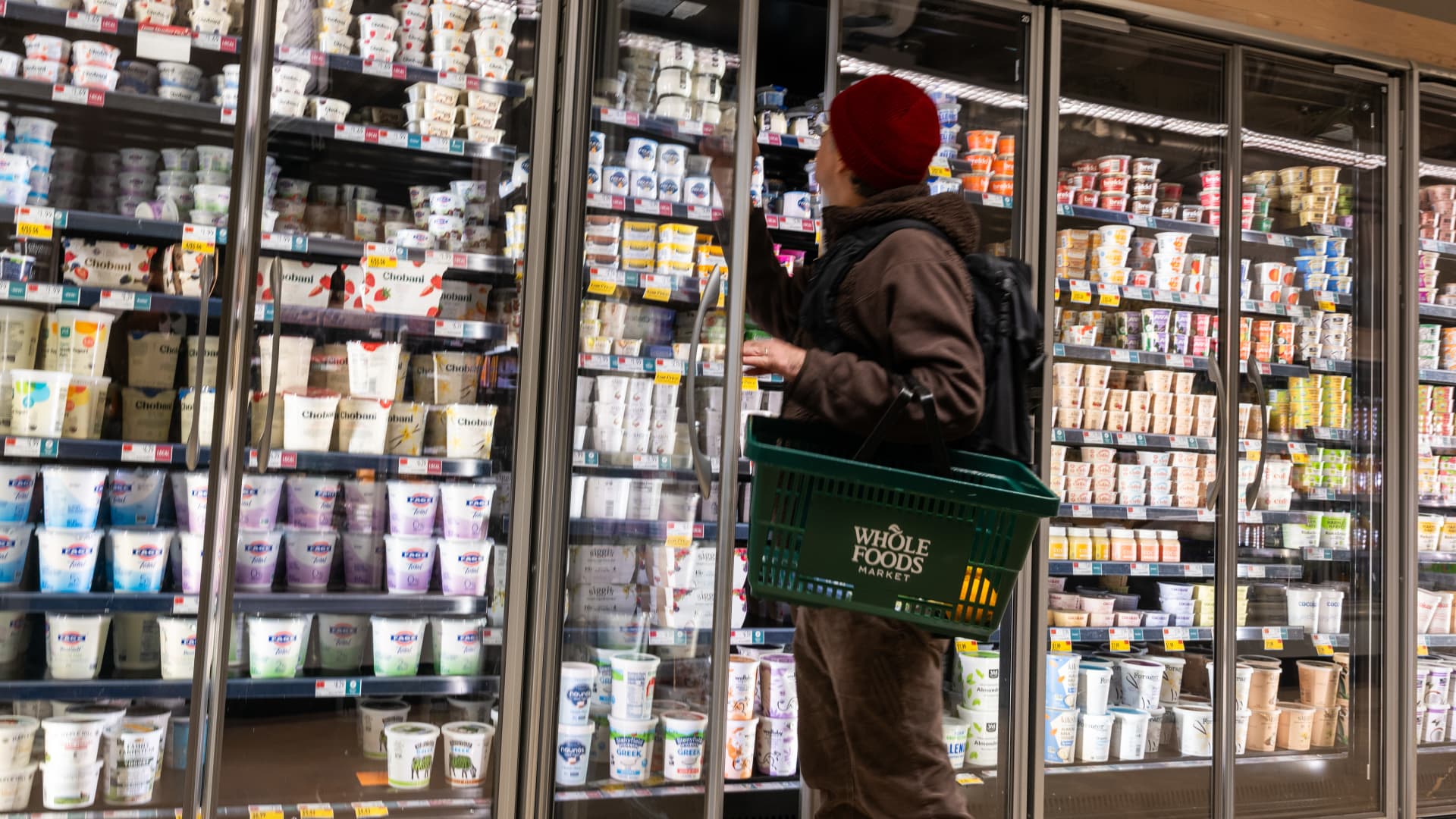
A person shops at a Whole Foods Market grocery store in New York City on Dec. 17, 2024.
Spencer Platt | Getty Images
And still, it’s too soon to tell how the looming tariffs on Canada, China and Mexico will play out, experts say.
“There is so much uncertainty in the system,” Heragu said. “Are the tariffs a threat? A negotiating tactic? Will they become a reality and if so, to what extent?”
According to Mousavian, “President Trump’s administration uses tariffs as a negotiation tool, as seen in cases like Colombia.”
President Trump had threatened tariffs and sanctions on Colombia but later pulled back after the South American nation agreed to accept military flights carrying deportees as part of the White House’s immigration crackdown.
While some tariff increases may occur, the likelihood of substantial, lasting tariffs at this moment remains low, Mousavian said.
Further, if inflation continues its downward trend, there is also the possibility that prices for many consumer staples could fall in the year ahead, Heragu said.


Personal Finance
Next-Generation Retirement Planning: Managing Longevity Risk and Variable Income Streams


U.S.- Canada Trade Talks Collapse; Carney Says Retaliatory Tariffs Begin September 8

Flock Cameras and the Future of Public Security

AI Infrastructure Boom Hits Physical Limits: Power, Financing, and Supply Chain Strain

Armanino adds Strategic Accounting Outsourced Solutions

New 2023 K-1 instructions stir the CAMT pot for partnerships and corporations

Tax Strategy: Employee Retention Credit update
-

 Stock News1 week ago
Nvidia Q2 FY2027 Earnings beats Wall Street Expectation with Record $96.2 Billion Revenue
-
 Technology5 days ago
AI Infrastructure Boom Hits Physical Limits: Power, Financing, and Supply Chain Strain
-
 Technology3 days ago
Flock Cameras and the Future of Public Security
-
 Economics3 days ago
U.S.- Canada Trade Talks Collapse; Carney Says Retaliatory Tariffs Begin September 8