Finance
Stocks making the biggest midday moves: MSFT, NFLX, MRVL, GTLB
Published
6 months agoon
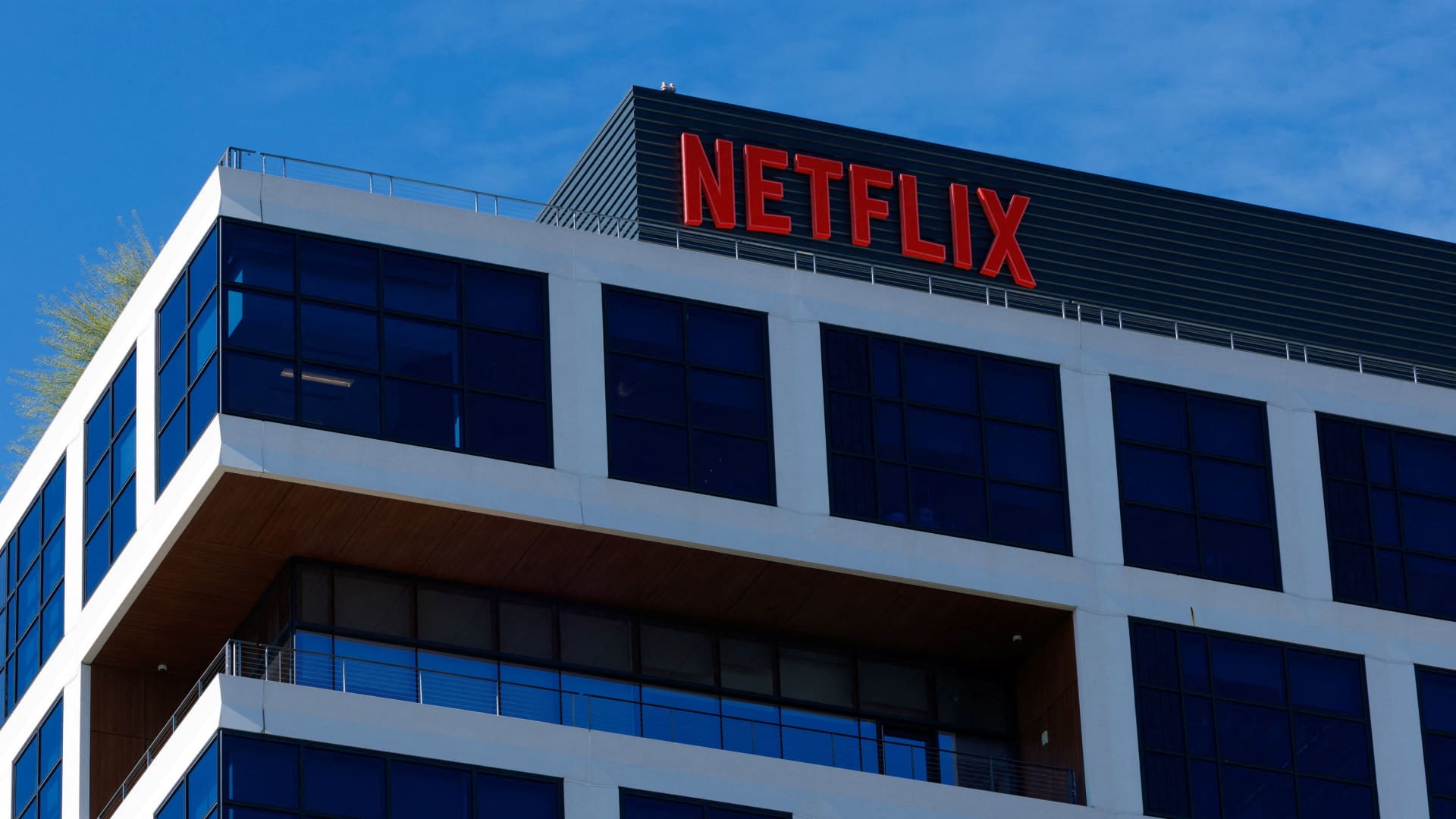
Check out the companies making the biggest moves midday: Genius Sports — The sports analytics company jumped 8% after setting lofty 2028 targets at its investor day. Genius sees ” group revenue ” totaling $1.2 billion by then, along with free cash flow of $220 million. Netflix — Shares declined 5% as investors waited to see how much the leading streaming platform would bid for Warner Bros Discovery . Reuters reported Tuesday that Netflix made an offer that was mostly cash. American Eagle Outfitters — Shares rose 14% after the clothing company raised its fourth quarter outlook and reported better-than-expected earnings in the third quarter. Alexandria Real Estate Equities — The real estate investment trust dropped 8.3% after slashing its dividend by 45% . Alexandria Real Estate Equities will now pay a quarterly cash dividend of 72 cents per share, down from $1.32 a share. Marvell Technology — The stock popped 9% after the provider of data infrastructure semiconductor solutions posted third-quarter earnings of 76 cents per share excluding one-time items on revenue of $2.08 billion, topping analysts’ consensus estimate of 73 cents per share on revenue of $2.07 billion, LSEG data showed. Microsoft — The Windows and Azure cloud provider dropped 2%, off its lows of the day, after the company denied a report from The Information that said Microsoft lowered its AI products sales targets. Thor Industries — The RV maker fell more than 7% after fiscal 2026 guidance failed to impress investors. Thor kept its earnings per share outlook in a range of $3.75 to $4.25, and sees revenue between $9 billion and $9.5 billion. Acadia Healthcare — The behavioral health care and residential treatment provider slid more than 13% after cutting its full-year earnings guidance. Acadia now sees earnings per share in a range of $1.94 to $2.04, down from a prior outlook of $2.35 to $2.45. Acadia also updated its liability reserves. Okta — An earnings beat boosted Okta shares by 2.7%. The company reported third-quarter earnings of 82 cents per share, excluding one-time items, on revenue of $742 million. Analysts expected earnings of 76 cents per share on revenue of $730 million, according to LSEG. Microchip Technology — The semiconductor manufacturer gained 8.6% after raising guidance for the third quarter. Microchip Technology now expects adjusted earnings of 40 cents per share versus previous guidance of 34 cents to 40 cents a share, and projected revenue at the high end of its previously guided range of $1.109 billion to $1.149 billion. Asana — After reporting third-quarter earnings of seven cents per share excluding one-time items on revenue of $201 million, the company’s stock added 4%. Analysts had expected earnings of six cents per share on revenue of $199 million, LSEG data shows. Asana also raised the high-end of its full-year revenue outlook for 2026. GitLab — The stock fell 13% after the company issued a correction to its full-year 2026 earnings guidance. GitLab sees earnings per share between 88 cents and 89 cents. It previously issued a forecast of 95 to 96 cents in earnings per share. Pure Storage — Shares plunged 25% after the data management and storage firm reported third-quarter earnings of 58 cents per share ex-items on revenue of $964.5 million. Analysts had expected EPS of 58 cents on revenue of $956 million, LSEG data shows. — CNBC’s Itzel Franco, Liz Napolitano and Michelle Fox contributed reporting.
You may like
Finance
Gen X can’t retire on time as inflation outpaces wages, survey finds
Published
2 weeks agoon
May 8, 2026
Alliance Global Partners chief global strategist Mark Grant discusses his income tax strategy for retirees on ‘Varney & Co.’
For the generation that should be in its “peak savings years,” the prospect of retiring on time has shifted from a plan to a prayer.
A newly released Employee Financial Wellness Survey by PwC found that nearly 50% of Gen X employees are pushing back their retirement dates, citing stagnant wages, rising everyday costs, and a lack of liquid savings.
Additionally, only 38% of Gen Xers believe they can retire when they originally planned, and more than half of this demographic expect to withdraw funds from their retirement accounts early to cover short-term costs.
“For employers, this isn’t a future problem. Financial anxiety during peak career years can affect focus and engagement,” PwC researchers write. “If the risks are clear, the question is why more employees aren’t taking action. It’s not a lack of desire. Most employees want stability, confidence and to feel in control. But many don’t feel equipped to get there.”
TEEN INVESTOR BOOM: WHY WALL STREET IS CHASING YOUNGEST GENERATIONS EARLIER THAN EVER
The primary driver of this retirement delay is the inability to save as inflation eats away at monthly expenses, the report notes. Twenty-five percent of the total workforce is living without a buffer, and nearly half cannot meet basic household expenses.

Nearly half of Gen X workers are delaying retirement, PwC reports. (Getty Images)
“[Forty-nine percent] say their compensation isn’t keeping up with costs. As expenses rise faster than income, day-to-day trade-offs are becoming routine. Employees aren’t just feeling squeezed. They’re making difficult financial decisions to stay afloat,” the PwC report continues..
As a result, when Gen Xers cannot afford to leave their current jobs, the entire corporate ladder stalls, creating business risks, with companies facing higher costs as older talent remains on payroll longer than expected.
BlackRock Global Head of Retirement Solutions Nick Nefouse joins ‘Varney & Co.’ to discuss a proposed rule expanding 401(k)s to crypto and real estate.
“When employees dip into retirement funds early or delay retirement altogether, it affects more than personal finances and retirement plan leakage,” the report says. “It may also influence workforce planning, healthcare costs, succession timing and overall organizational stability.”
The findings also show that a significant portion – 41% – of the workforce feel they were never given the tools to manage a crisis of this magnitude, leading to a sense of being “overwhelmed” by financial choices.
GET FOX BUSINESS ON THE GO BY CLICKING HERE
‘The Big Money Show’ breaks down new IRS limits for 401(k)s and IRAs, giving savers more room to invest for retirement.
PwC provided a call to action for employees and their employers, encouraging them to reduce the stigma around financial education, foster trust through human coaches, emphasize skill building and focus on day-to-day finances before long-term goals.
“Employees define financial wellness simply: less stress, fewer surprises and the freedom to make financial choices with confidence. For employers, that’s the opportunity.”
Finance
Why software stocks, 2026’s market dogs, have joined the rally
Published
1 month agoon
April 19, 2026

Cybersecurity and enterprise software stocks have been market dogs in 2026, with fears that AI will wipe out a wide range of companies in the enterprise space dominating the narrative. But they snapped a brutal losing streak this past week, joining in the broader market rally that saw all losses from the U.S.-Iran war regained by the Dow Jones Industrial Average and S&P 500.
Cybersecurity has been “a victim of some of the AI-related headlines,” Christian Magoon, Amplify ETFs CEO, said on this week’s “ETF Edge.”
It wasn’t just niche cybersecurity names. Take Microsoft, for example, which was recently down close to 20% for the year. Its shares surged last week by 13%.
A big driver of the pummeling in software stocks was a rotation within tech by investors to AI infrastructure and semiconductors and some other names in large-cap tech, Magoon said, and since cybersecurity stocks and ETFs are heavily weighted towards software companies, they were left behind even as those businesses continue to grow on a fundamental basis.
But Wall Street now has become more bullish with the stocks at lower levels. Brent Thill, Jefferies tech analyst, said last week that the worst may be over for software stocks. “I think that this concept that software is dead, and then Anthropic and OpenAI are going to kill the entire industry, is just over-exaggerated,” he said on CNBC’s “Money Movers” on Wednesday.
“Big Short” investor Michael Burry wrote in a Substack post on Wednesday that he is becoming bullish about software stocks after the recent selloff. “Software stocks remain interesting because of accelerated extreme declines last week arising from a reflexive positive feedback loop between falling software stocks and changes in the market for their bank debt,” he wrote.
The Global X Cybersecurity ETF (BUG), is down about 12% since the beginning of the year, with top holdings including Palo Alto Networks, Fortinet, Akamai Technologies and CrowdStrike. But BUG was up 12% last week. The First Trust NASDAQ Cybersecurity ETF (CIBR) is down 6% for the year, but up 9% in the past week.
Piper Sandler analyst Rob Owens reiterated an “overweight” rating on Palo Alto Networks which helped the stock pop 7% — it is now down roughly 6% on the year. Its peers saw similar moves, including CrowdStrike.
Performance of Global X cybersecurity ETF versus S&P 500 over past one-year period.
Magoon said expectations may have become too high in cybersecurity, and with a crowding effect among investors, solid results were not enough to to push stocks higher. But the down-and-then-back-up 2026 for the sector is also a reminder that when stocks fall sharply in a short period of time, opportunity may knock.
“Once you’re down over 10% in some of these subsectors, you start to see the contrarians start to say, ‘well, maybe I’ll take a look at this,'” Magoon said.
He said AI does add both opportunity and uncertainty to the cybersecurity equation, increasing demand but also introducing new competition. But he added, “I think the dip is good to buy in an AI-driven world,” specifically because the risks to companies may lead to more M&A in cyber names that benefits the stocks.
For now, investors may look for opportunity on the margins rather than rush back into beaten-up tech names. “I think investors are still going to remain underweight software,” Thill said.
But Magoon advises investors to at least take the reminder to keep an eye on niches in the market during pronounced downturns. “The best-performing are often the least bought and do the best over the next 12 months versus late-in-the-game piling on,” he said.
While that may have been a mindset that worked against the last investors into cybersecurity and enterprise software in mid-2025 when the negative sentiment started building, at least for now, it’s started working for the stocks in the sector again.
Meanwhile, this year’s biggest winner is also a good example of what can be an extended trade in either a bullish or bearish direction. Last year, institutional ownership of energy was at multi-year lows, Magoon said, referencing Bank of America data. “Reverse sentiment can be a great indicator,” he said.
But he cautioned that any selective buying of stocks that have dipped does have to contend with the risk that there is a potentially bigger drawdown in the market yet to come in 2026. That is because midterm election years historically have been marked by large drawdowns. “If you think it is bad right now, it could get a lot worse,” Magoon said. But he added that there’s a silver-lining in that data, too, for the patient investor. The market has posted very strong 12-month returns after midterm election drawdowns end. So, for investors with a longer-term time horizon and no need for short-term liquidity, Magoon said, “stick in there.”
Sign up for our weekly newsletter that goes beyond the livestream, offering a closer look at the trends and figures shaping the ETF market.
Finance
Violent downturns could test new ETF strategies, warns MFS Investment
Published
1 month agoon
April 17, 2026

New innovation in the exchange-traded fund industry could come at a cost to investors during extreme conditions.
According to MFS Investment Management’s Jamie Harrison, ETFs involved in increasingly complex derivatives and less transparent markets may be in uncharted territory when it comes to violent downturns.
“Those would be something that you’d want to keep an eye on as volatility ramps up,” the firm’s head of ETF capital markets told CNBC’s “ETF Edge” this week. “As innovation continues to increase at a rapid pace within the ETF wrapper, [it’s] definitely something that we advise our clients to be really front-footed about… Lack of transparency could absolutely be an issue if we’re going to start seeing some deep sell-offs.”
His firm has been around since 1924 and is known for inventing the open-end mutual fund. Last year, ETF.com named MFS Investment Management as the best new ETF issuer.
“It’s important to do due diligence on the portfolio,” he said. “Having a firm that has deep partnerships, deep bench of subject matter experts that plays with the A-team in terms of the Street and liquidity providers available [are] super important.”
Liquidity as the real issue?
Harrison suggested the real issue is liquidity, particularly during a steep sell-off.
“We’ve all seen the news and the headlines around potential private credit ETFs. That picture becomes much more murky,” he added. “It’s up to advisors, to investors [and] to clients to really dig in and look under the hood and engage with their issuers.”
He noted investors will have to ask some tough questions.
“What does this look like in a 20% drawdown? How does this liquidity facility work? Am I going to be able to get in? Am I going to be able to get out? And if I’m able to get out, am I able to get out at a price that’s tight to NAV [net asset value], and what’s the infrastructure at your shop in terms of managing that consideration for me,” said Harrison.
Amplify ETFs’ Christian Magoon is also concerned about these newer ETF strategies could weather a monster drawdown. He listed private credit as a red flag.
“If your ETF owns private credit, I think it’s worth taking a look at, kind of what the standards are around liquidity and how that ETF is trading, because that should be a bit of a mismatch between the trading pace of ETFs and the underlying asset,” the firm’s CEO said in the same interview.
Magoon also highlighted potential issues surrounding equity-linked notes. The notes provide fixed income security while offering potentially higher returns linked to stocks or equity indexes.
“Those could potentially be in stress due to redemptions and the underlying credit risk. That’s another kind of unique derivative,” Magoon said. “I would very closely look at any ETF that has equity-linked notes should we get into a major drawdown or there be a contagion in private credit or something related to the banking system.”
Gen X can’t retire on time as inflation outpaces wages, survey finds
Are you ready for it? 4 steps to successfully integrate AI into your operations
What that means for consumer loans
Armanino adds Strategic Accounting Outsourced Solutions
New 2023 K-1 instructions stir the CAMT pot for partnerships and corporations