Finance
Stocks making the biggest moves premarket: CRWD, MRK, PYPL, JBLU
Published
2 years agoon
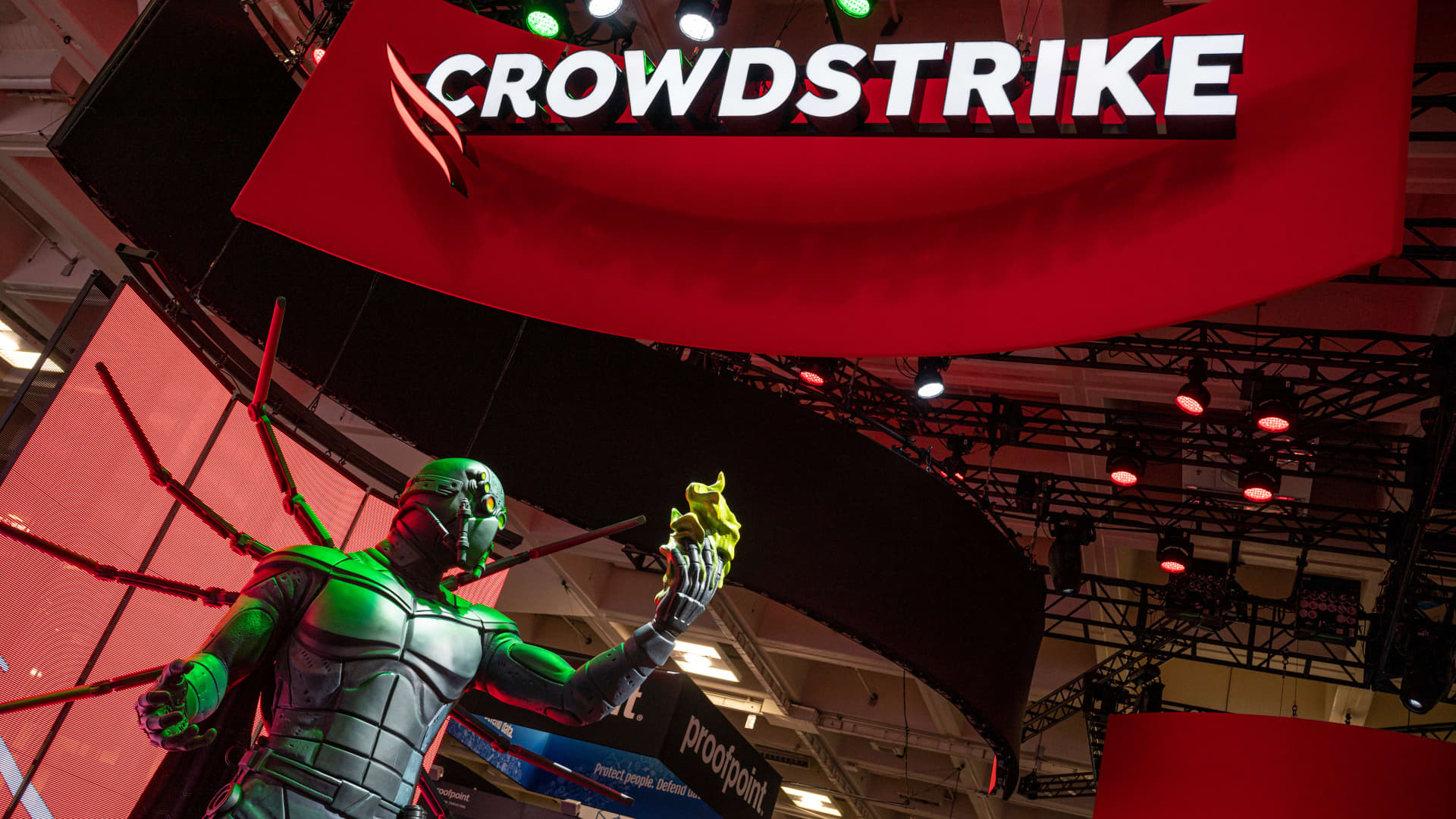
Check out the companies making headlines in premarket trading: CrowdStrike — Shares slipped 5% after CNBC reported that Delta Airlines has retained legal counsel to pursue damages from both CrowdStrike and Microsoft after a software update led to mass flight interruptions in July. Woodward — The aerospace and industrial equipment company slipped more than 11% after fiscal third-quarter revenue missed Wall Street estimates. Woodward posted revenue of $847.7 million in the quarter, while analysts polled by FactSet forecast $853.3 million. F5 Inc . — Shares surged nearly 14% after the software company reported a top- and bottom-line beat in the fiscal third quarter. F5 posted adjusted earnings of $3.36 per share, compared to an LSEG estimate of $2.97 per share. Revenue of $695 million was also higher than the $686 million expected. Amkor Technology — The semiconductor packaging company edged more than 6% lower after Amkor’s third-quarter outlook missed Wall Street estimates. Amkor expects earnings per share in the range of 42 cents to 56 cents in the fourth quarter, while analysts surveyed by FactSet had forecast 64 cents per share. Merck — Shares were down more than 1% after the pharma giant issued weaker-than-expected earnings guidance for the full year. The company sees its full-year bottom line in a range of $7.94 per share to $8.04 per share. That missed a FactSet estimate of $8.16 per share and was below a previous company forecast. Lattice Semiconductor — Shares dove 15.9% after second-quarter earnings and current-quarter revenue guidance came in below expectations. Lattice earned 23 cents per share, excluding items, on $124 million in revenue during the second quarter, while analysts polled by LSEG anticipated 24 cents in earnings per share and $130 million in revenue. Bank of America downgraded shares to underperform from neutral, citing cooling prospects for growth and little visibility. Pfizer — Shares gained 1.4% after the drugmaker posted a second-quarter earnings and revenue beat . Pfizer also raised its full-year outlook. It now expects adjusted earnings per share of $2.45 to $2.65 for the fiscal year and revenue between $59.5 billion and $62.5 billion. Varonis Systems — Shares of the data security company surged 10% after Varonis Systems posted second-quarter results that exceeded expectations and issued stronger-than-expected current-quarter guidance. Adjusted earnings of 5 cents per share topped the loss of 2 cents per share forecast by analysts polled by FactSet. Revenue of $130.3 million came in above the $124.8 million consensus estimate. Symbotic — Shares of the automation company fell more than 19% after weak guidance for the fiscal fourth quarter. Symbotic said it expects revenue between $455 million and $475 million in its fiscal fourth quarter, compared to a FactSet consensus of $516.9 million. The company also reported $491.9 million in revenue for its fiscal third quarter, which was above a Wall Street forecast of $464.6 million. Howmet Aerospace — The aerospace manufacturer climbed 8% after posting second-quarter adjusted earnings of 67 cents per share, higher than the 60 cents analysts polled by FactSet had expected. The firm’s revenue of $1.88 billion also exceeded the estimated $1.83 billion. Additionally, Howmet increased its quarterly dividend to 8 cents per share from 5 cents per share, to be payable Aug. 26. Corning — Shares dropped 5.5%. The company, known for developing the Gorilla Glass used for iPhones, reported second-quarter earnings per share of 47 cents, slightly above the 46 cents expected from analysts polled by LSEG. Earnings guidance, however, was about in line with analysts’ expectations. Archer-Daniels-Midland — Shares fell 2% after the agricultural products maker reported adjusted second-quarter earnings of $1.03 a share, far below the $1.22 consensus analyst estimate via LSEG. ADM’s revenue for the period also missed expectations. JetBlue — Shares jumped 4% after the airline said adjusted earnings per share was 8 cents for the second quarter. Analysts had expected a loss. Revenue was slightly better than expected in the period. PayPal — Shares jumped 4% after the payments company said second-quarter adjusted earnings per share was $1.19, far ahead of the 99 cents per share expected by analysts polled by FactSet. PayPal also raised its 2024 outlook and upped its share buyback plan. Procter & Gamble — Shares fell 3% after the consumer products giant reported second-quarter revenue of $20.53 billion, below the $20.74 billion expected by analysts surveyed by LSEG. P & G’s adjusted earnings of $1.40 a share for the period was higher than the $1.37 a share expected by analysts, according to LSEG. Leidos — The stock popped more than 7% on the back of better-than-expected second-quarter results. Leidos, which provides IT services for the U.S. Pentagon, earned $2.63 per share, excluding items, on revenue of $4.13 billion. Analysts polled by StreetAccount expected a profit of $2.27 per share on revenue of $4.06 billion. The company also raised its full-year earnings guidance. Zebra Technologies — Shares of the tracker and computer printing technology manufacturer gained 3% after the company reported second-quarter results that beat expectations. Zebra earned $3.18 per share, excluding certain items, on revenue of $1.22 billion. Analysts expected a profit of $2.80 per share on revenue of $1.18 billion, according to StreetAccount. The company also increased its full-year earnings guidance. — CNBC’s Michelle Fox, Hakyung Kim, Lisa Kailai Han, Alex Harring, Jesse Pound, Fred Imbert and John Melloy contributed reporting.
You may like
Finance
Why software stocks, 2026’s market dogs, have joined the rally
Published
2 weeks agoon
April 19, 2026

Cybersecurity and enterprise software stocks have been market dogs in 2026, with fears that AI will wipe out a wide range of companies in the enterprise space dominating the narrative. But they snapped a brutal losing streak this past week, joining in the broader market rally that saw all losses from the U.S.-Iran war regained by the Dow Jones Industrial Average and S&P 500.
Cybersecurity has been “a victim of some of the AI-related headlines,” Christian Magoon, Amplify ETFs CEO, said on this week’s “ETF Edge.”
It wasn’t just niche cybersecurity names. Take Microsoft, for example, which was recently down close to 20% for the year. Its shares surged last week by 13%.
A big driver of the pummeling in software stocks was a rotation within tech by investors to AI infrastructure and semiconductors and some other names in large-cap tech, Magoon said, and since cybersecurity stocks and ETFs are heavily weighted towards software companies, they were left behind even as those businesses continue to grow on a fundamental basis.
But Wall Street now has become more bullish with the stocks at lower levels. Brent Thill, Jefferies tech analyst, said last week that the worst may be over for software stocks. “I think that this concept that software is dead, and then Anthropic and OpenAI are going to kill the entire industry, is just over-exaggerated,” he said on CNBC’s “Money Movers” on Wednesday.
“Big Short” investor Michael Burry wrote in a Substack post on Wednesday that he is becoming bullish about software stocks after the recent selloff. “Software stocks remain interesting because of accelerated extreme declines last week arising from a reflexive positive feedback loop between falling software stocks and changes in the market for their bank debt,” he wrote.
The Global X Cybersecurity ETF (BUG), is down about 12% since the beginning of the year, with top holdings including Palo Alto Networks, Fortinet, Akamai Technologies and CrowdStrike. But BUG was up 12% last week. The First Trust NASDAQ Cybersecurity ETF (CIBR) is down 6% for the year, but up 9% in the past week.
Piper Sandler analyst Rob Owens reiterated an “overweight” rating on Palo Alto Networks which helped the stock pop 7% — it is now down roughly 6% on the year. Its peers saw similar moves, including CrowdStrike.
Performance of Global X cybersecurity ETF versus S&P 500 over past one-year period.
Magoon said expectations may have become too high in cybersecurity, and with a crowding effect among investors, solid results were not enough to to push stocks higher. But the down-and-then-back-up 2026 for the sector is also a reminder that when stocks fall sharply in a short period of time, opportunity may knock.
“Once you’re down over 10% in some of these subsectors, you start to see the contrarians start to say, ‘well, maybe I’ll take a look at this,'” Magoon said.
He said AI does add both opportunity and uncertainty to the cybersecurity equation, increasing demand but also introducing new competition. But he added, “I think the dip is good to buy in an AI-driven world,” specifically because the risks to companies may lead to more M&A in cyber names that benefits the stocks.
For now, investors may look for opportunity on the margins rather than rush back into beaten-up tech names. “I think investors are still going to remain underweight software,” Thill said.
But Magoon advises investors to at least take the reminder to keep an eye on niches in the market during pronounced downturns. “The best-performing are often the least bought and do the best over the next 12 months versus late-in-the-game piling on,” he said.
While that may have been a mindset that worked against the last investors into cybersecurity and enterprise software in mid-2025 when the negative sentiment started building, at least for now, it’s started working for the stocks in the sector again.
Meanwhile, this year’s biggest winner is also a good example of what can be an extended trade in either a bullish or bearish direction. Last year, institutional ownership of energy was at multi-year lows, Magoon said, referencing Bank of America data. “Reverse sentiment can be a great indicator,” he said.
But he cautioned that any selective buying of stocks that have dipped does have to contend with the risk that there is a potentially bigger drawdown in the market yet to come in 2026. That is because midterm election years historically have been marked by large drawdowns. “If you think it is bad right now, it could get a lot worse,” Magoon said. But he added that there’s a silver-lining in that data, too, for the patient investor. The market has posted very strong 12-month returns after midterm election drawdowns end. So, for investors with a longer-term time horizon and no need for short-term liquidity, Magoon said, “stick in there.”
Sign up for our weekly newsletter that goes beyond the livestream, offering a closer look at the trends and figures shaping the ETF market.
Finance
Violent downturns could test new ETF strategies, warns MFS Investment
Published
2 weeks agoon
April 17, 2026

New innovation in the exchange-traded fund industry could come at a cost to investors during extreme conditions.
According to MFS Investment Management’s Jamie Harrison, ETFs involved in increasingly complex derivatives and less transparent markets may be in uncharted territory when it comes to violent downturns.
“Those would be something that you’d want to keep an eye on as volatility ramps up,” the firm’s head of ETF capital markets told CNBC’s “ETF Edge” this week. “As innovation continues to increase at a rapid pace within the ETF wrapper, [it’s] definitely something that we advise our clients to be really front-footed about… Lack of transparency could absolutely be an issue if we’re going to start seeing some deep sell-offs.”
His firm has been around since 1924 and is known for inventing the open-end mutual fund. Last year, ETF.com named MFS Investment Management as the best new ETF issuer.
“It’s important to do due diligence on the portfolio,” he said. “Having a firm that has deep partnerships, deep bench of subject matter experts that plays with the A-team in terms of the Street and liquidity providers available [are] super important.”
Liquidity as the real issue?
Harrison suggested the real issue is liquidity, particularly during a steep sell-off.
“We’ve all seen the news and the headlines around potential private credit ETFs. That picture becomes much more murky,” he added. “It’s up to advisors, to investors [and] to clients to really dig in and look under the hood and engage with their issuers.”
He noted investors will have to ask some tough questions.
“What does this look like in a 20% drawdown? How does this liquidity facility work? Am I going to be able to get in? Am I going to be able to get out? And if I’m able to get out, am I able to get out at a price that’s tight to NAV [net asset value], and what’s the infrastructure at your shop in terms of managing that consideration for me,” said Harrison.
Amplify ETFs’ Christian Magoon is also concerned about these newer ETF strategies could weather a monster drawdown. He listed private credit as a red flag.
“If your ETF owns private credit, I think it’s worth taking a look at, kind of what the standards are around liquidity and how that ETF is trading, because that should be a bit of a mismatch between the trading pace of ETFs and the underlying asset,” the firm’s CEO said in the same interview.
Magoon also highlighted potential issues surrounding equity-linked notes. The notes provide fixed income security while offering potentially higher returns linked to stocks or equity indexes.
“Those could potentially be in stress due to redemptions and the underlying credit risk. That’s another kind of unique derivative,” Magoon said. “I would very closely look at any ETF that has equity-linked notes should we get into a major drawdown or there be a contagion in private credit or something related to the banking system.”
Finance
Anthropic Mythos reveals ‘more vulnerabilities’ for cyberattacks
Published
3 weeks agoon
April 15, 2026
Jamie Dimon, chief executive officer of JPMorgan Chase & Co., right, departs the US Capitol in Washington, DC, US, on Wednesday, Feb. 25, 2026.
Graeme Sloan | Bloomberg | Getty Images
JPMorgan Chase CEO Jamie Dimon said Tuesday that while artificial intelligence tools could eventually help companies defend themselves from cyberattacks, they are first making them more vulnerable.
Dimon said that JPMorgan was testing Anthropic’s latest model — the Mythos preview announced by the AI firm last week — as part of its broader effort to reap the benefits of AI while protecting against bad actors wielding the same technology.
“AI’s made it worse, it’s made it harder,” Dimon told analysts on the bank’s earnings call Tuesday morning. “It does create additional vulnerabilities, and maybe down the road, better ways to strengthen yourself too.”
When asked by a reporter about Mythos, Dimon seemed to refer to Anthropic’s warning that the model had already found thousands of vulnerabilities in corporate software.
“I think you read exactly what is it,” Dimon said. “It shows a lot more vulnerabilities need to be fixed.”
The remarks reveal how artificial intelligence, a technology welcomed by corporations as a productivity boon, has also morphed into a serious threat by giving bad actors new ways to hack into technology systems. Last week, Treasury Secretary Scott Bessent summoned bank CEOs to a meeting to discuss the risks posed by Mythos.
JPMorgan, the world’s largest bank by market cap, has for years invested heavily to stay ahead of threats, with dedicated teams and constant coordination with government agencies, Dimon said.
“We spend a lot of money. We’ve got top experts. We’re in constant contact with the government,” he said. “It’s a full-time job, and we’re doing it all the time.”
‘Attack mode’
Still, the CEO warned that risks extend beyond any single institution, given the interconnected nature of the financial system.
“That doesn’t mean everything that banks rely on is that well protected,” Dimon said. “Banks… are attached to exchanges and all these other things that create other layers of risk.”
JPMorgan Chief Financial Officer Jeremy Barnum said the industry has long been aware that AI cuts both ways in cybersecurity.
“These tools can make it easier to find vulnerabilities, but then also potentially be deployed by bad actors in attack mode,” Barnum said on the earnings call. Recent advances from Anthropic and others have simply intensified an existing trend, he said.
Dimon also said that while advanced AI tools are important, old-school cybersecurity practices remain essential.
“A lot of it is hygiene… how do you protect your data? How do you protect your networks, your routers, your hardware, changing your passcode?” he said. “Doing all those things right dramatically reduces the risk.”
Goldman Sachs CEO David Solomon said Monday during an earnings call that his bank was testing Mythos, though he declined to comment further.
What that means for consumer loans
Checks and Balance newsletter: Of God and MAGA
Why software stocks, 2026’s market dogs, have joined the rally
Armanino adds Strategic Accounting Outsourced Solutions
New 2023 K-1 instructions stir the CAMT pot for partnerships and corporations