Connect with us

Finance

Swiss banking giant UBS to launch share buyback of up to $2 billion

Published

on

UBS logo is seen at the office building in Krakow, Poland on February 22, 2024.

Jakub Porzycki | Nurphoto | Getty Images

UBS on Tuesday announced a new share repurchase program of up to $2 billion, with up to $1 billion of that total expected to take place this year.

“As previously communicated, in 2024 we expect to repurchase up to USD 1bn of our shares, commencing after the completion of the merger of UBS AG and Credit Suisse AG which is expected to occur by the end of the second quarter,” the bank said in a statement.

“Our ambition is for share repurchases to exceed our pre-acquisition level by 2026.”

The new program follows the completion of the 2022 buyback, during which 298.5 million of it shares were purchased. This represented 8.62% of its stock worth $5.2 billion, according to UBS.

The bank’s 2022 share repurchase program concluded last month.
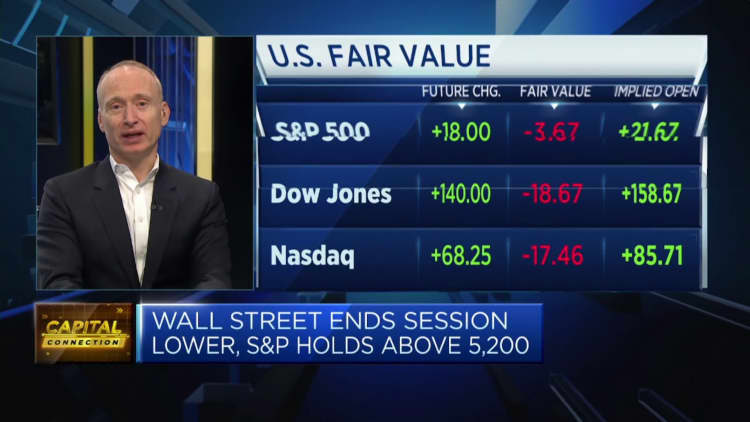
UBS discusses outlook for U.S. rates and stock market

Buybacks take place when firms purchase their own shares on the stock exchange, reducing the portion of shares in the hands of investors. They offer a way for companies to return cash to shareholders — along with dividends — and usually coincide with a company’s stock moving higher, as shares get scarcer.

UBS has undertaken the mammoth task of integrating Credit Suisse’s business, after announcing in late March 2023 that former chief Sergio Ermotti would return for a second spell as CEO.

Figures last week showed that Ermotti earned 14.4 million Swiss francs ($15.9 million) in 2023, following his surprise return. The bank in February reported a second consecutive quarterly loss on the back of integration costs, but continued to deliver strong underlying operating profits.

Shares are up more than 6% so far this year.

— CNBC’s Elliot Smith contributed to this article.

Continue Reading

Finance

Private Credit Expansion and Regulatory Oversight in 2026 Capital Markets

Published

on

The global private credit market has solidified its role as a fundamental pillar of enterprise finance, expanding rapidly across middle-market lending, asset-backed finance, and infrastructure financing. As non-bank financial institutions capture a larger share of corporate debt origination, global regulatory bodies are increasing oversight to evaluate market transparency and systemic risk interconnections.

Growth Drivers in Direct Lending
Direct lending platforms have continued to attract substantial institutional allocations from pension funds, sovereign wealth entities, and insurance companies seeking attractive risk-adjusted yields. Private debt funds offer corporate borrowers customized financing structures, faster execution timelines, and confidentiality compared to syndicated loan markets.

In 2026, private credit managers are increasingly financing larger corporate transactions, providing multi-billion-dollar credit facilities for buyout deals and corporate restructurings. The flexibility of private debt contracts—featuring unitranche pricing and tailored covenant packages—has made direct lending the preferred capital source for middle-market enterprise sponsors.

Regulatory Scrutiny and Systemic Risk Assessment
The rapid growth of non-bank intermediation has drawn heightened scrutiny from financial regulators in North America and Europe. Because private debt agreements are negotiated privately without public exchange disclosures, central banks are evaluating potential vulnerabilities related to asset valuation consistency and fund liquidity profiles.

Regulatory agencies are introducing guidelines aimed at improving reporting standards for private investment vehicles managing institutional assets. Key focus areas include monitoring leverage ratios within private credit funds and evaluating indirect credit exposures between commercial banking institutions and private debt funds.

Navigating Elevated Refinancing Costs
With benchmark interest rates remaining elevated, private debt borrowers face higher debt service obligations on floating-rate credit facilities. Financial advisory firms report an increase in proactive liability management strategies, including payment-in-kind (PIK) interest options, equity infusions from sponsors, and covenant modifications.

Private credit managers with deep operational capabilities are actively working alongside portfolio companies to optimize working capital and maintain cash flow coverage ratios during periods of higher borrowing costs.

Key Financial Takeaways
1. Mainstream Asset Class: Private credit has expanded beyond niche alternative asset status into a core corporate finance solution.
2. Enhanced Transparency Standards: Regulatory frameworks are evolving toward greater disclosure requirements for private debt managers.
3. Proactive Risk Management: Lenders and sponsors must prioritize debt sustainability and active portfolio monitoring amid high benchmark rates.

Continue Reading

Finance

Venture Capital and Startup Valuations in 2026: Focus on Unit Economics and Sustainable Growth

Published

on

The global venture capital (VC) ecosystem is operating under a disciplined investment framework in 2026. Following years of valuation adjustments and shifting liquidity environments, venture capital firms and private equity investors are prioritizing proven unit economics, positive cash flow pathways, and capital efficiency over rapid, unconstrained user acquisition.

The Shift Toward Disciplined Startup Valuations
Early-stage and growth-stage startup valuations have stabilized at sustainable historical averages. Venture capital partners are conducting rigorous due diligence processes before deploying capital, scrutinizing gross margins, customer acquisition costs (CAC), net revenue retention (NRR), and lifetime value (LTV) metrics.

While total capital deployed remains robust, seed and Series A funding rounds are taking longer to finalize. Founders are expected to demonstrate clear product-market fit and defensible intellectual property rather than relying on top-line revenue projections unsupported by strong underlying economics.

M&A Activity and Liquidity Solutions
The market for venture-backed exits is seeing renewed momentum through strategic mergers and acquisitions (M&A) and secondary market liquidity facilities. Established corporate enterprises are acquiring high-performing technology startups to integrate proprietary artificial intelligence models and specialized software solutions into their product ecosystems.

Simultaneously, secondary market transactions have become an essential liquidity mechanism for early employees and institutional investors. Specialized secondary funds are purchasing pre-IPO shares at discounted valuations, providing liquidity opportunities while companies remain private for longer durations.

Sector Allocation: Deep Tech, Clean Energy, and Enterprise Automation
Venture capital investment is heavily concentrated in deep technology and capital-intensive engineering sectors. High-growth investment themes include:
– Next-Generation Semiconductors: Hardware startups designing specialized AI processors and energy-efficient microchip architectures.
– Clean Technology: Battery chemistry innovations, carbon capture solutions, and grid-scale energy storage startups.
– Enterprise Process Automation: Software platforms that automate complex workflows in healthcare, financial services, and industrial logistics.

Key Insights for Entrepreneurs and Investors
1. Prioritize Capital Efficiency: Startups focused on achieving operational profitability receive higher valuation premiums from institutional investors.
2. Strategic Exit Planning: Corporate M&A is serving as a primary exit route for venture-backed startups navigating prolonged IPO windows.
3. Focus on High-Moat Technologies: Deep tech and proprietary software architectures are securing the majority of growth-stage capital allocations.

Continue Reading

Finance

The Evolution of Digital Payments: Cross-Border Settlement and Central Bank Digital Currencies in 2026

Published

on

The infrastructure supporting global commerce is undergoing a major technological upgrade as real-time digital payment rails, cross-border settlement solutions, and Central Bank Digital Currency (CBDC) pilot programs achieve widespread commercial adoption. Financial institutions and fintech developers are reimagining payment processing to eliminate friction, lower transaction fees, and accelerate settlement speed.

Transforming Cross-Border Settlement Infrastructure
For decades, international corporate payments relied on legacy correspondent banking networks characterized by multi-day settlement delays, opaque fee structures, and high foreign exchange markups. In 2026, modern cross-border payment networks are enabling near-instantaneous settlement for international trade transactions.

Financial technology platforms are leveraging distributed ledger technology and real-time gross settlement (RTGS) interconnections to settle transactions in seconds. International trade participants benefit from reduced working capital requirements and minimized foreign exchange volatility risks during cross-border transfers.

Commercial Expansion of Central Bank Digital Currencies
Central banks representing major global economies are advancing CBDC initiatives from research phases into active commercial deployment. Wholesale CBDCs—designed specifically for interbank settlement and financial institution clearing—are demonstrating substantial efficiency gains in domestic and international transactions.

At the retail level, several nations have introduced public digital currency options alongside existing commercial banking networks. These sovereign digital payment channels aim to expand financial inclusion, lower consumer transaction fees, and improve the efficiency of government-to-citizen financial disbursements.

Open Banking and Embedded Finance Ecosystems
Alongside settlement infrastructure upgrades, open banking regulations and embedded finance frameworks are transforming merchant-consumer interactions. Commercial businesses across retail, travel, and business-to-business (B2B) services are integrating seamless payment APIs directly into their customer software interfaces.

Through open banking frameworks, consumers can initiate secure bank-to-bank payments without relying on traditional credit card networks, significantly reducing merchant processing fees. Integrated Buy-Now-Pay-Later (BNPL) options and point-of-sale credit facilities continue to expand, driving higher conversion rates for digital commerce platforms.

Strategic Financial Takeaways
1. Treasury Optimization: Corporate treasurers should leverage instant cross-border payment platforms to minimize liquidity buffers and foreign exchange exposure.
2. CBDC Integration: Financial institutions must prepare internal core banking systems to interface with emerging wholesale CBDC payment rails.
3. Merchant Fee Reduction: Enterprise merchants can lower payment processing overhead by adopting account-to-account (A2A) open banking checkout solutions.

Continue Reading

Trending