
Personal Finance
Take a look inside a $1.1 million ‘zero emissions’ home

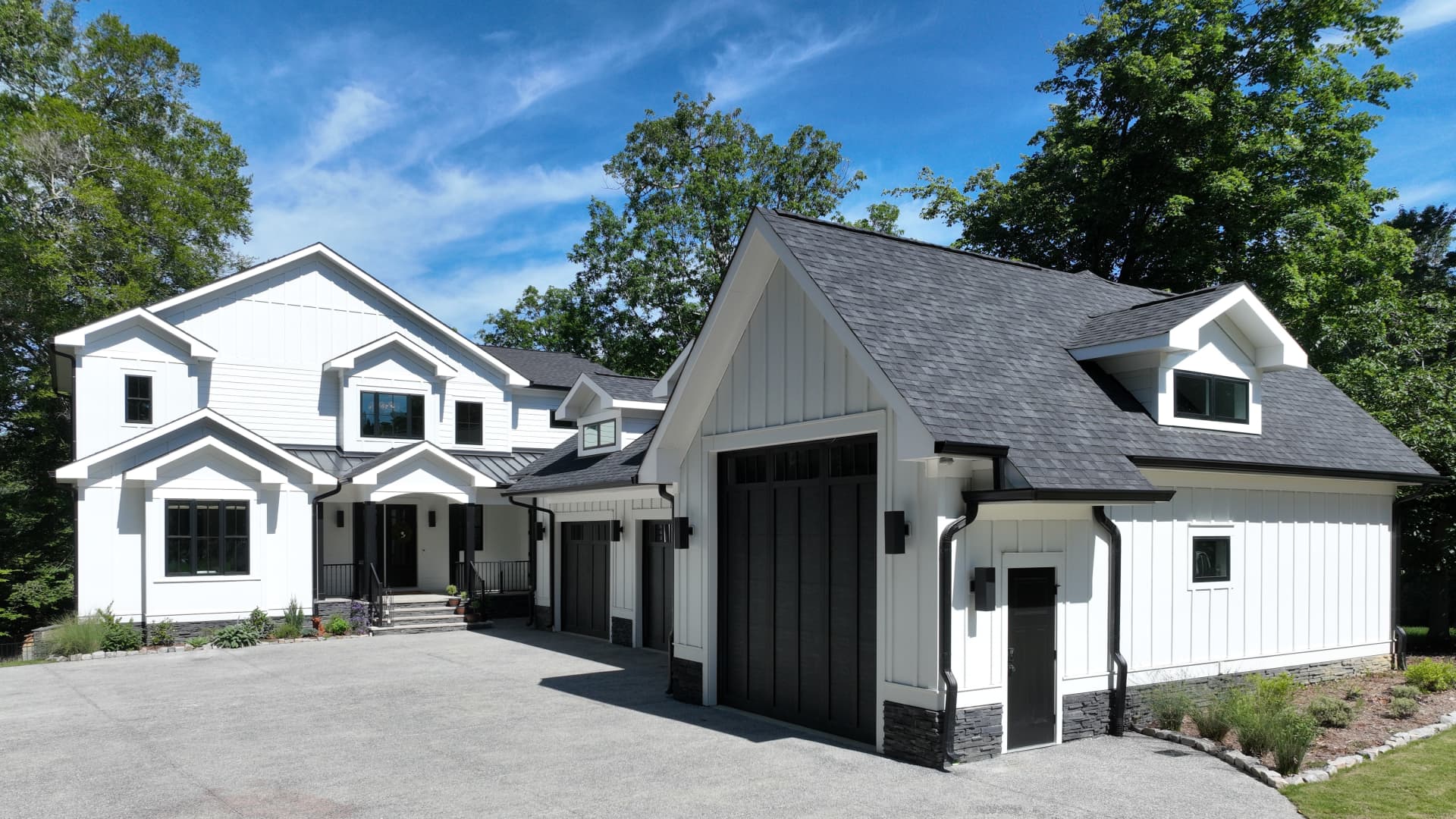
Courtesy: Wojciechowski Family
Real estate is a key puzzle piece in achieving the U.S.’ climate goals, according to federal officials.
Residential and commercial buildings account for 31% of the nation’s greenhouse gas emissions, after accounting for “indirect” emissions like electricity use, according to the Environmental Protection Agency. That’s more than other economic sectors like transportation and agriculture.
The Biden administration has adopted various policies to cut residential emissions.
The Inflation Reduction Act, enacted in 2022, offers financial benefits including tax breaks and rebates to homeowners who make their homes more energy-efficient, for example. The White House also recently issued guidelines for buildings in order to be considered “zero emissions,” meaning they are “energy efficient, free of onsite emissions from energy use and powered solely from clean energy,” according to the Department of Energy.
More from Personal Finance:
How EVs and gasoline cars compare on total cost
Here’s how to buy renewable energy from your electric utility
8 easy — and cheap — ways to cut your carbon emissions
Morgan Wojciechowski, 33, is among the first homeowners to get that federal “zero emissions” label. (That assessment was bestowed by the third-party firm Pearl Certification.)
Wojciechowski, her husband Casey, and their three dogs — Dixie, Bo and Charlie — moved into the newly built residence in Williamsburg, Virginia, in August 2023.
Wojciechowski, who is also the president of Healthy Communities, a local real-estate developer focused on sustainable construction, spoke with CNBC about her new home, its financial benefits and how consumers can best upgrade their homes to be more efficient.
The conversation has been edited and condensed for clarity.
Morgan Wojciechowski and her husband Casey.
Courtesy: Wojciechowski Family
Greg Iacurci: What does it mean for your home to be considered ‘zero emissions’?
Morgan Wojciechowski: It’s a very, very, very highly efficient home that’s all-electric. Those are kind of the first two bullet points of the White House definition.
The third part is we are part of the green energy program with [our power provider] Dominion. Not only am I producing solar [energy] and any excess is going back onto the grid, but the power from the grid coming into my home is clean and sustainable. It’s about $10 extra a month for me to get that clean energy.
GI: How much did your house cost to build?
MW: Like $1.1 million.
GI: And how big is the house?
MW: 5,800 square feet.
It’s a large home. But mine is not what everybody’s doing. My home was my personal project because I believe in sustainability and wanted to do it in a home that would be my forever home. But one that’s more replicable would be like what [Healthy Communities] builds at Walnut Farm, which is like 1,500 square feet. We’re selling it for $433,000.
GI: Can you break down your home’s estimated savings?
MW: Our utility bills are projected to be about $917 a year with [solar] panels, or around $80 a month.
The annual savings are $7,226 [relative to an average U.S. home, according to rater TopBuild Home Services]. That’s just from the efficiency of the home with solar.
If you took the solar production away, I would be saving $5,431 annually. The solar offsets it.
Courtesy: Wojciechowski Family
Courtesy: Wojciechowski Family
Courtesy: Wojciechowski Family
Courtesy: Wojciechowski Family
Courtesy: Wojciechowski Family
GI: What do you mean solar offsets it?
MW: You create energy. Your home uses that energy and sends excess energy back to Dominion. Those credits are stored in an account, and then those credits offset your bill. It’s called net metering.
GI: So the power company is paying you that money?
MW: Those credits are applied to your next billing cycle. They offset your overall utility bill, and that’s where your savings come in.
Solar panels only make sense if you build an energy-efficient home that’s really all-electric.
Courtesy: Wojciechowski Family
GI: Why is that?
MW: You have to have a home that’s constructed energy-efficiently enough or retrofitted — by replacing your windows with higher-grade windows, adding insulation — so that you will need fewer panels on your rooftop, so you have a quicker return on your investment. Solar only makes sense if you’re going to have a return on your investment within a few years.
GI: That makes solar more attractive?
MW: If you don’t do energy-efficient upgrades to a pre-existing home or if you don’t build a home that’s energy-efficient enough, you have to add more panels to compensate for the lack of energy efficiency. And if that number gets too big it turns people upside down.
Solar has to make sense with the home that you’re putting it on, or else, don’t do it. Maybe just upgrade your windows, add insulation, condition your crawl space, upgrade your mechanical systems.

There are a lot of things consumers can do. You don’t have to do it all at one time. You don’t have to have a solar home to be zero emissions; you have to have an energy-efficient house that’s all-electric, and you have to buy renewable energy from your utility company.
That’s extremely approachable. Lots of people can do that. Everybody can join in at their level of sustainability.
GI: How do you recommend people get started?
MW: I would tell a consumer, why don’t you start with windows and doors. That’s a very easy one. Do that and see how you notice any [efficiency] changes.
In a lot of older homes windows are very old and they leak. Air is coming in and out. If you think about it, a house is like an envelope. You you want to seal the inside of your home the best that you can.
I would hit insulation next.
A lot of older homes have HVAC systems, duct work inside of their attic. Insulate it so that it’s a conditioned space, so that those building systems don’t have to work in overdrive to keep up with really hot temperatures or really cold temperatures. That keeps it more energy efficient.
And there are tax incentives [available] for energy-efficient upgrades to your home. Consumers can get and write them off, so that’s attractive to people as well.
GI: If you’re a renter, there are certain things that are out of your control. I suppose you can ask your landlord.
MW: Depending upon what your rental situation is. I feel like that’s a little bit more daunting, to change someone else’s mind. Once you get to your own home, eventually, then you have more say of what you can do.
Until then, you could be mindful about the energy you use. Turn lights off. I mean, that’s a real thing. People don’t turn lights off. I mean, even though I have a really efficient home, I have timers on things because I don’t want to be wasting energy. That’s an easy one that anybody could do.


Personal Finance
Next-Generation Retirement Planning: Managing Longevity Risk and Variable Income Streams


U.S.- Canada Trade Talks Collapse; Carney Says Retaliatory Tariffs Begin September 8

Flock Cameras and the Future of Public Security

AI Infrastructure Boom Hits Physical Limits: Power, Financing, and Supply Chain Strain

Armanino adds Strategic Accounting Outsourced Solutions

New 2023 K-1 instructions stir the CAMT pot for partnerships and corporations

Tax Strategy: Employee Retention Credit update
-

 Stock News1 week ago
Nvidia Q2 FY2027 Earnings beats Wall Street Expectation with Record $96.2 Billion Revenue
-
 Technology6 days ago
AI Infrastructure Boom Hits Physical Limits: Power, Financing, and Supply Chain Strain
-
 Economics4 days ago
U.S.- Canada Trade Talks Collapse; Carney Says Retaliatory Tariffs Begin September 8
-
 Technology4 days ago
Flock Cameras and the Future of Public Security