
Personal Finance
Taylor Swift’s engagement ring could spark trends, challenge shoppers


Travis Kelce, left, and Taylor Swift react as the Edmonton Oilers and the Florida Panthers play during the first period in Game 4 of the 2025 Stanley Cup Final at Amerant Bank Arena in Sunrise, Florida, on June 12, 2025.
Bruce Bennett | Getty Images
Global popstar Taylor Swift and NFL player Travis Kelce are officially engaged — with a large diamond ring to prove it. But Swifties hoping to emulate the style may find it challenging to do so, experts say.
After a two-year relationship, Swift and Kelce announced their engagement through an Instagram post on their official accounts on Tuesday.
In the photos of their social media post appears a hard-to-miss diamond on Swift’s finger, a style that’s known as an old mine brilliant cut, Tree Paine, Swift’s publicist, told The Associated Press. The ring was designed by Kindred Lubeck at Artifex Fine Jewelry in New York City.
More from Personal Finance:
Couples leverage ‘something borrowed’ to cut wedding costs
Some couples are having ‘micro weddings’
How to use credit cards to pay for your wedding
“It looks to be upwards of 10 carats, and it might be a vintage stone given the cut,” Paul Zimnisky, a New York-based diamond industry analyst, said via email. “Given the quality of the diamond and the size, it could easily be worth hundreds of thousands.”
Jared Jewelers told CNBC through a written statement that the ring could cost approximately $250,000 to $500,000.
However, “no one knows for sure,” said Amanda Gizzi, senior vice president of corporate affairs at industry group Jewelers of America.
It’s “a lot of speculation at this point,” she said.
‘This ring aligns to recent trends’
While Swift’s ring was designed for her, it wouldn’t be unusual to see replicas or similar styles appear across the market, said Zimnisky. (The trend-setting Swift’s engagement moved several stocks this week, including names related to jewelry and apparel, amid fan interest in her ring and engagement dress.)
A comparable diamond, meanwhile, may be harder to come by.
Old mine diamonds have a “distinct elongated shape with curved edges” and go back to the time when diamonds were cut, shaped and polished by hand, according to Sarah Hanlon, celebrity and entertainment editor of The Knot, a bridal site.
“Due to their rarity, true old mine diamonds can be harder to source,” Hanlon said over email.
What’s more, the larger carat weight a stone is, the rarer and more expensive it’s likely to be, Gizzi said, “especially when we’re talking about natural diamonds versus a lab-grown.”
According to Zimnisky, lab-grown diamonds can be found for almost 90% less than the cost of a natural diamond.
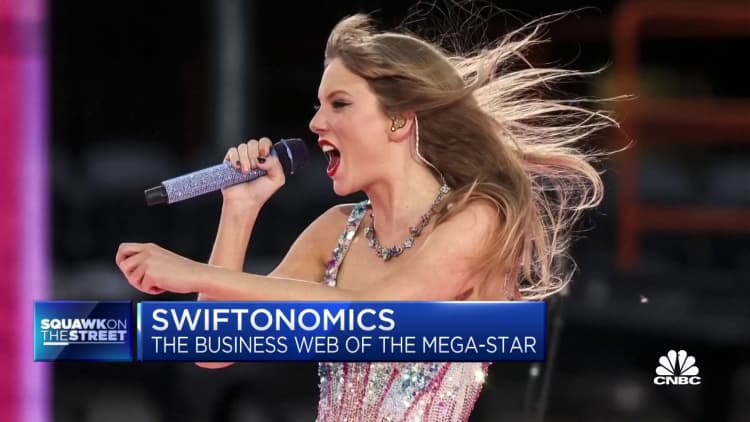
However, experts say the elongated style of the singer’s ring has already been popping up among engaged couples — or as a song by Swift goes, “It’s been a long time coming.”
“This style is very much on trend for what we’ve started to see, which is elongated cuts like hers, as well as a return to natural diamonds and then also this idea of antique cuts,” Gizzi said.
According to Jared Jewelers, “this ring aligns to recent trends in bold gold looks, fancy cuts, and oversized elongated stones.”
In fact, elongated shapes like marquise have been selling for a premium this year due to high demand, said Zimnisky.
‘There’s no wrong way to go about it’
Couples inspired by Swift’s ring can find more affordable versions with less expensive gemstones, said Zimnisky.
While old mine diamonds are rare and can be more costly, diamond shapes like cushions, emeralds and Asschers are easier to come by, said The Knot’s Hanlon.
Couples can also look into the vintage jewelry market, experts say.
“There’s no wrong way to go about it,” said Gizzi. “The inspiration is definitely something that can be found in different price points.”
When shopping for engagement rings, start off by defining your budget. While costs can range widely, the average couple spent $5,200 on an engagement ring, according to The Knot’s 2024 Jewelry and Engagement study.
Instead of rules of thumb like spending “three months’ salary,” your budget should come down to what you’re looking for in a ring, experts say.
When shopping for natural diamonds, the four C’s – the color, carat, clarity and cut – determine the feature of the diamond as well as the price.
Lab-grown diamonds will no longer follow the same rules. In June, the Gemological Institute of America, the organization that designed the widely used grading system, said it will instead use descriptive terms to determine the quality of lab-grown diamonds and classify the gems as either “premium” or “standard.”
The new grading system will be on the market on Oct. 1, said Stephen Morisseau, a spokesperson for the GIA.
Still, when looking at either lab-grown or natural stones, you want to understand the stone’s dimensions, its brilliance, the shape and the weight, said Gizzi.


Personal Finance
Next-Generation Retirement Planning: Managing Longevity Risk and Variable Income Streams


U.S.- Canada Trade Talks Collapse; Carney Says Retaliatory Tariffs Begin September 8

Flock Cameras and the Future of Public Security

AI Infrastructure Boom Hits Physical Limits: Power, Financing, and Supply Chain Strain

Armanino adds Strategic Accounting Outsourced Solutions

New 2023 K-1 instructions stir the CAMT pot for partnerships and corporations

Tax Strategy: Employee Retention Credit update
-

 Stock News1 week ago
Nvidia Earnings Preview: What Wall Street Expects From the AI Bellwether’s Q2 Report
-

 Accounting1 week ago
SEC’s Semiannual Reporting Proposal Faces Investor Pushback: What CFOs Need to Know
-

 Stock News1 week ago
Nvidia Q2 FY2027 Earnings beats Wall Street Expectation with Record $96.2 Billion Revenue
-

 Finance1 week ago
Treasury Bond Volatility Forces Bessent to Double Debt Buyback Size as Yields Swing
-
 Technology5 days ago
AI Infrastructure Boom Hits Physical Limits: Power, Financing, and Supply Chain Strain
-
 Technology3 days ago
Flock Cameras and the Future of Public Security
-
 Economics3 days ago
U.S.- Canada Trade Talks Collapse; Carney Says Retaliatory Tariffs Begin September 8