
Finance
Tesla’s Chinese rival Nio cuts price for new Onvo-branded car

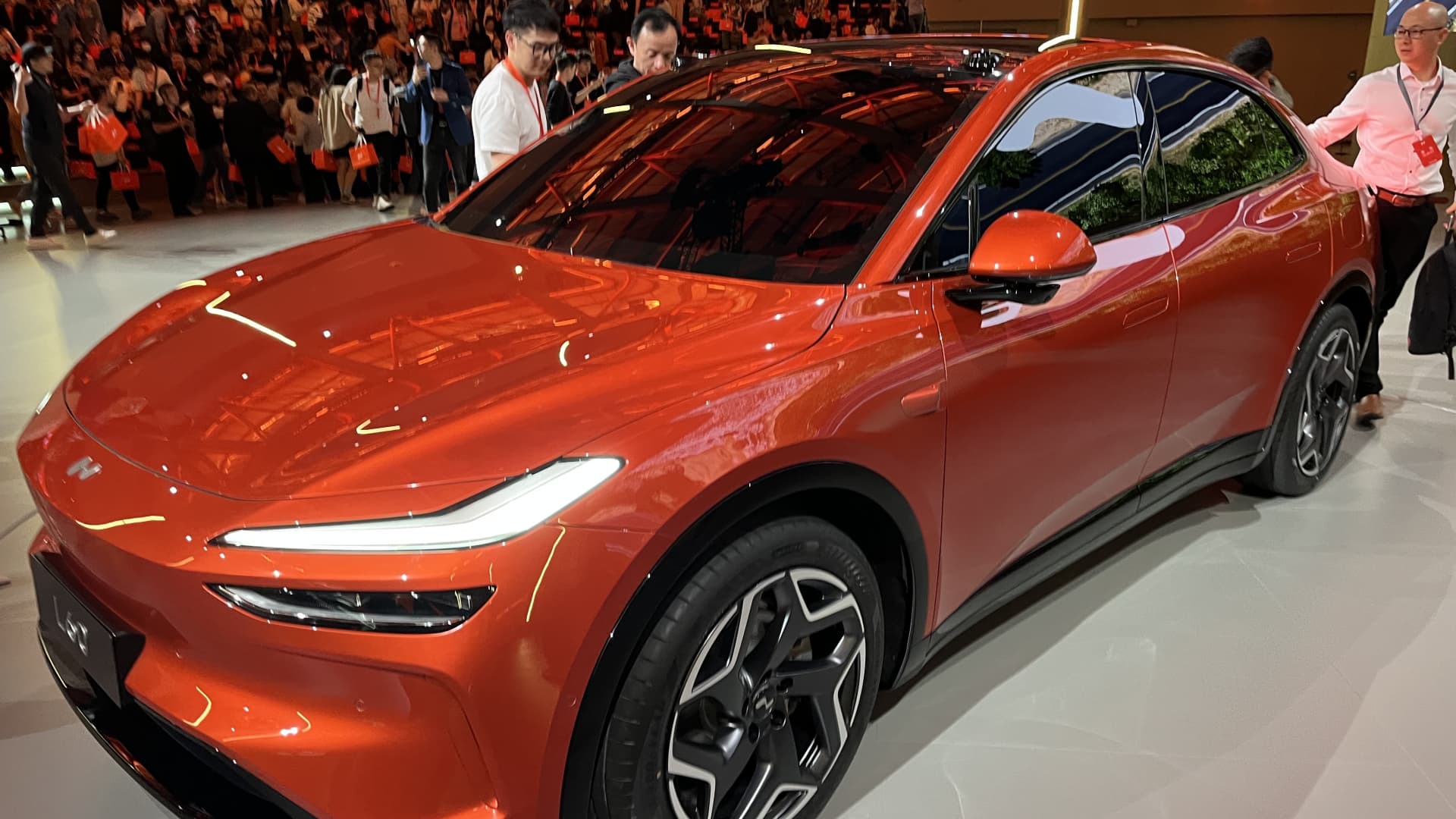
Chinese electric car company Nio launched its lower-cost brand Onvo on Wednesday, May 15, 2024, in Shanghai, China.
CNBC | Evelyn Cheng
HEFEI, China — There’s yet another Chinese electric car aiming to undercut Tesla, with a steeper discount.
Onvo, the lower-priced brand launched by premium electric car company Nio, announced its first car, the L60 SUV, would start as low as 149,900 Chinese yuan ($21,210) when buying battery services via a monthly subscription, starting at 599 yuan. That’s the equivalent to just over $1,000 a year for “renting” the battery.
A model with the battery and the car starts at 206,900 yuan. Deliveries are set to begin Sept. 28.
Nio shares briefly rose by more than 3.5% in U.S. trading Thursday after the Onvo L60 launch.
When Nio launched the Onvo brand in May, the company said the L60 would start selling at 219,900 yuan versus Tesla‘s Model Y at 249,900 yuan.
Geely-backed Zeekr is set to launch its first midsize electric SUV, the Zeekr 7X, in China on Sept. 20, starting at 239,900 yuan.
Xpeng in late August announced its mass market brand Mona would begin sales of its M03 electric coupe in China. The basic version starts at 119,800 yuan, with a driving range of 515 kilometers (320 miles) and some parking assist features.
A version of the Mona M03 with the more advanced “Max” driver assist features and a driving range of 580 kilometers will sell for 155,800 yuan.

In comparison, Tesla’s cheapest car — the Model 3 — costs 231,900 yuan in China, after a price cut in April.
Chinese electric car companies have gradually expanded overseas, often starting with Europe. However, the European Union is nearing the end of a process that would increase tariffs on imported Chinese-made battery electric cars starting in early November. The bloc began an investigation into the Chinese EV makers’ use of subsidies last year.
Nio cooperated with the EU’s probe but was not sampled, meaning its cars would be subject to a 20.8% duty, as of a July announcement from the European Commission. That’s higher than the 19.9% tariffs slated for Geely cars, and 17.4% for BYD’s.
In the fourth quarter, Nio plans to start deliveries in the United Arab Emirates, CEO William Li told investors on an earnings call on Sept. 5.
“Because of the tariff in Europe now, selling or exporting cars from China to Europe becomes more expensive,” Li said, according to a FactSet transcript.
“So we will focus on the existing five European markets that we have already started. We also know that to establish NIO such a premium brand in the European market will also take a longer time, and we are very patient with that.”

“But in the meantime, it doesn’t mean that we have stopped our activities there,” Li said. “Earlier this year, we have just opened our NIO house in Amsterdam, and we are still installing and deploying our power swap stations in Europe.”
He expects the L60 to reach 10,000 monthly deliveries in December, and 20,000 vehicle deliveries a month next year. He anticipates 15% vehicle margin on the new Onvo-branded cars.
The brand aims to have more than 200 stores in China by the end of this year, and already opened more than 100 as of early September.
Li said on the earnings call that Onvo and Firefly, an even lower-priced brand set to begin deliveries next year, would look to release vehicles for the international market.
— CNBC’s Sonia Heng contributed to this report.





Treasury Bond Volatility Forces Bessent to Double Debt Buyback Size as Yields Swing

Nvidia Earnings Preview: What Wall Street Expects From the AI Bellwether’s Q2 Report

SEC’s Semiannual Reporting Proposal Faces Investor Pushback: What CFOs Need to Know

Armanino adds Strategic Accounting Outsourced Solutions

New 2023 K-1 instructions stir the CAMT pot for partnerships and corporations

Tax Strategy: Employee Retention Credit update
-

 Economics1 week ago
U.S. Retail Sales Fall for the First Time in Nine Months as Consumer Spending Slows
-
 Economics1 week ago
Nvidia’s Potential $3 Billion SB Energy Investment Could Reshape AI Infrastructure
-

 Economics4 days ago
Top 10 Largest Economies by 2030: IMF & World Bank GDP Projections for Global Powerhouses
-
 Stock News4 days ago
How to understand Intel $15B Stock Offering
-

 Technology1 week ago
U.S.-China AI Competition Intensifies as Washington Pushes Allies to Choose Sides
-

 Economics4 days ago
Economic Profile of the United States of America (2026–2030 Horizon)
-

 Leaders3 days ago
Jackson Hole 2026: What the First Symposium Under Fed Chair Kevin Warsh Means for Markets
-
 Economics3 days ago
U.S. National Debt Surpasses $40 Trillion for the First Time: What It Means for the Economy