
Personal Finance
Trump big beautiful bill’s ‘no tax on tips’ — what workers need to know

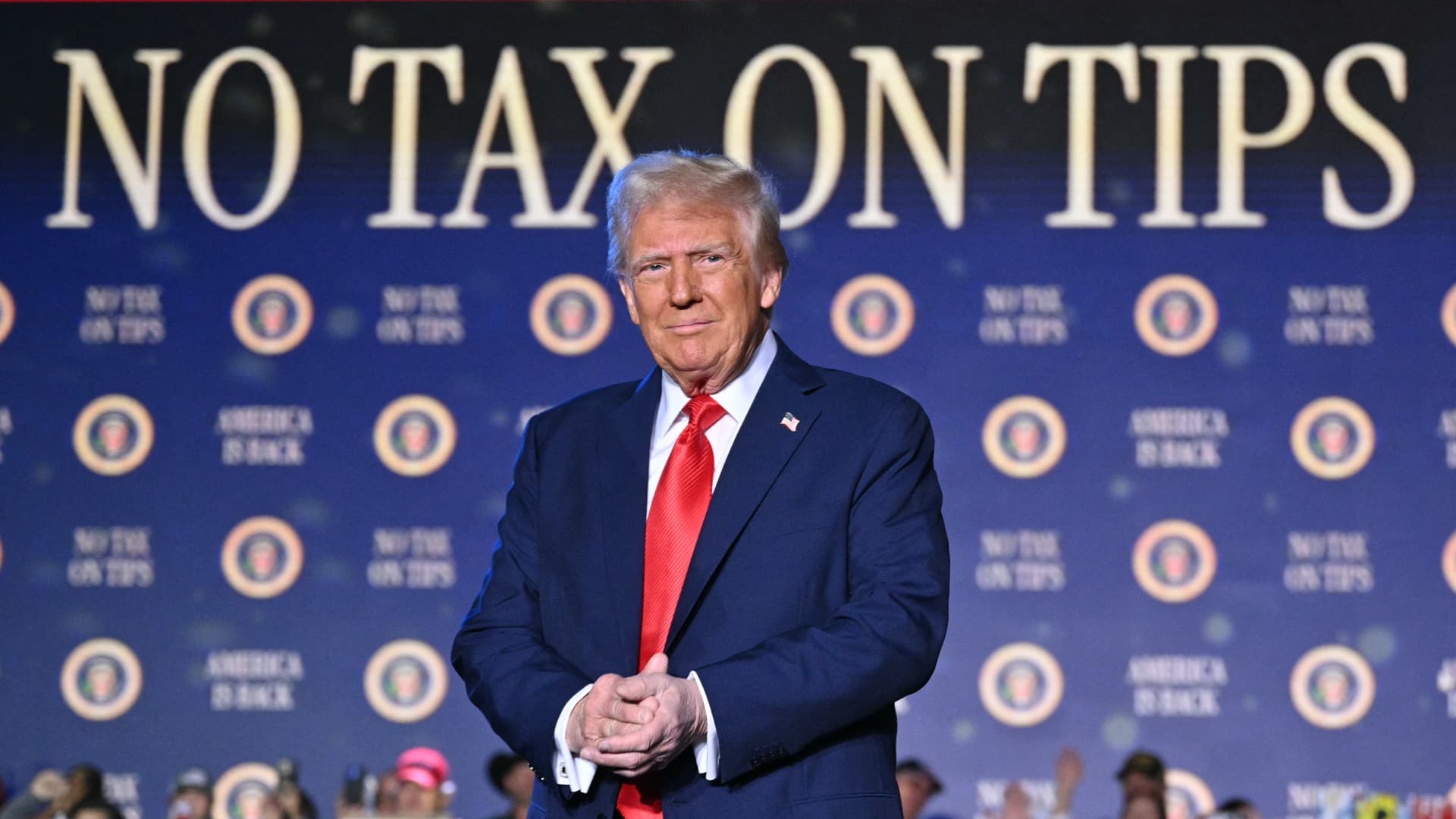
US President Donald Trump arrives to speak on his policy to end tax on tips in Las Vegas, Nevada, on January 25, 2025.
Mandel Ngan | Afp | Getty Images
President Donald Trump’s “big beautiful bill” includes a section called “no tax on tips” — an idea that both Republicans and Democrats floated during the 2024 campaign.
Now that the provision has been enacted, questions remain about how the tax break works and who qualifies.
Despite its name, “no tax on tips” doesn’t eliminate tax on tips, which are still subject to payroll and state taxes. Instead, it’s a deduction worth up to $25,000. The tax break is available from 2025 through 2028. It phases out, or gets reduced, once modified adjusted gross income exceeds $150,000.
However, the IRS needs to clarify which occupations qualify, which is expected to come in early October, according to the agency.
Meanwhile, “we’re looking at a crystal ball” for guidance, said Larry Gray, a Missouri-based certified public accountant who serves as IRS liaison for the National Association of Tax Professionals.
More from Personal Finance:
Trump’s ‘big beautiful bill’ caps student loans. What it means for you
Why 22 million people may see a ‘sharp’ increase in health premiums in 2026
Trump’s ‘big beautiful bill’ cuts SNAP for millions of families: Report
In 2023, there were roughly 4 million U.S. workers in tipped occupations, representing 2.5% of all employment, according to estimates from The Budget Lab at Yale University.
The cohort of workers who qualify for the tax break is even smaller — actors, musicians and singers, directors and playwrights — are included among the professions that are already prohibited under the legislation’s text.
Here’s a breakdown of what to know about Trump’s tip deduction.
What counts as ‘qualified tips’
As written, “qualified tips” are cash tips an employee earns. This includes tips a customer offers in cash or added to a credit card charge, as well as payouts under a tip-sharing arrangement.
Yet, the law also says that the tip must be paid voluntarily and determined by the customer or payor, which can put other forms of gratuities or mandatory service charges in question.
“It’s an entirely voluntary transaction,” said Alex Muresianu, a senior policy analyst at the Tax Foundation.
For example, the definition may exclude mandatory service fees, such as an automatic gratuity a restaurant might tack on for a large dining party.
“Based on the plain text of the law, it’s hard to argue that that’s something that’s given voluntarily,” said certified financial planner and enrolled agent Ben Henry-Moreland, a certified financial planner with advisor platform Kitces.com, who analyzed the legislation.
Tips must be ‘properly reported’
To qualify for the deduction, tips must be “properly reported,” according to Melanie Lauridsen, AICPA’s vice president of tax policy & advocacy.
That means employers must report the worker’s tips on so-called information returns — such as Form W-2 or 1099 — with a copy going to the employee and the IRS.
However, Trump’s legislation also increased the income thresholds for certain information returns. That could raise eligibility questions for tipped workers who don’t get a form.
For example, Form 1099-K reports business transactions from apps, such as PayPal or Venmo, along with gig economy platforms like Uber or Lyft. For 2025, the 1099-K reporting threshold returns to $20,000 and 200 transactions. Previously, the threshold was $2,500 for 2025.
Starting in 2026, the threshold for 1099-NEC, which reports contract income, jumps from $600 to $2,000.
However, there is also uncertainty about whether workers fully disclose cash tips to their employer and the IRS.
“The elephant in the room around this whole ‘no tax on tips’ provision is, so many tips go unreported to begin with,” said Henry-Moreland.



Personal Finance
Next-Generation Retirement Planning: Managing Longevity Risk and Variable Income Streams


U.S.- Canada Trade Talks Collapse; Carney Says Retaliatory Tariffs Begin September 8

Flock Cameras and the Future of Public Security

AI Infrastructure Boom Hits Physical Limits: Power, Financing, and Supply Chain Strain

Armanino adds Strategic Accounting Outsourced Solutions

New 2023 K-1 instructions stir the CAMT pot for partnerships and corporations

Tax Strategy: Employee Retention Credit update
-

 Stock News1 week ago
Nvidia Earnings Preview: What Wall Street Expects From the AI Bellwether’s Q2 Report
-

 Accounting1 week ago
SEC’s Semiannual Reporting Proposal Faces Investor Pushback: What CFOs Need to Know
-

 Stock News1 week ago
Nvidia Q2 FY2027 Earnings beats Wall Street Expectation with Record $96.2 Billion Revenue
-

 Finance1 week ago
Treasury Bond Volatility Forces Bessent to Double Debt Buyback Size as Yields Swing
-
 Technology5 days ago
AI Infrastructure Boom Hits Physical Limits: Power, Financing, and Supply Chain Strain
-
 Technology3 days ago
Flock Cameras and the Future of Public Security
-
 Economics3 days ago
U.S.- Canada Trade Talks Collapse; Carney Says Retaliatory Tariffs Begin September 8