
Accounting
Trump floats more EU, Canada tariffs if they work against US

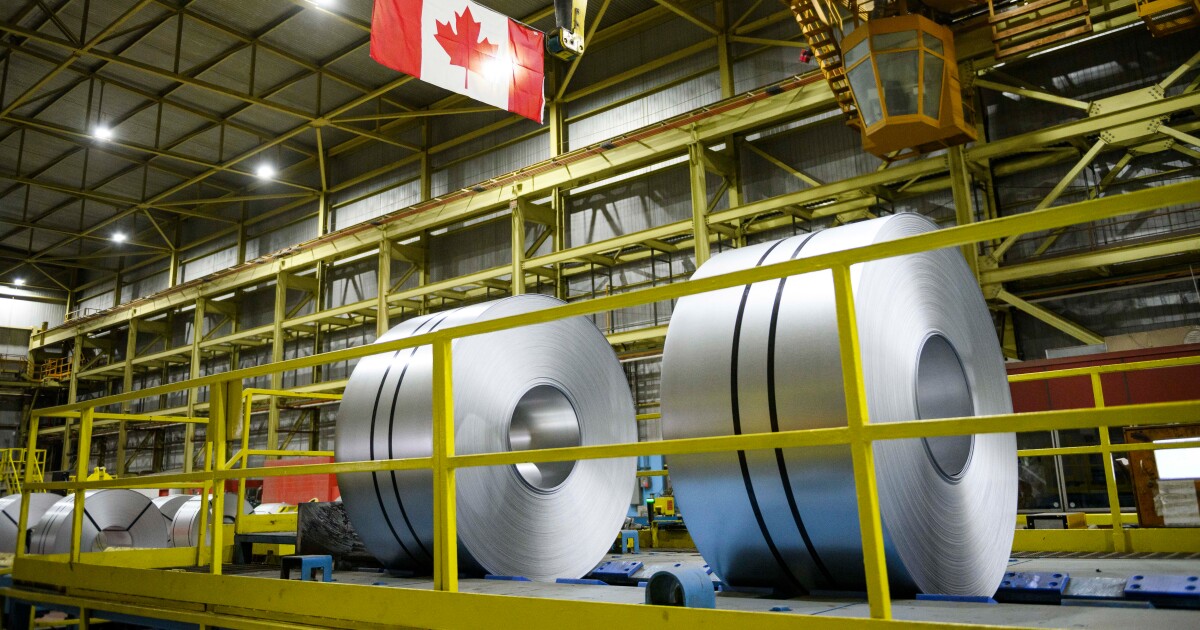

President Donald Trump suggested further tariffs would be imposed on the European Union and Canada if they worked together “to do economic harm” to the U.S.
In a late night Truth Social post, Trump said large-scale tariffs “far larger than currently planned” would be placed on them in such a scenario. The euro briefly pared a small gain and the Canadian dollar dipped.
“If the European Union works with Canada in order to do economic harm to the USA, large scale Tariffs, far larger than currently planned, will be placed on them both in order to protect the best friend that each of those two countries has ever had!” Trump posted.
Trump signed an order on Wednesday
The EU is preparing countermeasures in response. France has urged the European Commission, which handles trade matters for the bloc, to consider using its toughest trade weapon — the anti-coercion instrument – for the first time, Bloomberg reported earlier.
In preparation for Trump’s trade measures, the EU has been sharing notes with some of its like-minded allies, according to senior EU officials who spoke on the condition of anonymity. There’s no indication, however, that the bloc is coordinating its retaliation.
“It is now crucial that the EU delivers a decisive response to the tariffs – it must be clear that we will not back down in the face of the U.S.,” German Economy Minister Robert Habeck said in an emailed statement on Thursday. “Strength and self-confidence are required.”
Trump’s latest comments come after Canadian Prime Minister Mark Carney
“I want to ensure that France and the whole of Europe works enthusiastically with Canada, the most European of non-European countries,” Carney said in Paris.
The EU expects Trump’s reciprocal tariffs next week to be a double-digit rate across the bloc, according to people familiar with the thinking in Brussels. Officials there anticipate that the U.S. will use a single tariff rate for the EU as a whole, rather than setting different levels per member state.
The EU’s trade chief, Maros Sefcovic, and European Commission President Ursula von der Leyen’s head of cabinet met with U.S. Commerce Secretary Howard Lutnick, U.S. Trade Representative Jamieson Greer and Director of the National Economic Council Kevin Hassett this week to discuss the trade situation.
The talks with the U.S. made little headway and there’s little the EU can do to keep the levies from being imposed, said the people, who spoke on the condition of anonymity. An EU response to the U.S. tariffs likely won’t be immediate as the bloc will need to assess the details.
Trump has said the reciprocal levies will rectify non-tariff barriers that he says are unfair, such as domestic regulations and how countries collect taxes, including the EU’s value-added tax. The EU says its VAT is a fair, non-discriminatory tax that applies equally to domestic and imported goods.
Speaking to reporters Wednesday at the Oval Office, Trump said the reciprocal levies would be lower than expected.
“We’re going to make it all countries, and we’re going to make it very lenient,” Trump said. “I think people are going to be very surprised. It’ll be, in many cases, less than the tariff that they’ve been charging us for decades.”
Trump’s charge against the car sector has added more pain to an industry facing a difficult outlook in Europe. New-car registrations in the region during February fell 3.1% from a year earlier to 963,540 units, the European Automobile Manufacturers’ Association said this week, as uncertainty about the economy prompted consumers to hold back on bigger purchases.
Germany is by far the most exposed EU member state, from an automotive tariffs perspective. The U.S. imported $24.8 billion worth of new vehicles from the country last year, almost half the $52.3 billion total shipped in from the bloc.
Porsche AG and Mercedes-Benz Group AG will be hit hardest by President Donald Trump’s latest trade salvo, facing a potential €3.4 billion ($3.7 billion) blow from new U.S. tariffs on imported cars.
Although Volkswagen AG and BMW AG are somewhat insulated because all three manufacture cars in the U.S., the companies ship hundreds of thousands of high-value vehicles into the country every year. Several European brands, including Ferrari, are entirely reliant on imports.
Other automakers affected by higher tariffs on cars imported from the EU include Stellantis NV, the maker of Jeep, Alfa Romeo and Fiat; Tata Motors Ltd.’s Jaguar Land Rover; and Volvo Car AB.





Jackson Hole 2026: What the First Symposium Under Fed Chair Kevin Warsh Means for Markets

U.S. National Debt Surpasses $40 Trillion for the First Time: What It Means for the Economy

How to understand Intel $15B Stock Offering

Armanino adds Strategic Accounting Outsourced Solutions

New 2023 K-1 instructions stir the CAMT pot for partnerships and corporations

Tax Strategy: Employee Retention Credit update
-

 Economics1 week ago
U.S. Retail Sales Fall for the First Time in Nine Months as Consumer Spending Slows
-

 Accounting1 week ago
AI-Driven Automation and Continuous Accounting Frameworks
-

 Finance1 week ago
Cross-Border Settlement Innovation and Real-Time Payment Architecture
-

 Economics1 week ago
Macroeconomic Impact of Global Energy Shocks and Shipping Route Realignment in 2026
-

 Economics7 days ago
Nvidia’s Potential $3 Billion SB Energy Investment Could Reshape AI Infrastructure
-

 Personal Finance1 week ago
Navigating Residential Real Estate and Mortgage Strategy
-

 Leaders1 week ago
Modern Executive Leadership: Navigating Hybrid Work Dynamics and Outcome-Based Governance
-

 Economics2 days ago
Top 10 Largest Economies by 2030: IMF & World Bank GDP Projections for Global Powerhouses