
Personal Finance
Trump-fueled backlash ‘intensified’ flight from ESG funds

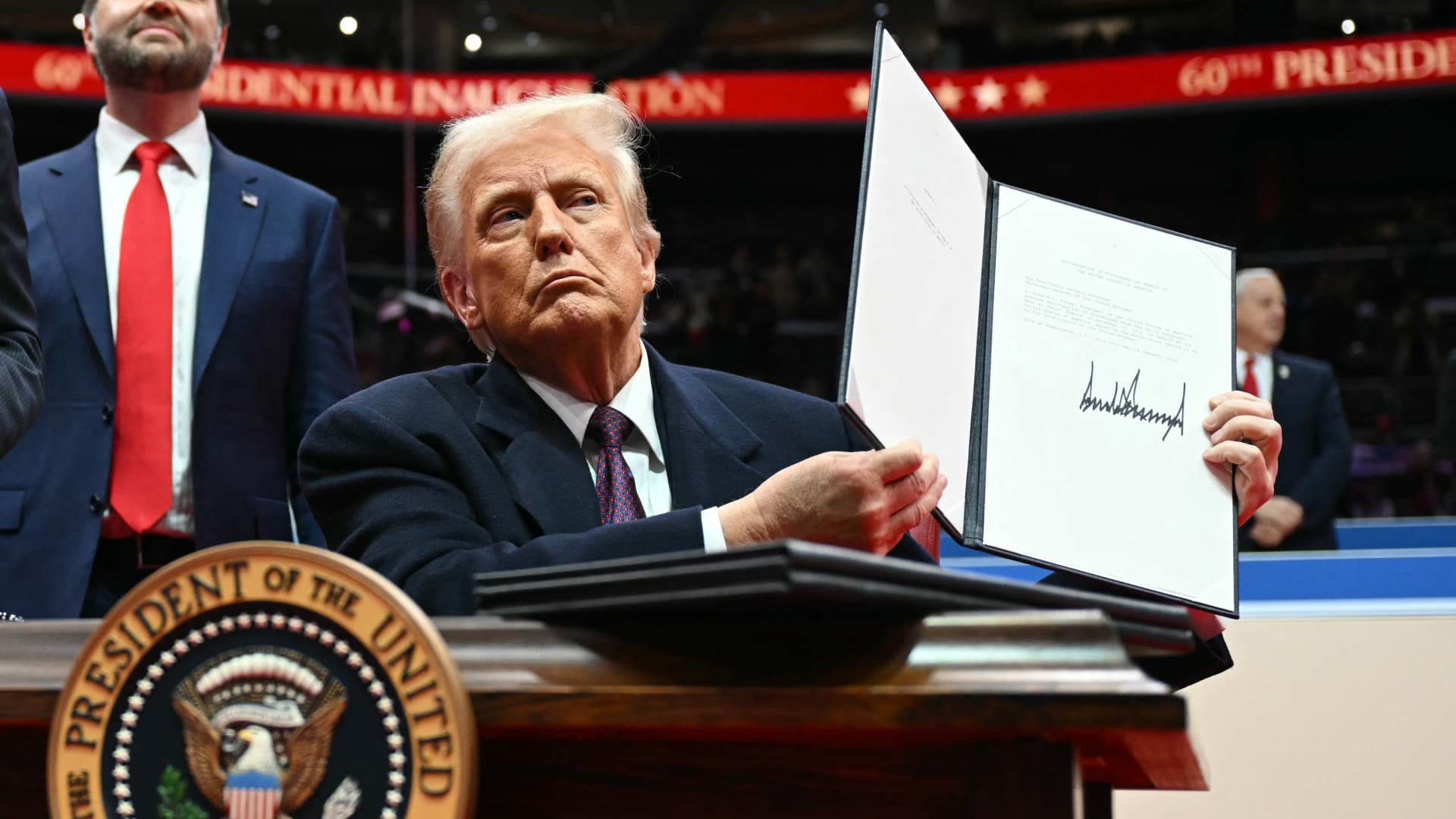
US President Donald Trump holds letter to the UN stating the US withdrawal from the Paris Agreement during the inaugural parade inside Capital One Arena, in Washington, DC, on January 20, 2025.
Jim Watson | Afp | Getty Images
Investors have continued to pull money from so-called ESG funds in early 2025 amid an “intensifying” backlash fueled by President Trump’s “anti-climate agenda” and his administration’s policies targeting diversity, equity and inclusion initiatives, according to a new Morningstar report.
Also known as socially responsible, sustainable, impact or values-based investing, “environmental, social and governance” funds let people invest according to certain values like climate change or corporate diversity.
Investors withdrew $6.1 billion from ESG funds in the first three months of 2025, after yanking out $4.3 billion in Q4 2024, according to Morningstar.
More from Personal Finance:
Consumers are spending as trade wars raise recession risk
Where young adults are most likely to live with parents
Consumers making financial changes in response to tariffs
The exodus in Q1 marked the 10th consecutive quarter of outflows.
“The continued loss of appetite among US investors for sustainable funds can be partly attributed to an anti-ESG backlash, which has intensified since the return of President Trump to the White House,” according to the report.
As of the end of Q1, U.S. investors held $330 billion in ESG funds, about 10% of the global total.
Pushback against climate, DEI policies
Yaorusheng | Moment | Getty Images
Even before Trump took office, persistently high interest rates weighed on performance in segments of the ESG market, like clean energy and other “green” stocks, according to Morningstar. Higher borrowing costs burden the renewables sector because the projects can be capital-intensive.
But Trump added additional pressure.
Within days of his inauguration, Trump announced the U.S. would withdraw from the Paris agreement, blocked subsidies for electric vehicles, pushed for more fossil-fuel production and started a “huge pushback” against DEI policies, Diana Iovanel, a senior markets economist at Capital Economics, wrote in a research note in March.

In late March, the Republican-led Securities and Exchange Commission stopped defending a climate-change disclosure rule in court. There’s also uncertainty about the fate of the Inflation Reduction Act, a historic climate change mitigation law signed by President Joe Biden.
Even before Trump’s second term began, at least 18 Republican-led states had adopted “anti-ESG legislation,” prompting some large asset managers to “pare back” their ESG efforts, Iovanel wrote.
Trump also signed an executive order to eliminate all DEI-related mandates and programs within the federal government, prompting major corporations like Walmart (WMT), Lowe’s (LOW) and Meta (META) to begin “scaling back their DEI commitments,” Morningstar wrote.
Why Trump isn’t ‘game over’ for ESG
Despite the headwinds, Trump’s agenda “isn’t ‘game over’ for ESG investing,” Iovanel wrote.
Demand for ESG investments “is here to stay” even in the face of political pressure, she wrote.
For one, despite Republican antipathy for ESG investing, it also has ample support, Iovanel wrote. States such as California have implemented pro-ESG regulations, and surveys indicate most large asset managers (including ones in the U.S.) invest in ESG assets despite the apparent controversy, she wrote.
Demand among individual investors also appears relatively high, especially among younger investors, analysts said.
About 84% of individual investors in the U.S. are interested in sustainable investing, according to a 2024 Morgan Stanley survey. Roughly two thirds, 65%, of respondents said their interest had increased in the prior two years.
While critics deride it as “woke” capitalism, advocates say there’s a strong investment thesis for ESG.
Specifically, they argue that ESG investing positions investors for higher long-term returns because companies that adopt such practices are poised to be more resilient, and therefore more successful, than peers.

Personal Finance
Next-Generation Retirement Planning: Managing Longevity Risk and Variable Income Streams


U.S.- Canada Trade Talks Collapse; Carney Says Retaliatory Tariffs Begin September 8

Flock Cameras and the Future of Public Security

AI Infrastructure Boom Hits Physical Limits: Power, Financing, and Supply Chain Strain

Armanino adds Strategic Accounting Outsourced Solutions

New 2023 K-1 instructions stir the CAMT pot for partnerships and corporations

Tax Strategy: Employee Retention Credit update
-

 Stock News1 week ago
Nvidia Earnings Preview: What Wall Street Expects From the AI Bellwether’s Q2 Report
-

 Accounting1 week ago
SEC’s Semiannual Reporting Proposal Faces Investor Pushback: What CFOs Need to Know
-

 Stock News1 week ago
Nvidia Q2 FY2027 Earnings beats Wall Street Expectation with Record $96.2 Billion Revenue
-

 Finance1 week ago
Treasury Bond Volatility Forces Bessent to Double Debt Buyback Size as Yields Swing
-
 Technology5 days ago
AI Infrastructure Boom Hits Physical Limits: Power, Financing, and Supply Chain Strain
-
 Technology3 days ago
Flock Cameras and the Future of Public Security
-
 Economics3 days ago
U.S.- Canada Trade Talks Collapse; Carney Says Retaliatory Tariffs Begin September 8