
Accounting
Trump hails tariffs as economy barrels into trade wars

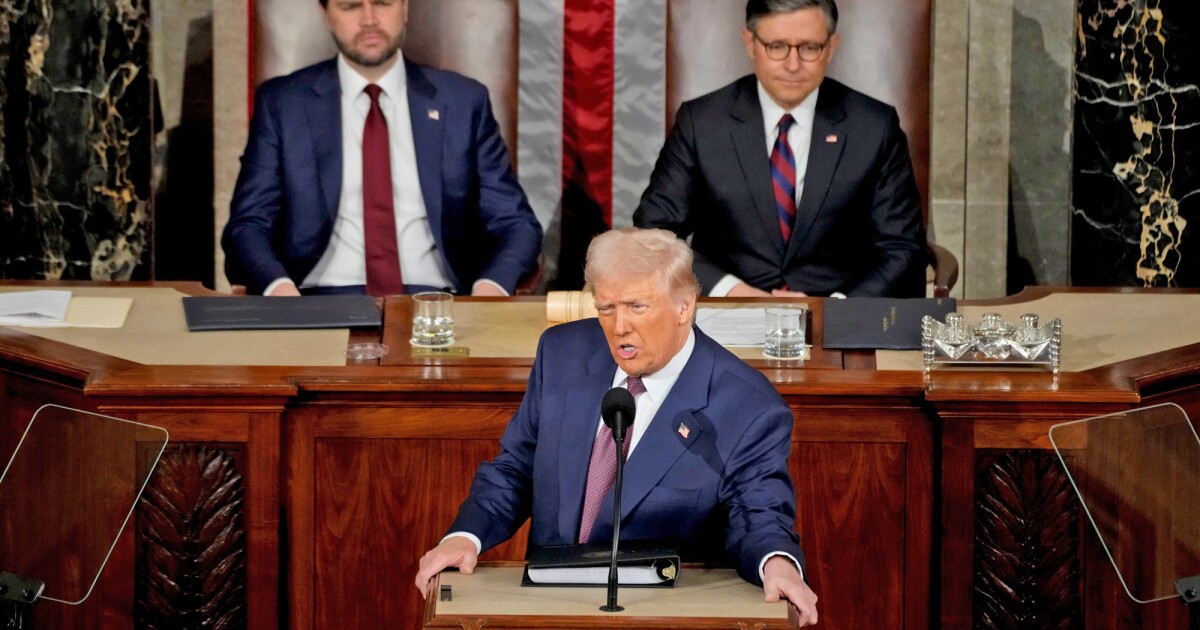

President Donald Trump took the lectern Tuesday for his primetime address beset by warning signs about the U.S. economy, and acknowledged to Americans there could be more discomfort ahead.
Trump defended his plan to remake the world’s largest economy through the biggest tariff increases in a century, saying it would raise “trillions and trillions” in revenue and rebalance trading relationships he called unfair. He cast the economic pain the levies are expected to cause in the form of higher prices as a “little disturbance” the nation ought to be able to overcome.
“Tariffs are about making America rich again and making America great again. And it’s happening, and it will happen rather quickly,” he said. “There’ll be a little disturbance, but we’re OK with that. It won’t be much.”
For large swaths of his record-setting 100-minute joint address to Congress on Tuesday night, though, Trump preferred to spend time on issues he sees as his political strengths. He hammered topics like transgender rights, migrant crime and diversity, equity and inclusion, and said relatively little about consumer prices.
The president proclaimed he was leading a “common-sense revolution,” saying “our country will be woke no longer.”not supported.
Trump turned to inflation only after a 19-minute opener. He blamed high prices for eggs and other goods on his predecessor, Joe Biden, and offered few new ideas to lower costs.
Some of his proposals at times sounded like magical solutions, including complex energy projects that could take years to complete and using savings from Elon Musk’s cost-cutting campaign, which have amounted to a small fraction of the federal deficit, to help pay down the debt.
The speech came at a pivotal moment. The president’s approval rating, which was positive in the weeks after his November election victory, has gone underwater in a series of polls. Data shows new strains on the economy as factory activity stagnates, inflation simmers, consumer confidence ebbs, and stocks lag behind equity markets in other countries.
Hours before he spoke, the S&P 500 Index closed at its
U.S. stock futures pointed to a turnaround on Wednesday, partly tied to Commerce Secretary Howard Lutnick saying the administration was already
An effort to disrupt Trump’s address by Democratic Representative Al Green was drowned out by Republican jeers and the lawmaker was escorted out of the chamber. Other Democrats held up signs with slogans such as “Musk Steals” and “False,” that were mocked on social media.
“I could find a cure to the most devastating disease,” Trump replied. “And these people sitting right here will not clap.”
In the face of challenging events, he has often resorted to his showmanship and ability to command the nation’s attention to avoid political damage.
Trump highlighted the heart-wrenching stories of invited guests, including freed American hostages. A 13-year-old boy diagnosed with cancer with ambitions of becoming a police officer was made a Secret Service agent by the agency’s director and Trump told a high school senior that he had earned admission to the US Military Academy at West Point.
Border security
He touted his immigration and border policies, which have ramped up deportations of undocumented migrants and designated Mexican cartels and other foreign gangs as terrorist organizations. He called on Congress to pass additional funds for border security.
But similar to the economy, the campaign promises that Trump made during the 2024 election have collided head-on with the realities that he’s confronted back in the White House. Inflation is tough to tame and wars are difficult to resolve.
On the world stage, the president sought to cast himself as a peacemaker, even as he boasted about withdrawing the U.S. from international institutions. He praised Ukrainian President Volodymyr Zelenskiy for saying he would accept a natural resources deal that was scuttled last week after a disastrous meeting at the White House, while reiterating his demand for an end to the conflict and expressing reservations about continued U.S. military aid to Kyiv.
Trump spoke just hours after hitting Canada and Mexico — the nation’s largest trading partners — with the new tariffs and doubling levies on Chinese imports to 20%. While those moves are aimed at boosting domestic jobs and production in his vision for a “golden age of America,”
Trump reiterated his threat to impose 25% tariffs on aluminum and steel and to put in place reciprocal tariffs on all countries with barriers to American imports, saying that the U.S. had been “ripped off for decades by nearly every country on Earth, and we will not let that happen any longer.”
“Whatever they tariff us, we tariff them,” Trump said. “Whatever they tax us, we tax them. If they do non-monetary tariffs to keep us out of their market, then we do non-monetary barriers to keep them out of our market.”
Trump touted his tariff moves as more effective at bringing jobs to the U.S. than Biden’s efforts, which included the Chips and Science Act and its billions in subsidies to spur domestic semiconductor manufacturing. Trump urged lawmakers to eliminate the Chips Act and said he would not give chipmakers any more funds from the law.
Separately, Trump announced plans to establish an office of shipbuilding at the White House. And he said he had spoken to the heads of the three largest U.S. automakers Tuesday before his speech. Car companies are particularly concerned that the tariffs on Mexican and Canadian goods could ratchet up prices even on vehicles assembled in the U.S.
Trump is casting his bid to spur domestic energy production as an antidote for inflation. Yet he has yet to implement potential policies that could encourage more domestic oil demand or lower the costs of energy production. And even so, it’s not clear the oil industry will go along. Oil executives who suffered huge losses from collapsing energy prices during the coronavirus pandemic have shown little appetite to dramatically bolster output as they focus on shareholder returns.
Even Trump’s bid to invigorate a long-stalled natural gas pipeline and export project in Alaska would take years to construct, delivering only limited dividends for American consumers, while supplying the fuel to residents inside the state and Asian allies abroad.
In his second term, Trump has moved rapidly to implement his policies with a stream of executive actions that are reshaping the U.S. government and its economic and security ties with the world.
Musk’s DOGE cuts
Musk, who is overseeing an effort to slash the federal government’s workforce and spending through the Department of Government Efficiency, was in the chamber and received a standing ovation from Republicans.
Those moves have led to consternation throughout Washington and concerns even from some Republicans over their scope. Democrats highlighted that wariness, with some lawmakers inviting former government workers who lost their jobs..
Trump gave a lengthy list of government programs and grants he cast as examples of waste, and reiterated previous claims — since walked back by other government officials — suggesting that Social Security was providing benefits to people hundreds of years old. Democrats frequently interjected to jeer the claims.
Trump’s appearance before Congress presented a crucial opportunity to press fellow Republicans on legislative action. The party is grappling with how to extend expiring tax cuts from Trump’s first term, approve additional benefits he promised during the campaign, and his calls to balance the budget.
“I’m calling for no tax on tips, no tax on overtime and no tax on Social Security benefits for our great seniors,” Trump said.





S&P 500 September Outlook: Tech Rally Holds Index at 7,600

India Unveils ‘Saptadhara’ Reform Agenda Targeting Technology, Youth Skilling, and Growth

S&P 500 Outperforms Amid Strong Corporate Earnings as Treasury Yields Cap Equity Multiples

Armanino adds Strategic Accounting Outsourced Solutions

New 2023 K-1 instructions stir the CAMT pot for partnerships and corporations

Tax Strategy: Employee Retention Credit update
-

 Technology1 week ago
AI Infrastructure Boom Hits Physical Limits: Power, Financing, and Supply Chain Strain
-

 Economics6 days ago
U.S.- Canada Trade Talks Collapse; Carney Says Retaliatory Tariffs Begin September 8
-
 Stock News2 days ago
S&P 500 September Outlook: Tech Rally Holds Index at 7,600
-

 Technology6 days ago
Flock Cameras and the Future of Public Security
-
 Finance2 days ago
S&P 500 Outperforms Amid Strong Corporate Earnings as Treasury Yields Cap Equity Multiples
-

 Insights2 days ago
Climate Resilience and Offshore Wind and Land Restoration Milestones
-

 Accounting2 days ago
Mandatory ESG Reporting Standards Demand Standardized Non-Financial Audit Trails
-
 Leaders2 days ago
India Unveils ‘Saptadhara’ Reform Agenda Targeting Technology, Youth Skilling, and Growth