
Accounting
Trump officials weigh Earth Day move against green groups

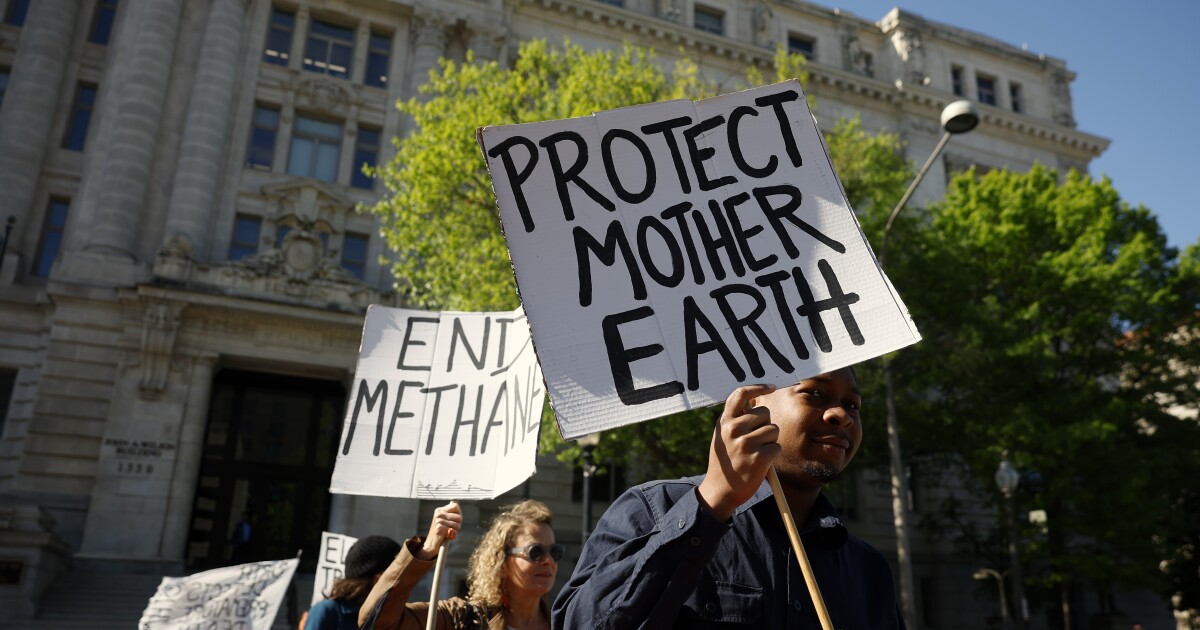

White House officials are preparing executive orders that would strip some environmental nonprofits of their tax-exempt status, setting up a possible Earth Day strike against organizations seen as standing in the way of President Donald Trump’s push for more domestic oil, gas and coal production.
The effort, described by people familiar with the matter, comes alongside other administration moves to use the U.S. Tax Code or government funding to single out groups that oppose the president’s agenda. It also follows years of scrutiny by congressional Republicans who have
Even broader steps have been contemplated, including possible investigations of environmental nonprofits’ activities and changes that could stifle funding for non-U.S. organizations treated as charities, said the people, who asked not to be named because deliberations are private. The efforts could also have wider reach, extending beyond environmental groups to nonprofits that work on other issues as well as philanthropic organizations and foundations.
Trump has already called for Harvard University to lose its exempt status and suggested the Internal Revenue Service should tax it as a “political entity” after the school rejected the administration’s demand for changes.
On Thursday, the president suggested that the White House could go further by revoking the tax-exempt status of other organizations, saying his administration will soon be “making some statements” about groups that are “so rich, so strong, and then they go so bad.”
The president specifically invoked the nonprofit watchdog group Citizens for Responsibility and Ethics in Washington, saying “the only charity they have is going after Donald Trump.” Separately, congressional Republicans in a hearing last year singled out Code Pink, the League of Conservation Voters and the Natural Resources Defense Council for scrutiny.
Any attempt to revoke tax-exempt status for prominent green groups would likely draw legal challenges, and it is unclear the effort would survive a court battle.
Yet it would present an unalloyed threat to nonprofit environmental advocacy that has for decades helped champion limits on toxic chemicals, air pollution and planet-warming greenhouse gas emissions. It also could help defund a climate movement that has pressed U.S. states and institutions across the globe to slash their greenhouse gas pollution and shift to emission-free power.
It would also mark another effort by Trump to confront work to battle climate change happening far outside the nation’s capital. Last week, Trump signed an executive order directing Attorney General Pam Bondi to take legal action against state laws or regulations that could impede the use of oil and gas, including policies meant to address climate change and environmental justice.
The consequences could ripple overseas too, affecting organizations in other countries that draw on U.S. support. For instance, a possible move under discussion to eliminate the so-called equivalency determination that allows foreign organizations to be essentially considered public charities could discourage grants from not-for-profit organizations in the U.S.
Some administration officials and supporters have warned that the effort would set a dangerous precedent, empowering similar attacks against conservative causes the next time a Democratic president is in the White House.
Related efforts have already spurred bipartisan concern. After the House of Representatives last year advanced legislation that would give the Treasury Department expansive powers to revoke the tax-exempt status of not-for-profit groups, the measure stirred
The Internal Revenue Service determines whether a nonprofit loses its status, but the agency is supposed to enforce federal tax laws independent of partisan concerns. Organizations can lose their tax-exempt status if they are involved in political campaign activities or heavily involved in lobbying. Groups can also forfeit their designation if they have excessive income unrelated to their core mission or fail to file annual returns with the IRS.
An executive order singling out environmental groups could be among initiatives being readied for Earth Day next Tuesday, people familiar with the matter said. The timing and direction of the orders could change as different parts of the administration debate details.
Trump has long criticized what he dubs the “green new scam,” and has vowed to undo government policies intended to fight climate change and promote emission-free energy. The president on his first day in office began the process of again
Environmental groups present a challenge to Trump’s ambitions, having vowed to mount legal challenges against many of the administration’s decisions. A federal judge in April temporarily ordered the government to restore climate grant funding frozen by Trump while legal challenges play out in court.
Nonprofit groups and philanthropies have been preparing for confrontations.
“Philanthropy has a strong view that the storm is coming their way,” said Scott Curran, the chief executive officer of Beyond Advisers, a social impact consultancy. Curran said he’s been working with organizations, especially those that have drawn opposition in the past, since last year to shore up their governance and compliance in preparation for increased scrutiny.





U.S.-China AI Competition Intensifies as Washington Pushes Allies to Choose Sides

Nvidia’s Potential $3 Billion SB Energy Investment Could Reshape AI Infrastructure

U.S. Retail Sales Fall for the First Time in Nine Months as Consumer Spending Slows

Armanino adds Strategic Accounting Outsourced Solutions

New 2023 K-1 instructions stir the CAMT pot for partnerships and corporations

Tax Strategy: Employee Retention Credit update
-

 Economics1 week ago
Top 65 Largest Economies in the World for 2027
-

 Finance1 week ago
Private Credit Expansion and Regulatory Oversight in 2026 Capital Markets
-

 Technology1 week ago
Quantum Computing Advances and PostQuantum Cryptography
-

 Economics1 week ago
Federal Reserve Holds Rates at 3.50% Amid Divided Committee and Energy Volatility
-

 Economics1 week ago
Impacts of the Ukraine and Iran Wars on World Global Economy and Financial Market
-

 Insights1 week ago
Technology-Driven Productivity Gains Outpacing Demographic Labor Shortages
-

 Stock News1 week ago
Tech Sector Earnings Beat Driven by Robust Q2 Profit Growth and AI Infrastructure Spend
-
 Economics6 days ago
US Inflation Matches Wall Street Projections as Core CPI Cools to 2.5%: Key Implications for Economy and Markets