
Finance
Trump pivot on tariffs shows Wall Street still has a seat at his table

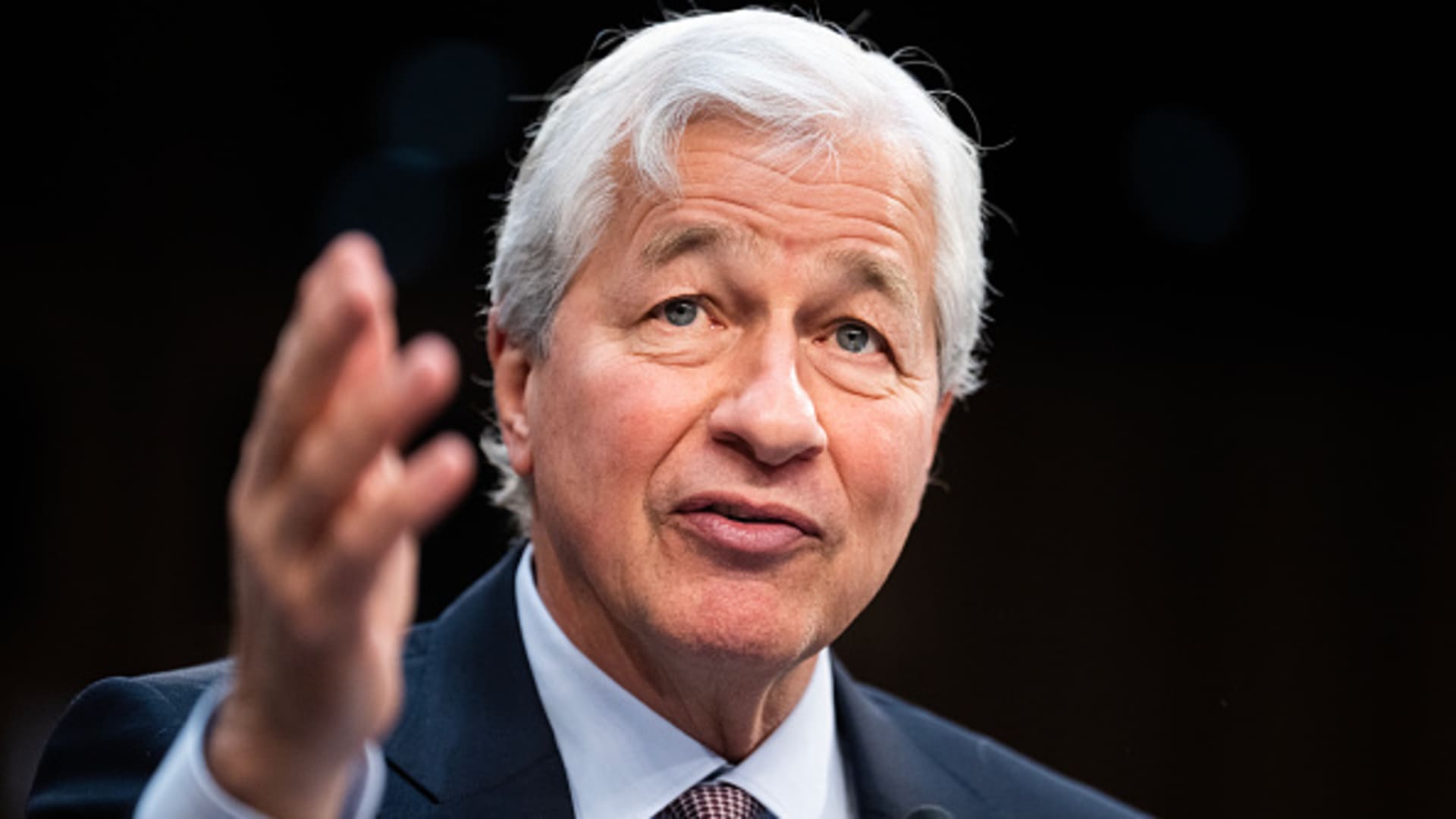
Jamie Dimon, CEO of JPMorgan Chase, testifies during the Senate Banking, Housing and Urban Affairs Committee hearing titled Annual Oversight of Wall Street Firms, in the Hart Building on Dec. 6, 2023.
Tom Williams | Cq-roll Call, Inc. | Getty Images
With each passing day since President Donald Trump‘s sweeping tariff announcement last week, a growing sense of unease had begun to pervade Wall Street.
As stocks plunged and even the safe haven of U.S. Treasurys were selling off, investors, executives and analysts started to fret that a core assumption from the first Trump presidency may no longer apply.
Amid the market carnage, the world’s most powerful person showed that he had a greater tolerance for inflicting pain on investors than anyone had anticipated. Time after time, he and his deputies denied that the administration would back off from the highest American tariff regime in a century, sometimes inferring that Wall Street would have to suffer so that Main Street could thrive.
“It goes without saying that last week’s price action was shocking to see as the market has begun to rewrite completely its sense for what a second Trump presidency means for the economy,” said R. Scott Siefers, a Piper Sandler analyst, earlier this week.
So it came as a huge relief to investors when, minutes after 1 p.m. ET on Wednesday, Trump relented by rolling back the highest tariffs on most countries except China, sparking the biggest one-day stock rally for the S&P 500 since the depths of the 2008 financial crisis.
Despite a presidency in which Trump has tested the limits of executive power — bulldozing federal agencies and laying off thousands of government employees, for example — the episode shows that the market, and by proxy Wall Street statesmen like JPMorgan Chase CEO Jamie Dimon who can explain its gyrations, are still guardrails on the administration.
Later Wednesday afternoon, Trump told reporters that he pivoted after seeing how markets were reacting — getting “yippy,” in his words — and took to heart Dimon’s warning in a morning TV appearance that the policy was pushing the U.S. economy into recession.
Dimon’s appearance in a Fox news interview was planned more than a month ago and wasn’t a last-minute decision meant to sway the president, according to a person with knowledge of the JPMorgan CEO’s schedule.
Bond vigilantes
Of particular concern to Trump and his advisors was the fear that his tariff policy could incite a global financial crisis after yields on U.S. government bonds jumped, according to the New York Times, which cited people with knowledge of the president’s thinking.
“The stock market, bond market and capital markets are, to a degree, a governor on the actions that are taken,” said Mike Mayo, the Wells Fargo bank analyst. “You were hearing about parts of the bond market that were under stress, trades that were blowing up. You push so hard, but you don’t want it to break.”
Typically, investors turn to Treasurys in times of uncertainty, but the sell-off indicated that institutional or sovereign players were dumping holdings, leading to higher borrowing costs for the government, businesses and consumers. That could’ve forced the Federal Reserve to intervene, as it has in previous crises, by slashing rates or acting as buyer of last resort for government bonds.

“The bond market was anticipating a real crisis,” Ed Yardeni, the veteran markets analyst, told CNBC’s Scott Wapner on Wednesday.
Yardeni said it was the “bond vigilantes” that got Trump’s attention; the term refers to the idea that investors can act as a type of enforcer on government behavior viewed as making it less likely they’ll get repaid.
Amid the market churn, Wall Street executives had reportedly worried that they didn’t have the influence they did under the first Trump administration, when ex-Goldman partners including Steven Mnuchin and Gary Cohn could be relied upon.
But this last week also showed investors that, in his mission to remake the global order of the past century, Trump is willing to take his adversarial approach with trading partners and the larger economy to the knife’s edge, which only invites more volatility.
‘Chaos discount’
Banks, closely watched for the central role they play in lending to corporations and consumers, entered the year with great enthusiasm after Trump’s election.
The setup was as promising as it had been in decades, according to Mayo and other analysts: A strengthening economy would help boost loan demand, while lower interest rates, deregulation and the return of deals activity including mergers and IPO listings would only add fuel to the fire.
Instead, by the last weekend, bank stocks were in a bear market, having given up all their gains since the election, on fears that Trump was steering the economy to recession. Amid the tumult, it’s likely that reports will show that deal-making slowed as corporate leaders adopt a wait-and-see attitude.
“The chaos discount, we call it,” said Brian Foran, an analyst at Truist bank.
Foran and other analysts said the Trump factor made it difficult to forecast whether the economy was heading for recession, which banks would be winners and losers in a trade war and, therefore, how much they should be worth.
Investors will next focus on JPMorgan, which kicks off the first-quarter earnings season on Friday. They will likely press Dimon and other CEOs about the health of the economy and how consumers and businesses are faring during tariff negotiations.
Wednesday’s reprieve could prove short lived. The day after Trump’s announcement and the historic rally, markets continued to decline. There remains a trade dispute between the world’s two largest economies, each with their own needs and vulnerabilities, and an unclear path to compromise. And universal tariffs of 10% are still in effect.
“We got close, and that’s a very uncomfortable place to be,” Mohamed El-Erian, chief economic advisor of Allianz, the Munich-based asset manager, said Wednesday on CNBC, referring to a crisis in which the Fed would need to step in.
“We don’t want to get there again,” he said. “The more you get to that point repeatedly, the higher the risk that you’re going to cross it.”





Nvidia Q2 FY2027 Earnings beats Wall Street Expectation with Record $96.2 Billion Revenue

Treasury Bond Volatility Forces Bessent to Double Debt Buyback Size as Yields Swing

Nvidia Earnings Preview: What Wall Street Expects From the AI Bellwether’s Q2 Report

Armanino adds Strategic Accounting Outsourced Solutions

New 2023 K-1 instructions stir the CAMT pot for partnerships and corporations

Tax Strategy: Employee Retention Credit update
-

 Economics1 week ago
Nvidia’s Potential $3 Billion SB Energy Investment Could Reshape AI Infrastructure
-
 Economics4 days ago
Top 10 Largest Economies by 2030: IMF & World Bank GDP Projections for Global Powerhouses
-
 Stock News4 days ago
How to understand Intel $15B Stock Offering
-
 Technology1 week ago
U.S.-China AI Competition Intensifies as Washington Pushes Allies to Choose Sides
-
 Stock News1 day ago
Nvidia Earnings Preview: What Wall Street Expects From the AI Bellwether’s Q2 Report
-
 Economics4 days ago
Economic Profile of the United States of America (2026–2030 Horizon)
-
 Leaders3 days ago
Jackson Hole 2026: What the First Symposium Under Fed Chair Kevin Warsh Means for Markets
-
 Economics3 days ago
U.S. National Debt Surpasses $40 Trillion for the First Time: What It Means for the Economy