
Accounting
Trump signs executive action to create sovereign wealth fund

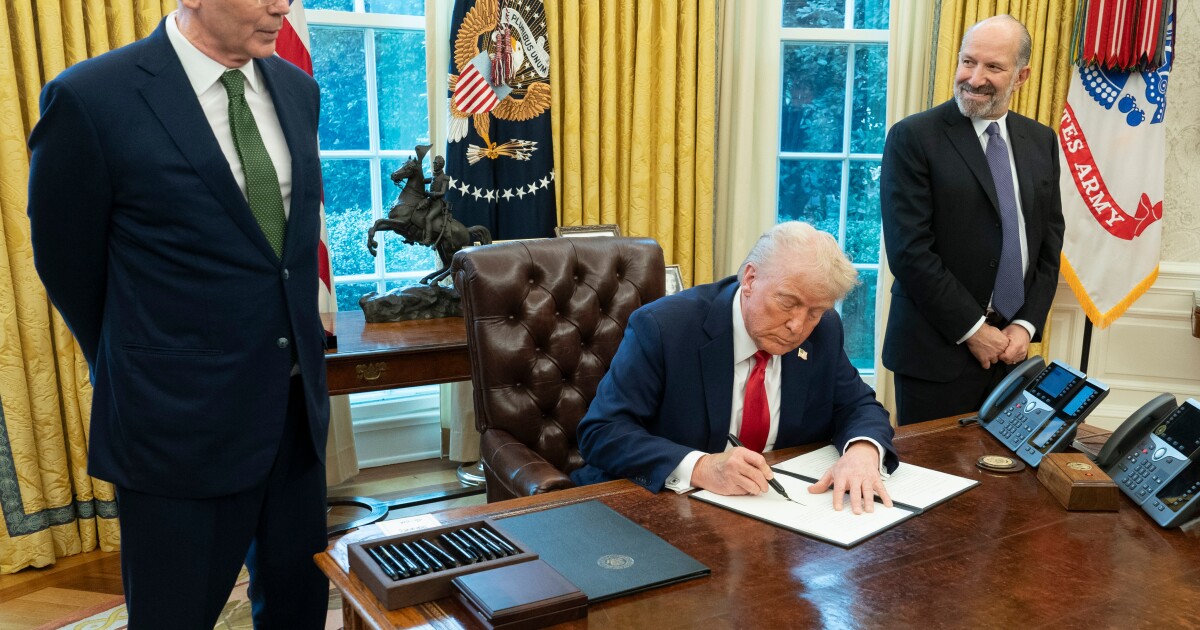

President Donald Trump signed an executive action he said would direct officials to create a sovereign wealth fund for the U.S., following through on an idea he floated during the presidential campaign.
“We have tremendous potential,” Trump told reporters in the Oval Office on Monday as he announced the move. The president said the action would charge Treasury Secretary Scott Bessent and Howard Lutnick, the nominee for Commerce secretary, with spearheading the effort.
Bessent, who joined Trump at the Oval Office, said the fund would be created in the next 12 months, calling it an issue “of great strategic importance.”
Trump suggested the fund could be used to facilitate the sale of TikTok, which is currently operating in the U.S. thanks to an extension he signed prolonging the deadline for a forced sale or shutdown.
Lutnick said the U.S. government could leverage its size and scale given the business it does with companies, citing drug makers as an example.
“If we are going to buy two billion COVID vaccines, maybe we should have some warrants and some equity in these companies,” he said.ot supported.
The action calls for officials to submit a plan to Trump within 90 days, including recommendations for funding, investment strategies, fund structure and governance. And it asks for an evaluation of the legal considerations for setting up and running a fund, including whether legislation is required.
Trump advisors have previously discussed plans to use the U.S. International Development Finance Corp. to partner with major institutional players to leverage U.S. economic powers.
Among those driving the conversation about using the DFC both more like a sovereign fund and as a tool to radically change America’s approach to foreign aid are Elon Musk and Stephen Feinberg, the billionaire co-founder of Cerberus Capital Management, who Trump has nominated as deputy defense secretary, according to people familiar who were close to the president’s transition team before taking office.
Trump on Friday said he was nominating Ben Black — the son of Apollo Global Management co-founder Leon Black — to head the DFC.
Trump floated the idea of a sovereign wealth fund during an address at the Economic Club of New York during the campaign in September, where he proposed funneling money from tariffs into a wealth fund that could invest in manufacturing hubs, defense and medical research.
“We will create America’s own sovereign wealth fund to invest in great national endeavors for the benefit of all the American people,” Trump said at the time and suggested that the Wall Street and corporate leaders at that event could have a role to play, helping to “advise and recommend investments.”
Sovereign wealth funds generally exist in countries that either have large foreign exchange reserves, such as China, or revenue from the sale of oil or other commodities, like Norway and Saudi Arabia. The money is then invested in everything from stocks and bonds to infrastructure and technology. Among the
“We’re going to monetize the asset side of the U.S. balance sheet for the American people,” Bessent said. “It’ll be a combination of liquid assets, assets we have in this country as we work to bring them out for the American people.”
Former President Joe Biden had also been crafting a proposal to create a fund that would invest in national security interests, including technology, energy and critical links in the supply chain.
There are 20 states that have sovereign wealth funds, generally funded by commodities or land, that might serve as models. The largest is the Alaska Permanent Fund, started in 1976, which currently manages about $82 billion. A more recent example is North Dakota’s $11.5 billion Legacy Fund, created in 2010.
North Dakota deposits 30% of its oil and gas tax revenue into the fund monthly. During any two-year budget cycle, the state can access 5% of the money to help finance projects and provide tax relief.
The fund helped make it possible for North Dakota to announce a plan late last month to phase out property taxes for homeowners over the next decade.
Trump on Monday delayed plans to hit Mexico and Canada with tariffs, citing measures the two countries were taking to crack down on the flow of fentanyl and illegal migration.





Nvidia Q2 FY2027 Earnings beats Wall Street Expectation with Record $96.2 Billion Revenue

Treasury Bond Volatility Forces Bessent to Double Debt Buyback Size as Yields Swing

Nvidia Earnings Preview: What Wall Street Expects From the AI Bellwether’s Q2 Report

Armanino adds Strategic Accounting Outsourced Solutions

New 2023 K-1 instructions stir the CAMT pot for partnerships and corporations

Tax Strategy: Employee Retention Credit update
-

 Economics1 week ago
Nvidia’s Potential $3 Billion SB Energy Investment Could Reshape AI Infrastructure
-

 Economics5 days ago
Top 10 Largest Economies by 2030: IMF & World Bank GDP Projections for Global Powerhouses
-

 Stock News5 days ago
How to understand Intel $15B Stock Offering
-
 Stock News2 days ago
Nvidia Earnings Preview: What Wall Street Expects From the AI Bellwether’s Q2 Report
-

 Technology1 week ago
U.S.-China AI Competition Intensifies as Washington Pushes Allies to Choose Sides
-

 Economics5 days ago
Economic Profile of the United States of America (2026–2030 Horizon)
-

 Leaders4 days ago
Jackson Hole 2026: What the First Symposium Under Fed Chair Kevin Warsh Means for Markets
-

 Economics4 days ago
U.S. National Debt Surpasses $40 Trillion for the First Time: What It Means for the Economy