Accounting
Trump struggles to market his tax law that 61% of voters oppose
Published
10 months agoon

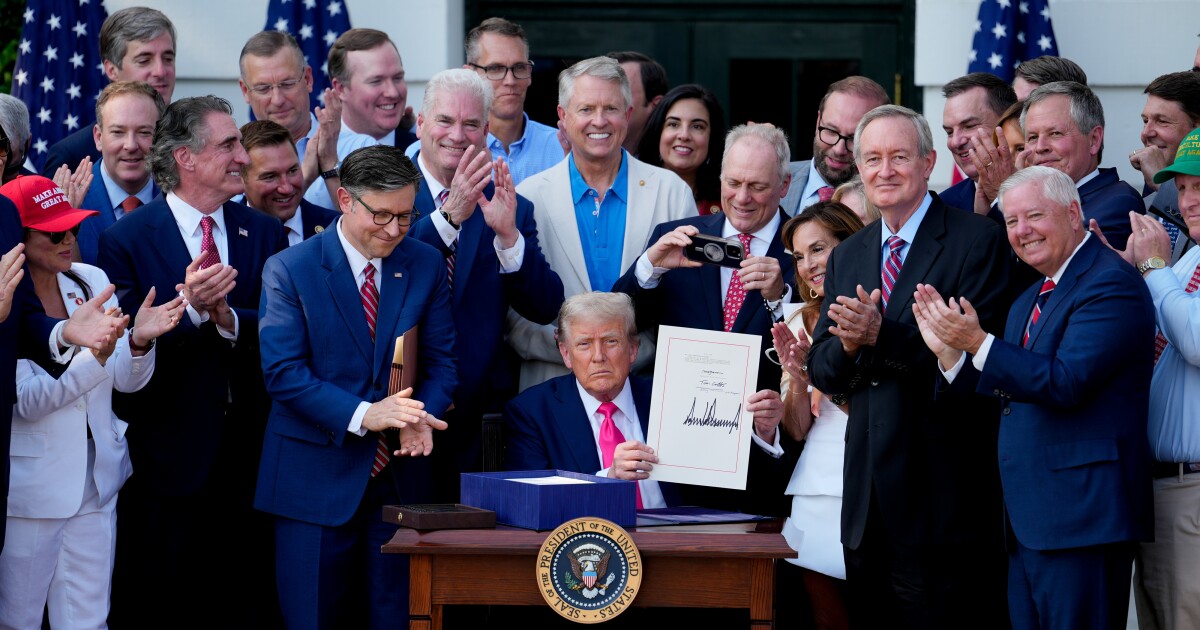
Passage of Donald Trump’s sweeping tax, health and spending bill was no small feat for Republicans, but selling it to the American people may prove to be tougher, even for a president who built a career on savvy branding.
The $3.4 trillion fiscal package narrowly squeaked through the Republican majorities in both the House and Senate after Trump jumped into late-night negotiating sessions to push it through. But the president has yet to convince the public that the law’s sweeping tax cuts and reductions to social safety-net programs are good policy.
Some 61% of Americans oppose the legislation, while only 39% support it, according to a new
Survey respondents are also not convinced that the bill will do much to generate economic growth — the centerpiece of Republicans’ argument for rushing it through Congress. Only 29% said the new law would help the economy, while 51% said they thought it would be harmful and another 20% indicated it would not make much of a difference, the CNN/SSRS poll, conducted July 10-13, found.
This polling data doesn’t come as a surprise to White House officials, who were well aware of how unpopular the legislation was, even before Trump pressured lawmakers to muscle it through both chambers of Congress by his self-imposed July 4 deadline.
Despite the poor perception, White House wanted to lock in an economic achievement to demonstrate that Trump would deliver on his campaign promises. Administration officials view the bill as a cornerstone of their economic messaging strategy to win over voters in the 2026 midterm elections when control of the House and the Senate will be at stake.
Amid voters’ ongoing frustration with high prices, elevated interest rates and the uncertainty caused by tariffs, Trump officials have told allies they were under intense pressure to pass the legislation despite the known political risks.
“The One Big Beautiful Bill is an encapsulation of so many of the campaign promises that the American people elected President Trump to enact,” White House spokesperson Abigail Jackson said in a statement. “Whether it’s tax cuts, a more secure border, a stronger military, or any other provision in the legislation, there’s something for everyone.”
Vice President JD Vance visited Pennsylvania, a key swing state, on Wednesday to champion the bill and its benefits. Alongside Small Business Administration chief Kelly Loeffler and Republican Representative Rob Bresnahan of Pennsylvania, he urged supporters to go out and tell others about how great the legislation is before the midterms. Top cabinet officials will also travel in the coming months to promote the law, according to a White House official.
So far, Trump himself does not have plans to criss-cross the country to boost support for the tax cuts. Trump recently told NBC News that he would travel “a little bit” to talk about the bill, “but honestly, it’s been received so well I don’t think I have to,” he added.
Republicans lost the messaging war during Trump’s first-term tax overhaul, with Democrats
A former Trump White House official said it’s hard for the president to sell his policies because he quickly moves onto the next thing. Another Trump advisor said the administration must first confront a spate of tariff deadlines in August before the president worries about convincing voters of the efficacy of the tax bill.
Republicans are intent on playing up the permanent extension of the personal tax cuts and breaks for businesses, arguing that absent the legislation, millions of Americans would have seen their tax bills rise next year when Trump’s first term cuts were set to expire.
Republicans plan to play up parts of the bill that poll well — including Trump’s campaign promises to end taxes on tips and overtime pay and to make auto loans deductible — even though some of those last for just a few years. Conservatives want to portray the bill as delivering the economic relief voters have long sought.
At the same time, Democrats are eager to brand the legislation as a giveaway to the rich that comes at the expense to deep cuts to Medicaid and the country’s food stamp program — provisions expected to hit many of the same working class voters who helped enable Trump’s rise to power.
Nearly 17 million people are estimated to lose their health insurance with new eligibility standards and expiration of a tax credit that cut the cost of coverage for some Americans, according to the Congressional Budget Office.
“So many people in rural areas that voted overwhelmingly for Donald Trump are covered by Medicaid,” said longtime Republican pollster Whit Ayres. “They were very savvy at how they set it up with all of the tax cuts and credits taking effect immediately, but the Medicaid cuts don’t take effect until after the midterms in 2026, which was pretty crafty.”
Even so, Republican lawmakers worry about the potential political blowback from the cuts to Medicaid and food stamps, especially when Americans start to lose health insurance, or rural hospitals slash services or close entirely.
Polling shows Americans support Medicaid cuts when lawmakers talk about adding work requirements to be eligible for the benefits. But close to
“The efforts to put lipstick on a pig will not be successful,” said Neera Tanden, the president and chief executive officer of the left-leaning Center for American Progress. “The various limited tax benefits of the legislation for particular sectors are overwhelmed by the dramatic cuts to health care and hunger programs.”
To help counter the critiques, Republicans are trying to talk up the idea that the law prevents undocumented immigrants from accessing Medicaid. Undocumented immigrants, in most cases,
To quell the skittishness of lawmakers, top Trump advisors and allies privately have pledged to spend money in 2026 to help vulnerable Republicans boost their campaigns and sell the bill, according to people familiar with those plans.
“We have to play offense,” said John McLaughlin, one of Trump’s 2024 campaign pollsters. “We need to let the voters know this is what Democrats stand for. If the bill had not passed, 95% of Americans would have seen their taxes rise.”
You may like

The Financial Accounting Standards Board met this week to discuss its projects on accounting for transfers of cryptocurrency assets and enhancing the disclosures around certain digital assets, such as stablecoins.
Processing Content
During Wednesday’s meeting, FASB’s board made certain tentative decisions, according to a
At a future meeting, the board plans to consider clarifying the derecognition guidance for crypto transfer arrangements to assess whether the control of a crypto asset has been transferred.
FASB also began deliberations on the
The board decided to provide illustrative examples in Topic 230, Statement of Cash Flows, to clarify whether certain digital assets such as stablecoins can meet the definition of cash equivalents. It also decided to include the following concepts in the illustrative examples:
- Interpretive explanations that link to the current cash equivalents definition;
- The amount and composition of reserve assets; and,
- The nature of qualifying on-demand, contractual cash redemption rights directly with the issuer.
FASB plans to clarify that an entity should consider compliance with relevant laws and regulations when it’s creating a policy concerning which assets that satisfy the Master Glossary definition of the term “cash equivalents“ will be treated as cash equivalents.
“I agree with the staff suggestion to look at examples,” said FASB vice chair Hillary Salo. “From my perspective, I think that is going to help level the playing field. People have been making reasonable judgments. I agree with that. And I think that this is really going to help show those goalposts or guardrails of what types of stablecoins would be in the scope of cash equivalents, and which ones would not be in the scope of cash equivalents. I certainly appreciate that approach, and I think it has the least potential impact of unintended consequences, because I do agree with my fellow board members that we shouldn’t be changing the definition of cash equivalents, and it’s a high bar to get into the cash equivalent definition.”
“I’m definitely supportive of not changing the definition of cash equivalents,” said FASB chair Richard Jones. “I believe that’s settled GAAP in a way, and we’re not really seeing a call to change it for broader issues. I am supportive of the example-based approach. The challenge with examples, though, is everybody’s going to want their exact pattern, but that’s not what we’re doing.”
The examples will explain the rationale for how digital assets such as stablecoins do or do not qualify as cash equivalents and give a roadmap for other types of digital assets with varying fact patterns to be able to apply.
“We really don’t want to be as a board facing a situation where something was a cash equivalent and then no longer is at a later date,” said Jones. “That’s not good for anyone, so keeping it as a high bar with certain rigid criteria, I think, is fine.”
Stablecoins are supposed to be pegged to fiat currencies such as U.S. dollars and thus provide more stability to investors. “In my view, while a stablecoin may meet the accounting definition established for cash equivalents, not every one of those stablecoins in the cash equivalent classification represents the same level of risk,” said FASB member Joyce Joseph.
She noted that the capital markets recognize the distinctions and have established a Stablecoin Stability Assessment Framework to evaluate a stablecoin’s ability to maintain its peg to a fiat currency. Such assessments look at the legal and regulatory framework associated with the stablecoin, and provide investors with information that could enable them to do forward-looking assessments about the stability of the stablecoin.
“However, for an investor to consider and utilize such information for a company analysis the financial statement disclosures would need to include information about the stablecoin itself,” Joseph added. “In outreach, the staff learned that investors supported classifying certain stablecoins as cash equivalents when transparent information is available about the entities at which the reserve assets are held. Therefore, in my view, taking all of this into consideration a relevant and informative company disclosure would include providing investors with the name of the stablecoin and the amount of the stablecoin that is classified as a cash equivalent, so investors can independently assess the liquidity risks more meaningfully and more comprehensively by utilizing broader information that is available in the capital markets and its emerging information.”
Such information could include the issuer, reserves, governance and management, she noted, so investors would get a more holistic look at the risks that holding the stablecoin would entail for a given company.
The board decided to require all entities to disclose the significant classes and related amounts of cash equivalents on an annual basis for each period that a statement of financial position is presented.
Entities should apply the amendments related to the classification of certain digital assets as cash equivalents on a modified prospective basis as of the beginning of the annual reporting period in the year of adoption.
FASB decided that entities should apply the amendments related to the disclosure of the significant classes and amounts of cash equivalents on a prospective basis as of the date of the most recent statement of financial position presented in the period of adoption.
The board will allow early adoption in both interim and annual reporting periods in which financial statements have not been issued or made available for issuance.
FASB also decided to permit entities to adopt the amendments to be illustrated in the examples related to the classification of certain digital assets as cash equivalents without the need to perform a preferability assessment as described in Topic 250, Accounting Changes and Error Corrections.
The board directed the staff to draft a proposed accounting standards update to be voted on by written ballot. The proposed update will have a 90-day comment period.
Accounting
Lawmakers propose tax and IRS bills as filing season ends
Published
2 weeks agoon
April 17, 2026

Senators introduced several pieces of tax-related legislation this week, including measures aimed at improving customer service at the Internal Revenue Service, cracking down on tax evasion and curbing the carried interest tax break, in addition to efforts in the House to repeal the Corporate Transparency Act.
Processing Content
Senators Bill Cassidy, R-Louisiana, and Mark Warner, D-Virginia, teamed up on introducing a bipartisan bill, the
The bill would establish a dashboard to inform taxpayers of backlogs and wait times; expand electronic access to information and refunds; expand callback technology and online accounts; and inform individuals facing economic hardship about collection alternatives.
“Taxpayers deserve a simple, stress-free experience when dealing with the IRS,” Cassidy said in a statement Wednesday. “This bill makes the process quicker and easier for taxpayers to get the information they need.”
He also mentioned the bill during a
“I’m happy to meet with the team … and do all I can to make it as good as you want it to be,” said Bisignano.
“My bill would equip the IRS with the legislative mandate to create an online dashboard so that taxpayers can monitor average call wait time and budget time accordingly,” said Cassidy. He noted that the bill would allow a callback for taxpayers that might need to wait longer than five minutes to speak to a representative, and establish a program to identify and support taxpayers struggling to make ends meet by providing information about alternative payment methods, such as installments, partial payments and offers in compromise.
“I know people are kind of desperate and don’t know where to turn for cash, so I think this could really ease anxiety,” he added. “This legislation is bipartisan and is likely to pass this Congress.”
Cassidy and Warner
“Taxpayers shouldn’t have to jump through hoops to get basic answers from the IRS — and in the last year, those challenges have only gotten worse,” Warner said in a statement. “I am glad to reintroduce this bipartisan legislation on Tax Day to ease some of this frustration by increasing clear communication and making IRS resources more readily available.”
Stop CHEATERS Act
Also on Tax Day, a group of Senate Democrats and an independent who usually caucuses with Democrats teamed up to introduce the Stop Corporations and High Earners from Avoiding Taxes and Enforce the Rules Strictly (Stop CHEATERS) Act.
Senate Finance Committee ranking member Ron Wyden, D-Oregon, joined with Senators Angus King, I-Maine, Elizabeth Warren, D-Massachusetts, Tim Kaine, D-Virginia, and Sheldon Whitehouse, D-Rhode Island. The bill would provide additional funding for the IRS to strengthen and expand tax collection services and systems and crack down on tax cheating by the wealthy.
“Wealthy tax cheats and scofflaw corporations are stealing billions and billions from the American people by refusing to pay what they legally owe, and far too many of them are getting a free pass because Republicans gutted the enforcement capacity of the IRS,” Wyden said in a statement. “A rich tax cheat who shelters mountains of cash among a web of shell companies and passthroughs is likelier to be struck by lightning than face an IRS audit, and Republicans want to keep it that way. This bill is about making sure the IRS has the resources it needs to go after wealthy tax cheats while improving customer service for the vast majority of American taxpayers who follow the law every year.”
Earlier this week. Wyden also
The Stop CHEATERS Act would provide the IRS with additional funding for tax enforcement focused upon high-income tax evasion, technology operations support, systems modernization, and taxpayer services like free tax-payer assistance.
“As Congress seeks ways to fund much-needed policy priorities and address our growing national debt, there is one common sense solution that should have unanimous bipartisan support: let’s enforce the tax laws already on the books,” said King in a statement. “Our legislation will make sure the IRS has the resources it needs to confront the gap between taxes owed and taxes paid – while ensuring that our tax enforcement professionals are focused on the high-income earners who account for the most tax evasion. This is a serious problem with an easy solution; let’s pass this legislation and make sure every American pays what they owe in taxes.”
Carried interest
Wyden, King and Whitehouse also teamed up on another bill Thursday to close the carried interest tax break for hedge fund managers that
Carried interest is a form of compensation received by a fund manager in exchange for investment management services, according to a
Under the bill, the
“Our tax code is rigged to favor ultra-wealthy investors who know how to game the system to dodge paying a fair share, and there is no better example of how it works in practice than the carried interest loophole,” Wyden said in a statement. “For several decades now we’ve had a tax system that rewards the accumulation of wealth by the rich while punishing middle-class wage earners, and the effect of that system has been the strangulation of prosperity and opportunity for everybody but the ultra-wealthy. There are a lot of problems to fix to restore fairness and common sense to our tax code, and closing the carried interest loophole is a great place to start.”
Repealing Corporate Transparency Act
The House Financial Services Committee is also planning to markup a bill next Tuesday that would fully repeal the Corporate Transparency Act, which has already been significantly
If enacted, the repeal would eliminate beneficial ownership reporting requirements, removing a transparency measure designed to help law enforcement and national security officials identify who is behind U.S. companies.
“This repeal would turn the United States back into one of the easiest places in the world to set up anonymous shell companies, something Congress worked for years to fix,” said Erica Hanichak, deputy director of the FACT Coalition, in a statement. “These entities are routinely used to facilitate corruption, financial crime, and abuse. Rolling back the CTA doesn’t just weaken transparency, it signals to bad actors around the world that the U.S. is once again open for illicit business.”
Accounting
IRS struggles against nonfilers with large foreign bank accounts
Published
3 weeks agoon
April 15, 2026

The Internal Revenue Service rarely penalizes taxpayers who have high balances in foreign bank accounts and fail to file the proper forms, according to a new report.
Processing Content
The
Taxpayers with specified foreign financial assets that meet a certain dollar threshold are also required to report the information to the IRS by filing Form 8938. Failure to file the form can result in penalties of up to $60,000. However, TIGTA’s previous reports have demonstrated that the IRS rarely enforces these penalties.
The IRS created an Offshore Private Banking Campaign initiative to address tax noncompliance related to taxpayers’ failure to file Form 8938 and information reporting associated with offshore banking accounts, but it’s had limited success.
Even though the initiative identified hundreds of individual taxpayers with significant foreign bank account deposits who failed to file Forms 8938, the campaign only resulted in relatively few taxpayer examinations and a small number of nonfiling penalties. The campaign identified 405 taxpayers with significant foreign account balances who appeared to be noncompliant with their FATCA reporting requirements.
The IRS used two ways to address the 405 noncompliant taxpayers: referral for examinations and the issuance of letters to them.
- 164 taxpayers (who had an average unreported foreign account balance of $1.3 billion) were referred for possible examination, but only 12 of the 164 were examined, with five having $39.7 million in additional tax and $80,000 in penalties assessed.
- 241 noncompliant taxpayers (who had an average unreported account balance of $377 million) received a combination of 225 educational letters (requiring no response from the taxpayers) and 16 soft letters (requiring taxpayers to respond). None of the 241 taxpayers were assessed the initial $10,000 FATCA nonfiling penalty.
“While taxpayers can hold offshore banking accounts for a number of legitimate reasons, some taxpayers have also used them to hide income and evade taxes,” said the report.
Significant assets and income are factors considered by the IRS when assessing whether taxpayers intentionally evaded their tax responsibilities, the report noted. Given the large size of the average unreported foreign account balances, these taxpayers probably have higher levels of sophistication and an awareness of their obligation to comply with the law.
TIGTA believes the IRS needs to establish specific performance measures to determine the effectiveness of the FATCA program. “If the IRS does not plan to enforce the FATCA provisions even where obvious noncompliance is identified, it should at least quantify the enforcement impact of its efforts,” said the report. “This will ensure that IRS decision makers have the information they need to determine if the FATCA program is worth the investment and improves taxpayer compliance.
TIGTA made three recommendations in the report, including revising Campaign 896 processes to include assessing FATCA failure to file penalties; assessing the viability of using Form 1099 data to identify Form 8938 nonfilers; and implementing additional performance measures to give decision makers comprehensive information about the effectiveness of the FATCA program. The IRS disagreed with two of TIGTA’s recommendations and partially agreed with the remaining recommendation. IRS officials didn’t agree to assess penalties in Campaign 896 or with implementing performance measures to assess the effectiveness of the FATCA program.
“From our perspective, TIGTA’s conclusions regarding IRS Campaign 896 are based, in part, on a misguided premise and overgeneralizations, including the treatment of ‘potential noncompliance’ as tantamount to ‘egregious noncompliance’ that warrants a monetary penalty without contemplating the variety of justifications that may exempt a taxpayer from having to file Form 8938,” wrote Mabeline Baldwin, acting commissioner of the IRS’s Large Business and International Division, in response to the report.
What that means for consumer loans
Checks and Balance newsletter: Of God and MAGA
Why software stocks, 2026’s market dogs, have joined the rally
Armanino adds Strategic Accounting Outsourced Solutions
New 2023 K-1 instructions stir the CAMT pot for partnerships and corporations