
Accounting
Trump tax cuts would cost more than almost all federal agencies

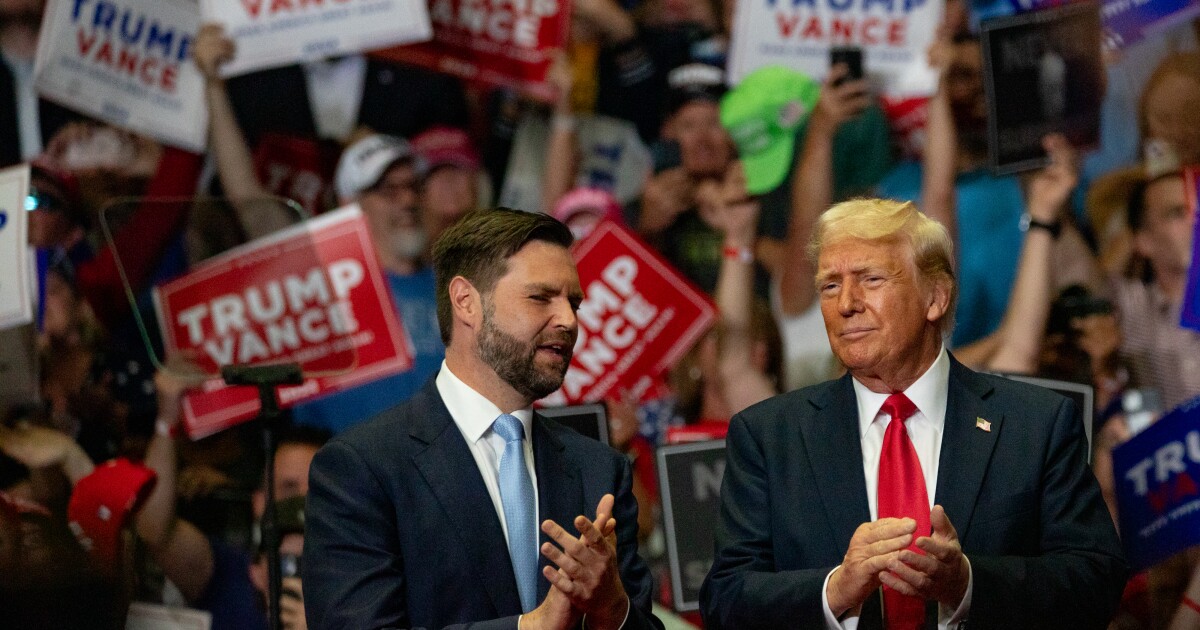
Republican nominee Donald Trump and running mate JD Vance are campaigning on a grab bag of tax cut proposals that could collectively cost as much as $10.5 trillion over a decade, a massive sum that would exceed the combined budgets of every domestic federal agency.
Even if Congress were to eliminate every dollar of non-defense discretionary spending — projected to be $9.8 trillion over the next 10 years — it still wouldn’t offset the estimated expense of the wide-ranging tax cuts Trump and Vance have floated in recent weeks.
The price tag is based on rough, initial estimates from tax and budget specialists because the Trump campaign hasn’t released detailed policy plans for its tax promises.

Emily Elconin/Bloomberg
The Trump campaign said in a statement the former president will cut wasteful spending and increase energy production to pay for the tax cuts and lower the national debt. The campaign didn’t offer more detail.
Though Democrat Kamala Harris also has proposed a few large tax cuts — she would exempt tips from taxation and expand the child tax credit — the impact on the nation’s finances pales in comparison. She calls for offsetting the lost income, which one think tank estimates at $2 trillion, with tax increases on corporations and wealthy individuals.
The sheer magnitude of the Trump campaign’s tax promises make it highly unlikely they all would pass even in a Congress controlled by Trump allies. The Republican ticket’s tax proposals include extending Trump’s 2017 tax cuts, a big expansion to the child tax credit and exemptions for tips and Social Security payments.
“Congress is not going to pass a $10 trillion deficit-financed tax cut,” said Kyle Pomerleau, a senior fellow with the right-leaning American Enterprise Institute.
Republicans have long argued that tax cuts boost growth. But it’s not clear how much Trump’s proposals, which largely cut levies for individuals rather than businesses, would spur new economic activity.
The combined cost of the Trump plans is so big that if Congress were to try to pass the tax cut proposals and keep spending flat, it means they could continue to fund the military, federal benefit programs, like Social Security, pay interest on the debt — and nothing else. That means eliminating major federal agencies that handle duties such as law enforcement, border security, air traffic control, tax collection and international relations.
Harris and President Joe Biden released a detailed budget proposal this year to cut federal deficits $3 trillion over a decade, by raising taxes on corporations and wealthy individuals and other measures. Those plans mirror some of the offsets Harris has proposed but previously have run into powerful opposition from major business lobbies.
Without those compensating tax increases, the Harris proposals could increase the deficit by as much as $2 trillion over the next decade, according to the University of Pennsylvania Penn Wharton Budget Model.
Trump’s supporters are accustomed to his impromptu, broad-stroke policy pronouncements, while key Democratic constituency groups demand detailed policy proposals and a firm plan offsetting the cost.
Harris is continuing to roll out policy ideas piecemeal. On Tuesday, she called for an
Tax agenda
For both candidates, much will hinge on how well their party does in congressional elections, said Wendy Edelberg, a former Federal Reserve and Congressional Budget Office economist who’s now director of the Brookings Institution’s Hamilton Project.
The outlook “depends on a million different factors, particularly the balance of power in Congress,” Edelberg said. “Perhaps no policy will get enacted as specifically proposed by either candidate.”
Taxes will be a top agenda item in Congress next year, regardless of who wins the White House or which party controls the House and Senate. Major portions of Trump’s 2017 tax cuts — including lower individual rates and deduction for small businesses — expire at the end of 2025, which will force Congress to address the tax code next year.
Trump has made extending his signature tax law the centerpiece of his agenda. The Congressional Budget Office says that would cost $4.6 trillion over ten years. He’s also floated lowering the corporate rate to 15% from 21%, adding another $874 billion to the total, according to a budget model by the Committee for a Responsible Federal Budget.
On the campaign trail, the Republican ticket has verbally floated more tax ideas with hefty price tags: excluding Social Security payments from taxes ($1.8 trillion), exempting taxes on tipped wages ($250 billion) and increasing the $2,000 child tax credit per child to $5,000 ($3 trillion).
Added all up, that’s $10.5 trillion. If Congress were to seriously consider these ideas, official federal scorekeepers would model out the effects, including how the tax cuts interact with one another.
Revenue raisers
Trump has offered very few options to raise more federal revenue. He’s vowed to block any cuts to Medicare and Social Security benefits and has called for an increase in military spending. He’s proposed universal tariffs ranging from 10-20%, which on the lowest end of the spectrum could bring in $2.8 trillion over ten years, according to the left-leaning Urban-Brookings Tax Policy Center.
That has the potential to cover some of the cost of his tax cuts, but doesn’t take into account what economists warn are large negative economic growth effects or the cost of compensating farmers for trade retaliation from other countries.
The rising national debt is already stoking concern among investors and ratings agencies.
Federal Reserve Chair Jerome Powell has warned that higher government budget deficits are on an unsustainable path. In November, Moody’s Investors Service signaled it could downgrade the U.S. from the highest investment grade, Aaa.
CBO projects federal debt held by the public will exceed 100% of the GDP next year and rise to 122% in ten years without any new tax cuts.
“The fiscally responsible thing for either candidate to do, if they are proposing tax cuts, is to tell us how they are going to pay for them,” said Keith Hall of George Mason University, who once led the nonpartisan CBO.





U.S. Inflation Outlook for 2027

S&P 500 September Outlook: Tech Rally Holds Index at 7,600

India Unveils ‘Saptadhara’ Reform Agenda Targeting Technology, Youth Skilling, and Growth

Armanino adds Strategic Accounting Outsourced Solutions

New 2023 K-1 instructions stir the CAMT pot for partnerships and corporations

Tax Strategy: Employee Retention Credit update
-

 Technology1 week ago
AI Infrastructure Boom Hits Physical Limits: Power, Financing, and Supply Chain Strain
-
 Stock News4 days ago
S&P 500 September Outlook: Tech Rally Holds Index at 7,600
-

 Economics1 week ago
U.S.- Canada Trade Talks Collapse; Carney Says Retaliatory Tariffs Begin September 8
-

 Finance4 days ago
S&P 500 Outperforms Amid Strong Corporate Earnings as Treasury Yields Cap Equity Multiples
-

 Technology1 week ago
Flock Cameras and the Future of Public Security
-

 Insights4 days ago
Climate Resilience and Offshore Wind and Land Restoration Milestones
-

 Accounting4 days ago
Mandatory ESG Reporting Standards Demand Standardized Non-Financial Audit Trails
-
 Leaders4 days ago
India Unveils ‘Saptadhara’ Reform Agenda Targeting Technology, Youth Skilling, and Growth