
Accounting
Trump tells House Republicans he wants funds to finish wall, tax cuts

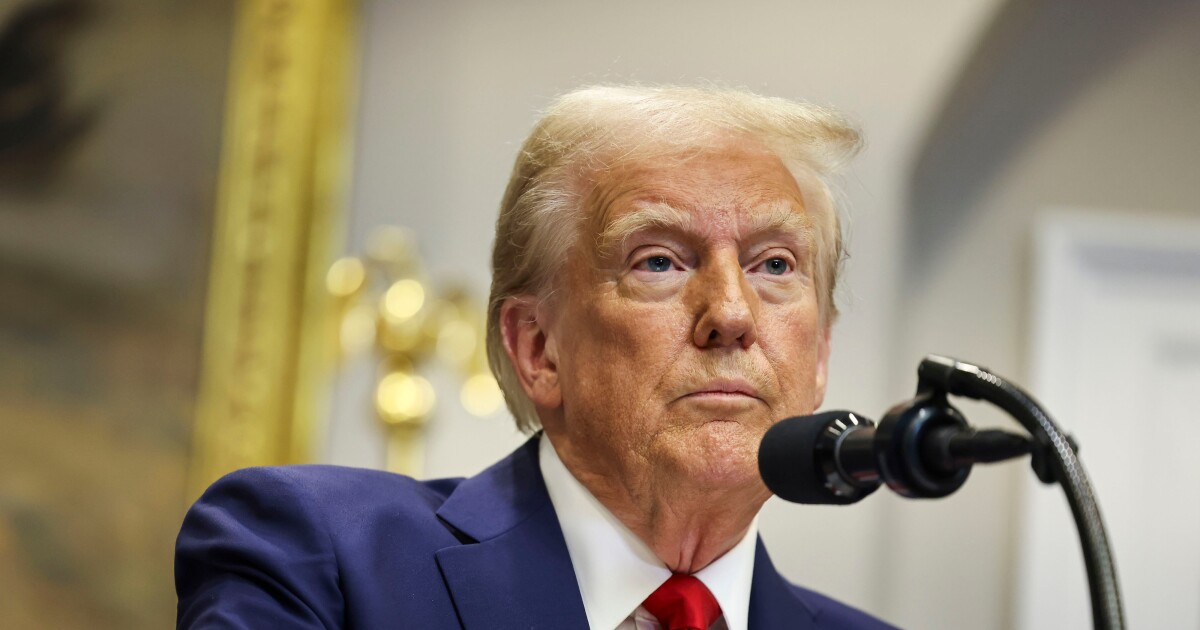

President Donald Trump told House Republicans that he hoped they would pass legislation funding the completion of the border wall and stepped up deportation efforts as part of an ambitious agenda that includes extending his signature tax cuts and enabling more oil and gas production.
“I’m looking forward to working with Congress on a reconciliation bill that financially takes care of our plans to totally and permanently restore the sovereign borders of the United States once and for all,” Trump said Monday as he addressed GOP lawmakers gathered at his Doral resort in Miami.
Trump said he wanted “full funding for a record increase in border security personnel and retention bonuses for ICE and border control” — referring to U.S. Immigration and Customs Enforcement — as well as a “massive increase in the number of detention beds and funding for all border security infrastructure and barriers, including completion of the border wall.”
Trump also indicated that he was pursuing the ability to deport undocumented migrants, even if they couldn’t be returned to their home countries.
“Let them be brought to a foreign land and maintained by others for a very small fee as opposed to being maintained in our jails for massive amounts of money,” Trump said.
While the president said such a program was “subject to getting it approved,” his remarks appeared to validate a recent CBS News report that his administration was negotiating an agreement with El Salvador’s government allowing the U.S. to deport migrants there as a “safe third country.” That plan would revive a deal struck during Trump’s first term that was never implemented.
House Republicans gathered to hear directly from the president on how to make good on his campaign trail message: lowering taxes, unleashing domestic energy production and cracking down on U.S.-Mexico border crossings.
Trump said he was “eager to get to work with Congress on the largest package of tax cuts and reforms in American history” but agnostic on what legislative vehicle they used to accomplish that goal.
“One bill, two bills, I don’t care,” Trump said, adding he did not “want to get hung up on the budget process.”
GOP discussions
Republican lawmakers offered mixed reactions to Trump’s speech. One lawmaker called it not helpful that Trump did not provide specific guidance on whether one, or two, reconciliation packages should be pursued.
But Blake Moore, vice chair of the conference, said Trump showed “he’s fully aware of the obstacle ahead, or the challenge that it’s going to be.”
“So knowing that he gets that and he’s asking us to stick together and think it’s really good for members to hear,” he said.
Speaker Mike Johnson said the members are spending much of the two-day retreat behind closed doors in an attempt to coalesce behind a strategy to advance those goals and on how to offset the hefty price tag attached to those priorities.
Also on the agenda is finding consensus on raising the nation’s debt limit, an issue that pits Trump — who wants quick action — against hard-line members of his party, who want to use the vote to extract controversial spending cuts. Republicans also face their first real legislative test since they assumed control of Congress and the White House, funding the government before a March 14 shutdown deadline.
Republicans have a rare opportunity to pass tax, energy and border legislation with only votes from their own party, if they can all stick together. Narrow margins in both the House and Senate mean that Republicans can only afford to lose a handful of votes in either chamber.
That slim majority is likely to most acutely be felt in the House, where a fractious majority, disparate priorities and an inclination to play political hardball means that getting enough Republicans to sign onto a bill implementing Trump’s policies will be difficult.
“President Trump wants his agenda passed. We have to put our differences aside, and stop thinking about ourselves, and start thinking about the country as a whole,” said Representative Carlos Gimenez, a Florida Republican. “I am sure there are going to be some things in that package I may not like personally, but the package is going to be good for America and we need to move it forward.”
Trump wants additional tax cuts that could increase the price tag of renewal.
He told lawmakers he intended to “keep my promises, starting with no taxes on tips, no tax on Social Security and no tax on overtime.”
Budget process
Republicans have yet to decide whether to produce one massive bill, or tackle border security first and come back for the remaining issues later in the year before a Dec. 31, 2025 deadline to extend a series of expiring tax cuts.
Even more divisive is how to pay for these plans, which could cost several trillion dollars. Republicans have floated using revenue from higher tariffs and slashing spending to offset the costs of tax cuts and additional border security measures.
But some GOP members are wary of deep spending cuts, which could gut benefit programs popular among voters. House leaders are also hesitant to include the tariffs — which Trump can impose on his own without Congress — because it removes the White House’s leverage to use import duty threats to settle disputes with trading partners.
Trump has done little to settle some of those intra-party squabbles, and again avoided charting a course on Monday night. Johnson has set an ambitious goal to pass a bill out of the House this spring. The speaker has set an even tighter deadline — Feb. 24 — for Congress to adopt a budget resolution that outlines how much the bill can cost.
House Republicans will meet again at the Doral golf club on Tuesday, where they will hear from Vice President JD Vance. Trump is scheduled to return to the White House Monday evening.





Nvidia Q2 FY2027 Earnings beats Wall Street Expectation with Record $96.2 Billion Revenue

Treasury Bond Volatility Forces Bessent to Double Debt Buyback Size as Yields Swing

Nvidia Earnings Preview: What Wall Street Expects From the AI Bellwether’s Q2 Report

Armanino adds Strategic Accounting Outsourced Solutions

New 2023 K-1 instructions stir the CAMT pot for partnerships and corporations

Tax Strategy: Employee Retention Credit update
-

 Economics1 week ago
Nvidia’s Potential $3 Billion SB Energy Investment Could Reshape AI Infrastructure
-

 Economics5 days ago
Top 10 Largest Economies by 2030: IMF & World Bank GDP Projections for Global Powerhouses
-

 Stock News5 days ago
How to understand Intel $15B Stock Offering
-
 Stock News1 day ago
Nvidia Earnings Preview: What Wall Street Expects From the AI Bellwether’s Q2 Report
-

 Technology1 week ago
U.S.-China AI Competition Intensifies as Washington Pushes Allies to Choose Sides
-

 Economics5 days ago
Economic Profile of the United States of America (2026–2030 Horizon)
-
 Leaders4 days ago
Jackson Hole 2026: What the First Symposium Under Fed Chair Kevin Warsh Means for Markets
-

 Economics4 days ago
U.S. National Debt Surpasses $40 Trillion for the First Time: What It Means for the Economy