
Personal Finance
Trump’s ‘big beautiful bill’ adds SALT deduction ‘torpedo,’ pro says

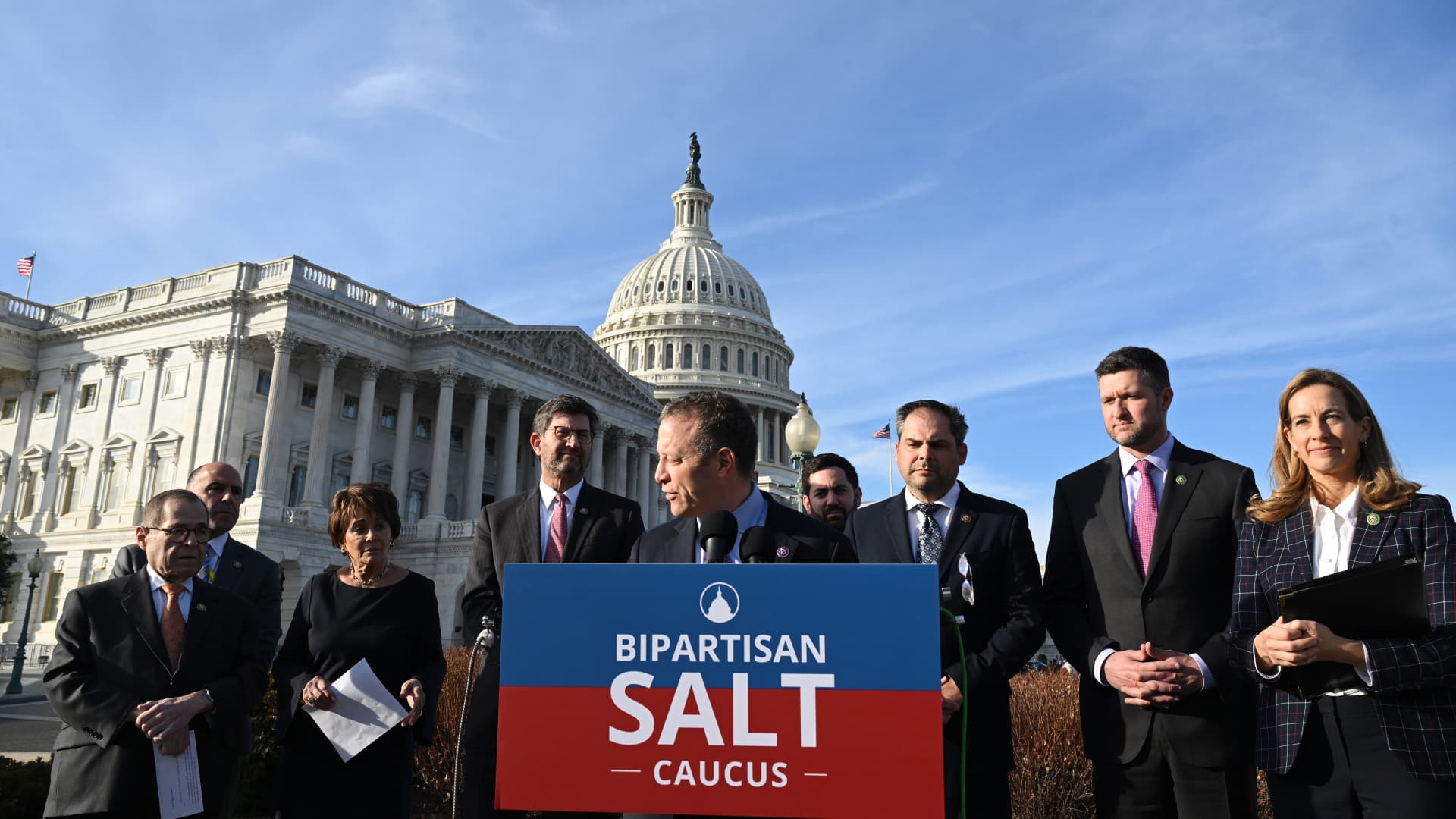
U.S. Representative Josh Gottheimer, D-NJ, speaks during a press conference about the SALT Caucus outside the Capitol on Wednesday February 08, 2023 in Washington, DC.
Matt McClain | The Washington Post | Getty Images
President Donald Trump‘s ‘big beautiful bill’ delivers a temporary higher limit on the federal deduction for state and local taxes, known as SALT. But the phaseout, or income-based benefit reduction, could trigger a tax surprise for some higher earners, experts say.
If you itemize tax breaks, you can claim the SALT deduction, which includes state and local income taxes and property taxes. Trump’s legislation raises the SALT deduction limit to $40,000 starting in 2025, with a 1% yearly increase through 2029, before reverting to $10,000 in 2030.
However, the $40,000 SALT cap starts to phase out once modified adjusted gross income, or MAGI, exceeds $500,000. The SALT limit drops to $10,000 once MAGI reaches $600,000. MAGI is adjusted gross income with some tax breaks added back in.
This phaseout can create a “SALT torpedo” — an artificially high tax rate — when MAGI falls between $500,000 and $600,000, certified public accountant Jeff Levine said in a LinkedIn post this week.
In some cases, you could pay a 45.5% federal tax rate on earnings between those thresholds, experts say.
More from Personal Finance:
Tax changes under Trump’s ‘big beautiful bill’ — in one chart
‘YOLO’-buying EVs: As $7,500 tax credit ends, consumers may rush to cash in
Trump’s ‘big beautiful bill’ cuts SNAP for millions of families: Report
Here’s how the “SALT torpedo” works and who could be impacted, according to tax experts.
How the SALT deduction phaseout works
Under Trump’s legislation, the SALT deduction limit for 2025 is now $30,000 higher. But a 30% phaseout kicks in once MAGI exceeds $500,000 for 2025.
Between $500,000 and $600,000, “you’re losing 30% for every dollar” of benefit between those thresholds, said certified financial planner Jim Guarino, managing director at Baker Newman Noyes in Woburn, Massachusetts. He is also a CPA.
At $600,000, if you multiply the extra $100,000 of income by 30%, that’s a $30,000 benefit reduction, which drops the $40,000 SALT cap back to $10,000.
A ‘quirky’ phaseout boosts tax rate
With the 30% SALT deduction phaseout between $500,000 and $600,000 MAGI, some individuals could pay higher-than-expected tax on earnings between those thresholds, according to Robert Keebler, a CPA with tax advisory firm Keebler & Associates in Green Bay, Wisconsin.
Between $500,000 to $600,000, you’re increasing taxable income while losing part of the SALT deduction, which raises your effective tax rate — the percent of taxable income you pay.
If taxable income rises while the SALT deduction falls, your effective tax rate on income between $500,000 to $600,000 could far exceed your regular income tax rate, Keebler said in a LinkedIn post last week.
“It’s definitely a quirky little phaseout provision,” Andy Whitehair, a CPA and a director with Baker Tilly’s Washington tax council practice, told CNBC. “When people start actually crunching numbers, they might be in for some surprises.”
Whitehair also shared a basic example of the phaseout on LinkedIn this week.
If your income is $500,000 and you subtract $75,000 of itemized deductions (including $40,000 for SALT), your taxable income is $425,000.
By contrast, $600,000 of income would drop the SALT deduction to $10,000, which reduces itemized deductions to $45,000, and raises taxable income to $555,000.
In this simplified example, there is $45,500 more federal tax owed by earning $100,000 more, which is 45.5%, Whitehair said.
If your 2025 earnings could be near $500,000, you should run projections with a tax advisor and weigh strategies to reduce MAGI, experts say.
With the steep tax penalty between $500,000 and $600,000, you may reconsider Roth individual retirement conversions, incurring large capital gains or other moves that could boost your income, according to Keebler.



Personal Finance
Next-Generation Retirement Planning: Managing Longevity Risk and Variable Income Streams


U.S.- Canada Trade Talks Collapse; Carney Says Retaliatory Tariffs Begin September 8

Flock Cameras and the Future of Public Security

AI Infrastructure Boom Hits Physical Limits: Power, Financing, and Supply Chain Strain

Armanino adds Strategic Accounting Outsourced Solutions

New 2023 K-1 instructions stir the CAMT pot for partnerships and corporations

Tax Strategy: Employee Retention Credit update
-

 Stock News1 week ago
Nvidia Earnings Preview: What Wall Street Expects From the AI Bellwether’s Q2 Report
-

 Accounting1 week ago
SEC’s Semiannual Reporting Proposal Faces Investor Pushback: What CFOs Need to Know
-

 Stock News1 week ago
Nvidia Q2 FY2027 Earnings beats Wall Street Expectation with Record $96.2 Billion Revenue
-

 Finance1 week ago
Treasury Bond Volatility Forces Bessent to Double Debt Buyback Size as Yields Swing
-
 Technology5 days ago
AI Infrastructure Boom Hits Physical Limits: Power, Financing, and Supply Chain Strain
-
 Technology3 days ago
Flock Cameras and the Future of Public Security
-
 Economics3 days ago
U.S.- Canada Trade Talks Collapse; Carney Says Retaliatory Tariffs Begin September 8