
Accounting
Trump’s economic confidants battle for sway on tax, Fed policy

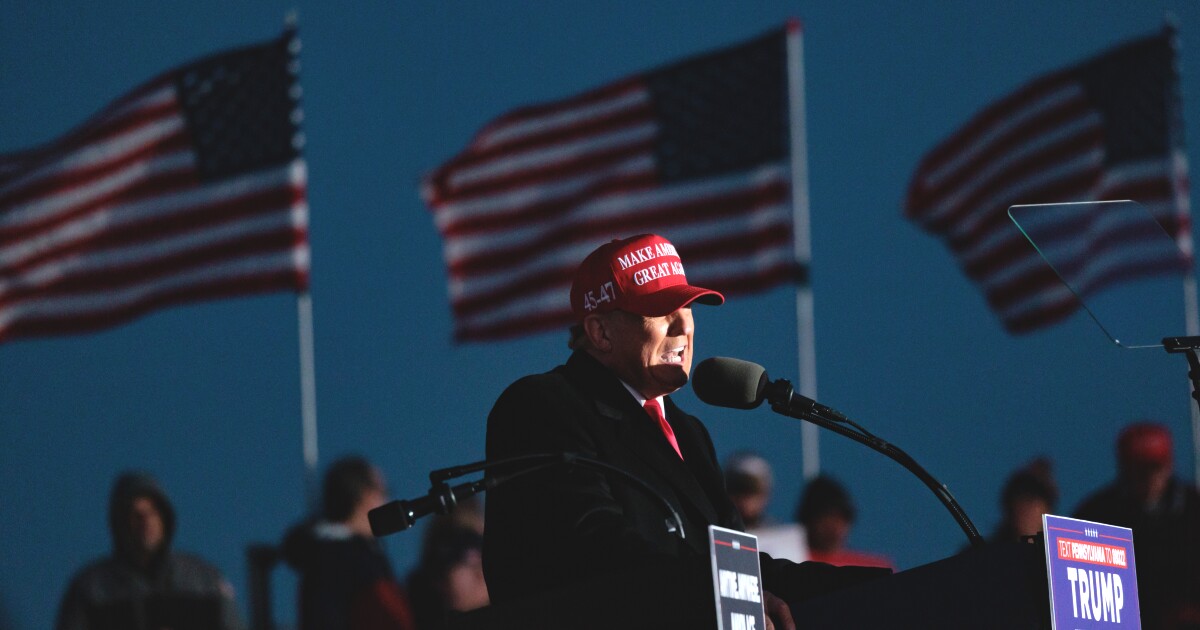
Economic advisers in Donald Trump’s orbit are clashing over their favored policy ideas, a fight that is spilling into public view as they jockey for influence over the presumptive Republican presidential nominee’s second-term plans.
In recent weeks, informal advisers have floated ideas such as a proposal for a flat tax; penalties for countries that shift away from the U.S. dollar; and reforms to the Federal Reserve to give the president more control over the independent central bank.
The only problem with these ideas? Trump himself has not signed off on any of them and the unauthorized policy plans are annoying his top campaign staff.
While he has groused about the Chinese yuan, the high cost of housing or the Fed’s stubbornly high interest rates in passing conversations with advisers, he hasn’t voiced support for specific ideas to tackle these problems, nor has he requested a formal plan from his cadre of informal economic advisers,
The public jockeying and extreme ideas from various factions within Republican circles undercut the strategy of a remarkably disciplined campaign that has helped Trump cruise to the party’s nomination even as he’s mired in court cases. The plans, which often embrace fringe economic ideas, reinforce Trump’s political unorthodoxy, leaving voters — and markets — uncertain on what he would do with a second term.

Hannah Beier/Photographer: Hannah Beier/Bloom
These economic trial balloons have infuriated top Trump campaign officials and created distractions as they prepare for the general election. The campaign is consumed with managing Trump’s appearances at his ongoing criminal trial in New York City involving hush-money payments, and figuring out ways to generate political momentum from the days in court. They are also busy strategizing how to win key swing states in November and planning fundraisers, as they try to close a wide campaign cash gap with President Joe Biden.
One person familiar with the proposals compared the recent raft of economic ideas to Trump officials frequently appearing on TV when he was president, in the hopes he would catch their appearance and they could shape his viewpoint.
Policy plans
A handful of conservative think tanks have been generating white papers and collecting resumes to prepare for a return of Trump, including the Heritage Foundation, America First Policy Institute, Conservative Partnership Institute and the Center for Renewing America.
Trump is also receiving economic advice from former top officials, including director of the Office of Management and Budget Russ Vought, former U.S. Trade Representative Robert Lighthizer, former head of the Council of Economic Advisers Kevin Hassett and former National Economic Council director Larry Kudlow, along with wealthy donors including John Paulson and Scott Bessent, both of whom have been floated as potential candidates for Treasury secretary. Many of his key advisers don’t support ideas to meddle with the Fed.
For months, the Trump campaign has been trying to rein in proposals from various factions with limited success.
“Let us be very specific here: Unless a message is coming directly from President Trump or an authorized member of his campaign team, no aspect of future presidential staffing or policy announcements should be deemed official,” campaign managers Susie Wiles and Chris LaCivita said in a written statement to the media this winter.
Monetary policy battle
Whether and how to rein in the Federal Reserve’s power is one of the most divisive issues among Republicans. During Trump’s first term in the White House, he often tried to pressure the Fed and Chair Jerome Powell to keep interest rates low.
It’s an open question whether Trump in a second term would select Fed officials and other White House aides that would want to keep the central bank independent, said Nathan Sheets, the global chief economist at Citigroup Inc.
“Any kind of policy that eroded independence in an appreciable way would be greeted by the markets very vigorously and adversely and would be a source of great pressure and volatility,” he said. “I think it would be such a problem that any gains a political actor might think that they would glean from undercutting Fed independence would be so small compared to the potential costs that they might have.”
Trump isn’t the first president to try to exert influence over the Fed by advocating for rate cuts and more dovish policies.
Richard Nixon famously called for rate cuts, which made inflation roar back to life in the 1970s. In a 1984 White House meeting between President Ronald Reagan, White House chief of staff James Baker and then Fed Chair Paul Volcker, Baker pressured the central bank chief not to raise interest rates before the election.
Trump repeatedly criticized the Fed and Powell in 2018, when the central bank was still raising interest rates, and into 2019, even threatening to fire Powell. The Fed started cutting rates in the summer of 2019.
Fed independence
“We act like, ‘Oh my god, this could never happen.’ But it’s not like it hasn’t been attempted or succeeded in the past. It’s just that it was always being done through subterfuge because no one would have the gall to just come out and do it. But gall is not an issue for Trump,” said Stephen Myrow, a managing partner at Beacon Policy Advisers and a former George W. Bush Treasury official.
A few outside Trump advisers have discussed ways to give the president the power to oust Powell before his term ends in 2026.
Given the Fed’s independence as an institution, Trump cannot fire or replace Powell and instantly change monetary policy. All decisions made by the Federal Reserve require approval by the Board of Governors, so even one or two potential Trump nominees could be outvoted.
“The executive branch has already taken over monetary policy. Janet Yellen has used Treasury policy to usurp monetary policy and ease financial conditions. Her actions are one reason rate hikes have been ineffective,” Bessent, a Trump donor, said in an interview, refuting the notion Trump is seeking a major change. “President Trump and his economic team understand that the one thing that anchors medium and long-term rates is the Fed’s credibility.”
–With assistance from Stephanie Lai and Rich Miller.





U.S.- Canada Trade Talks Collapse; Carney Says Retaliatory Tariffs Begin September 8

Flock Cameras and the Future of Public Security

AI Infrastructure Boom Hits Physical Limits: Power, Financing, and Supply Chain Strain

Armanino adds Strategic Accounting Outsourced Solutions

New 2023 K-1 instructions stir the CAMT pot for partnerships and corporations

Tax Strategy: Employee Retention Credit update
-

 Stock News1 week ago
Nvidia Q2 FY2027 Earnings beats Wall Street Expectation with Record $96.2 Billion Revenue
-
 Technology6 days ago
AI Infrastructure Boom Hits Physical Limits: Power, Financing, and Supply Chain Strain
-
 Technology4 days ago
Flock Cameras and the Future of Public Security
-
 Economics4 days ago
U.S.- Canada Trade Talks Collapse; Carney Says Retaliatory Tariffs Begin September 8