
Finance
Tungsten mine opens in Korea as U.S. seeks non-China critical minerals

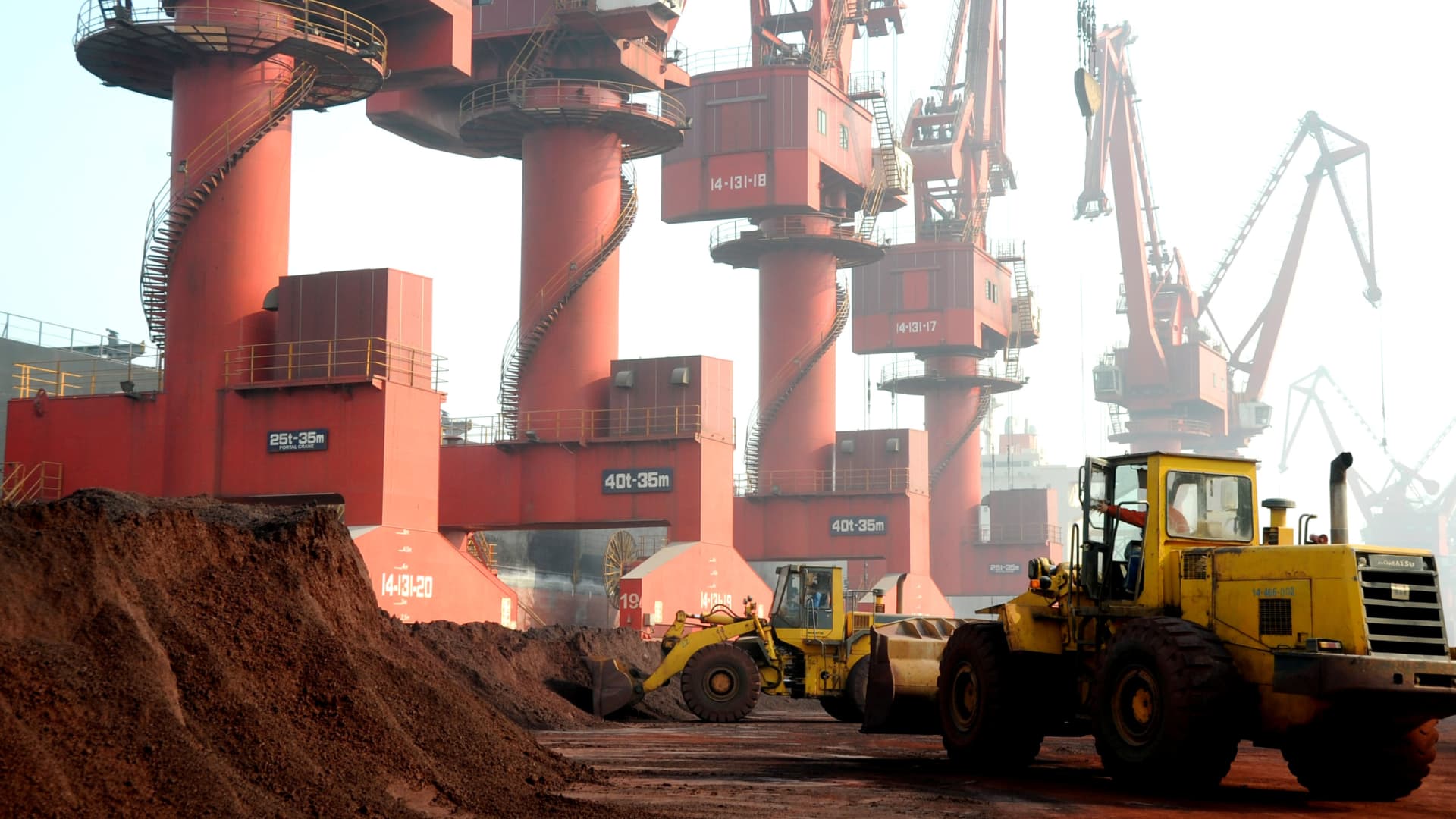
Workers transporting soil containing rare earth elements for export at a port in Lianyungang, Jiangsu province, China, Oct. 31, 2010.
Stringer | Reuters
BEIJING — China will start limiting exports of critical metal tungsten this weekend, just as alternatives to Chinese suppliers of the metal are reopening.
It’s a reversal of past decades, during which, according to analysts, Chinese businesses poured cheap tungsten into the global market to put competitors out of business — eventually controlling 80% of the supply chain, according to Argus. Tungsten is an extremely hard metal used in weapons and semiconductors.
As part of new rules limiting exports of “dual use” goods — which can be used for military or civilian purposes — China’s Ministry of Commerce earlier this month released a list indicating that businesses wanting to export a range of tungsten and critical mineral products would need to apply for licenses. The latest measures will take effect Dec. 1.
The move comes as escalating U.S.-China tensions boost demand for non-China tungsten. The U.S. Defense Department has banned its contractors from buying China-mined tungsten starting Jan. 1, 2027.
“It’s a bit late for the Chinese on tungsten,” said Christopher Ecclestone, principal and mining strategist at Hallgarten & Company.
“Everybody needs more tungsten. That’s the message out there right now,” he said. “The thing that’ll prompt more tungsten is not a Chinese ban. It’s a Chinese ban causing [it to become more] profitable to mine tungsten.”

Ecclestone pointed out that tungsten prices have not reacted much to China’s announcement. For mining the metal to be significantly profitable, he estimates prices would need to trade $50 higher than their current price of around $335 — measured by the industry in per metric ton units of ammonium para tungstate, in which one metric ton unit is 10 kilograms.
Higher prices in the U.S. alone could encourage more tungsten production.
While China restricts tungsten exports, the U.S. increased tariffs on Chinese tungsten by 25% in September. The majority of public comments on the U.S. tungsten tariffs supported the duties, noting benefits for domestic manufacturing. Some even requested the duties rise to 50%.
It may take years to open a mine, but more tariffs, expected under a Trump administration, could make it “more commercially viable” for some U.S. mining projects to reopen, said Cullen S. Hendrix, senior fellow at the Peterson Institute for International Economics.
‘Friendshoring’ tungsten
The U.S. has not commercially mined tungsten since 2015, according to official records. But this year, one of the world’s largest mines for the metal is moving close to resuming production in South Korea.
Canada-based Almonty Industries said last week it came one step closer to fully reopening the Sangdong mine and processing plant with the installation of grinding equipment. The mine, more than 10 hours east of Seoul by bus, closed in 1994.
Almonty aims to restore Sangdong to around 50% of its potential output by summer 2025, CEO Lewis Black told CNBC last month, after a ceremony that highlighted cooperation with the local government.
He noted that 90% of South Korea’s tungsten comes from China, and that Chinese companies might invest in other businesses to maintain their market share indirectly.
Jeong Kwang-yeol, the vice governor for economic affairs in Gangwon where Sangdong is located, said the region is willing to offer foreign investors incentives as he hopes the mine can become an anchor for other industrial companies to expand in the region. He cited estimates that the first phase of the mine would create 250 jobs and 1,500 indirect positions.
Almonty currently operates a tungsten mine in Portugal. In 2015, the company completed an acquisition that gave it the mining rights to Sangdong, and in 2021 it obtained $75.1 million for project financing from German state bank KfW IPEX-Bank. Almonty said overall investment in Sangdong so far has exceeded $130 million.
“In the medium-term, the U.S. will need to rely on friendshoring” for tungsten, said Gracelin Baskaran, director of the critical minerals security program at the Center for Strategic and International Studies. She noted that Almonty has committed 45% of the South Korea Sangdong mine to the U.S. through a long-term supply contract.
Several members of the U.S. Geological Survey, a government agency which analyzes the availability of natural resources, visited Sangdong earlier this year to assess its capacity. China was the largest source of U.S. tungsten imports in June at 45%, according to the agency.
Demand for tungsten in and outside China is expected to rise, keeping tungsten prices elevated in the near term, said Emre Uzun, ferro-alloys and steel analyst at Fastmarkets. But starting late next year, he expects increased non-China supply to help stabilize raw tungsten prices.
“Outside China, demand will also rise, but supply is expected to grow when operations expand and projects progress,” he said, pointing to the Sangdong mine and tungsten projects in Kazakhstan, Australia and Spain.
U.S. tungsten deposits
Despite the lack of tungsten production in the United States, the U.S. Geological Survey has identified around 100 sites in 12 U.S. states with significant amounts of the metal: Alaska, Arizona, California, Colorado, Idaho, Montana, North Carolina, New Mexico, Nevada, Texas, Utah and Washington.
In Idaho, roughly 4 hours away from Boise, a small Canadian company called Demesne Resources plans in coming days to close an eight-year deal worth $5.8 million to acquire the IMA tungsten mine, CEO Murray Nye said on Tuesday. He expects the mine could begin production by spring.
Nye said decades of historical records indicate the mine has significant quantities of tungsten, silver and molybdenum, a metal often used to strengthen others. That, he said, has the makings of what he expects to be a “nice, profitable mine.”





Treasury Bond Volatility Forces Bessent to Double Debt Buyback Size as Yields Swing

Nvidia Earnings Preview: What Wall Street Expects From the AI Bellwether’s Q2 Report

SEC’s Semiannual Reporting Proposal Faces Investor Pushback: What CFOs Need to Know

Armanino adds Strategic Accounting Outsourced Solutions

New 2023 K-1 instructions stir the CAMT pot for partnerships and corporations

Tax Strategy: Employee Retention Credit update
-

 Economics1 week ago
U.S. Retail Sales Fall for the First Time in Nine Months as Consumer Spending Slows
-

 Economics1 week ago
Nvidia’s Potential $3 Billion SB Energy Investment Could Reshape AI Infrastructure
-

 Economics4 days ago
Top 10 Largest Economies by 2030: IMF & World Bank GDP Projections for Global Powerhouses
-

 Stock News4 days ago
How to understand Intel $15B Stock Offering
-

 Technology1 week ago
U.S.-China AI Competition Intensifies as Washington Pushes Allies to Choose Sides
-
 Stock News22 hours ago
Nvidia Earnings Preview: What Wall Street Expects From the AI Bellwether’s Q2 Report
-

 Economics4 days ago
Economic Profile of the United States of America (2026–2030 Horizon)
-

 Leaders3 days ago
Jackson Hole 2026: What the First Symposium Under Fed Chair Kevin Warsh Means for Markets