
Finance
U.S. consumer giants have one big sales problem: China

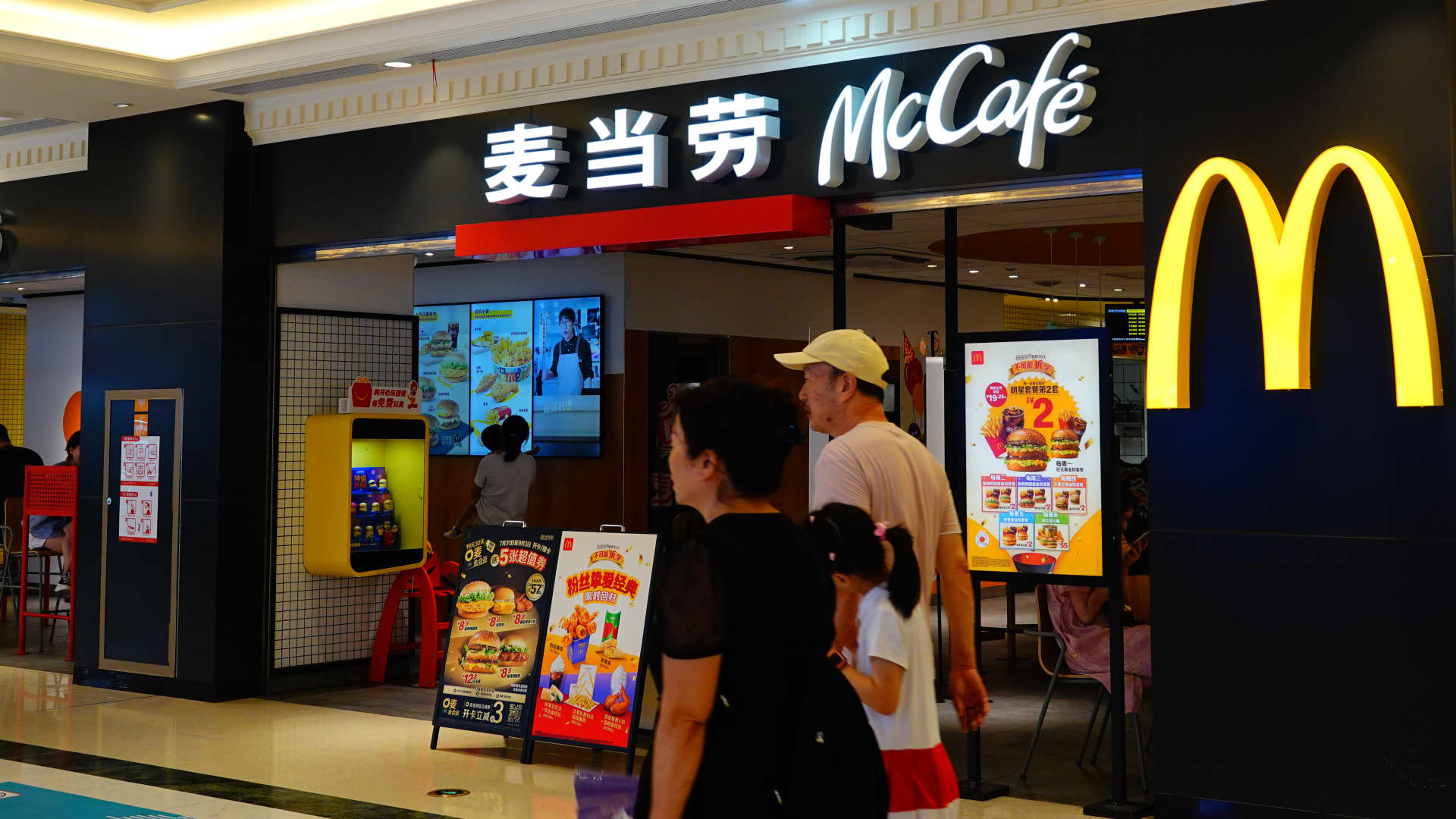
Pictured here is a McDonald’s store in Yichang, Hubei province, China, on July 30, 2024.
Nurphoto | Nurphoto | Getty Images
BEIJING — A theme emerging in the latest slew of U.S. companies’ earnings reports is a drag from the China market.
The Chinese economy — home to more than four times the population of the U.S. — has attracted multinational corporations for decades given its large, fast-growing market. But slower growth and intense local competition, amid tensions with the U.S., are now weighing on corporate earnings.
“Consumer sentiment in China is quite weak,” McDonald’s chairman, CEO and director Christopher Kempczinski, said of the quarter ended June 30.
“You’re seeing both in our industry and across a broad range of consumer industries, the consumer being very, very much deals seeking,” he added. “In fact, we’re seeing a lot of switching behavior in terms of just consumers, whatever is the best deal, that’s where they end up going.”
McDonald’s said sales for its international developmental licensed markets segment declined 1.3% from a year ago. The unit includes China, for which the company indicated sales declined but did not specify by how much.

Chinese companies have also struggled. Nationwide retail sales grew by just 2% in June from a year ago.
In the mainland China stock market, known as A shares, earnings likely hit a bottom in the first quarter and may “pick up mildly” in the second half of the year, Lei Meng, China equity strategist at UBS Securities, said in a July 23 note.
Several U.S. consumer giants echoed the downward trend in their latest earnings reports.
Apple said Greater China sales fell by 6.5% year-on-year in the quarter ended June 29. Johnson and Johnson said China is a “very volatile market” and a major business segment that’s performed below expectations.
After a “strong start” to the year, General Mills CFO Kofi Bruce said the quarter ending May 26 “saw a real souring or downturn in consumer sentiment,” hitting Haagen-Dazs store traffic and the company’s “premium dumpling business.” General Mills owns the Wanchai Ferry dumpling brand.
The company’s China organic net sales fell by double digits during the quarter.
We don’t expect the return to the growth rates that we saw pre-Covid.
The regional results are also affecting longer-term corporate outlooks.
In China, “we don’t expect the return to the [double-digit] growth rates that we saw pre-Covid,” Procter and Gamble CFO Andre Schulten said on an earnings call last week. He expected that over time, China would improve to mid-single-digit growth, similar to that in developed markets.
Procter and Gamble said China sales for the quarter ending late June fell by 9%. Despite declining births in China, Schulten said the company was able to grow baby care product sales by 6% and increase market share thanks to a localization strategy.
Hotel operator Marriott International cut its revenue per available room (RevPAR) outlook for the year to 3% to 4% growth, due largely to expectations that Greater China will remain weak, as well as softer performance in the U.S. and Canada.
Marriott’s RevPAR Greater China fell by about 4% in the quarter ended June 30, partly affected by Chinese people choosing to travel abroad on top of a weaker-than-expected domestic recovery.
However, the company noted it signed a record number of projects in the first half of the year in China.
McDonald’s also affirmed its goal to open 1,000 new stores in China a year.
Domino’s said its China operator, DPC Dash, aims to have 1,000 stores in the country by the end of the year. Last week, DPC Dash said it had just over 900 stores as of the end of June, and that it expects first-half revenue growth of at least 45% to 2 billion yuan ($280 million).
Local competition
Coca-Cola noted “subdued” consumer confidence in China, where volumes fell in contrast to growth in Southeast Asia, Japan and South Korea. Asia Pacific net operating revenue fell by 4% year-on-year to $1.51 billion in the quarter ended June 28.
“There’s a general macro softness as the overall economy works through some of the structural issues around real estate, pricing, etc.,” Coca-Cola Chairman and CEO James Quincey said on an earnings call.
But he attributed the drop in China volumes “entirely” to the company’s shift from unprofitable water products in the country toward sparkling water, juice and teas. “I think the sparkling volume was slightly positive in China,” Quincey said.
Having to adapt to a new mix of products and promotions was a common occurrence in U.S. companies’ earnings calls.
“We’ve continued to face a more cautious consumer spending and intensified competition in the past year,” Starbucks CEO Laxman Narasimhan said on an earnings call. “Unprecedented store expansion and a mass segment price war at the expense of comp and profitability have also caused significant disruption to the operating environment.”
Starbucks reported China same-store sales dropped by 14% in the quarter ended June 30, far steeper than the 2% decline in the U.S.
Chinese rival Luckin Coffee, whose drinks can cost half the price of one at Starbucks, reported a 20.9% drop in same-store sales for the quarter ended June 30.
But the company claimed sales for those stores surged by nearly 40% to the equivalent of $863.7 million. Luckin has more than 13,000 self-operated stores, primarily in China.
Starbucks said its 7,306 stores in China saw revenue drop by 11% to $733.8 million during the same quarter.
Both companies face many competitors in China, from Cotti Coffee on the lower end to Peet’s on the higher end. The only public disclosures regarding Peet’s China business described it as “strong double-digit organic sales growth” in the first half of the year.
Bright spots
Not all major consumer brands have reported such difficulties.
Canada Goose reported Greater China sales grew by 12.3% to 21.9 million Canadian dollars ($15.8 million) in the quarter ended June 30.
Athletic shoe brands also reported growth in China, while warning of slowdown ahead.
Nike reported 7% year-on-year growth in Greater China revenue — nearly 15% of its business — for the quarter ended May 31.
“While our outlook for the near term has softened, we remain confident in Nike’s competitive position in China in the long term,” said Matthew Friend, CFO and executive vice president of the company.
Adidas reported 9% growth in Greater China revenue for the quarter ended June 30. The region accounts for about 14% of the company’s total net revenue.
CEO Bjorn Gulden said on an earnings call that Adidas was taking market share in China every month, but local brands posed fierce competition. “Many of them are manufacturers that go then straight to retail with their own stores,” he said. “So the speed they have and the price value they have for that consumer was different than it was earlier. And we are trying to adjust to that.”
Skechers reported 3.4% year-on-year growth in China in the three months ended June 30.
“We continue to think China is on the road to recovery,” Skechers CFO John Vandemore said on an earnings call. “We expect a better second half of the year than what we’ve seen thus far, but we are watching things carefully.”
— CNBC’s Robert Hum and Sonia Heng contributed to this report.





S&P 500 September Outlook: Tech Rally Holds Index at 7,600

India Unveils ‘Saptadhara’ Reform Agenda Targeting Technology, Youth Skilling, and Growth

S&P 500 Outperforms Amid Strong Corporate Earnings as Treasury Yields Cap Equity Multiples

Armanino adds Strategic Accounting Outsourced Solutions

New 2023 K-1 instructions stir the CAMT pot for partnerships and corporations

Tax Strategy: Employee Retention Credit update
-

 Technology6 days ago
AI Infrastructure Boom Hits Physical Limits: Power, Financing, and Supply Chain Strain
-

 Economics4 days ago
U.S.- Canada Trade Talks Collapse; Carney Says Retaliatory Tariffs Begin September 8
-
 Stock News7 hours ago
S&P 500 September Outlook: Tech Rally Holds Index at 7,600
-

 Technology4 days ago
Flock Cameras and the Future of Public Security
-
 Finance7 hours ago
S&P 500 Outperforms Amid Strong Corporate Earnings as Treasury Yields Cap Equity Multiples
-

 Insights8 hours ago
Climate Resilience and Offshore Wind and Land Restoration Milestones
-

 Accounting8 hours ago
Mandatory ESG Reporting Standards Demand Standardized Non-Financial Audit Trails
-
 Leaders7 hours ago
India Unveils ‘Saptadhara’ Reform Agenda Targeting Technology, Youth Skilling, and Growth