
Personal Finance
Unemployment insurance program is unprepared for a recession: experts

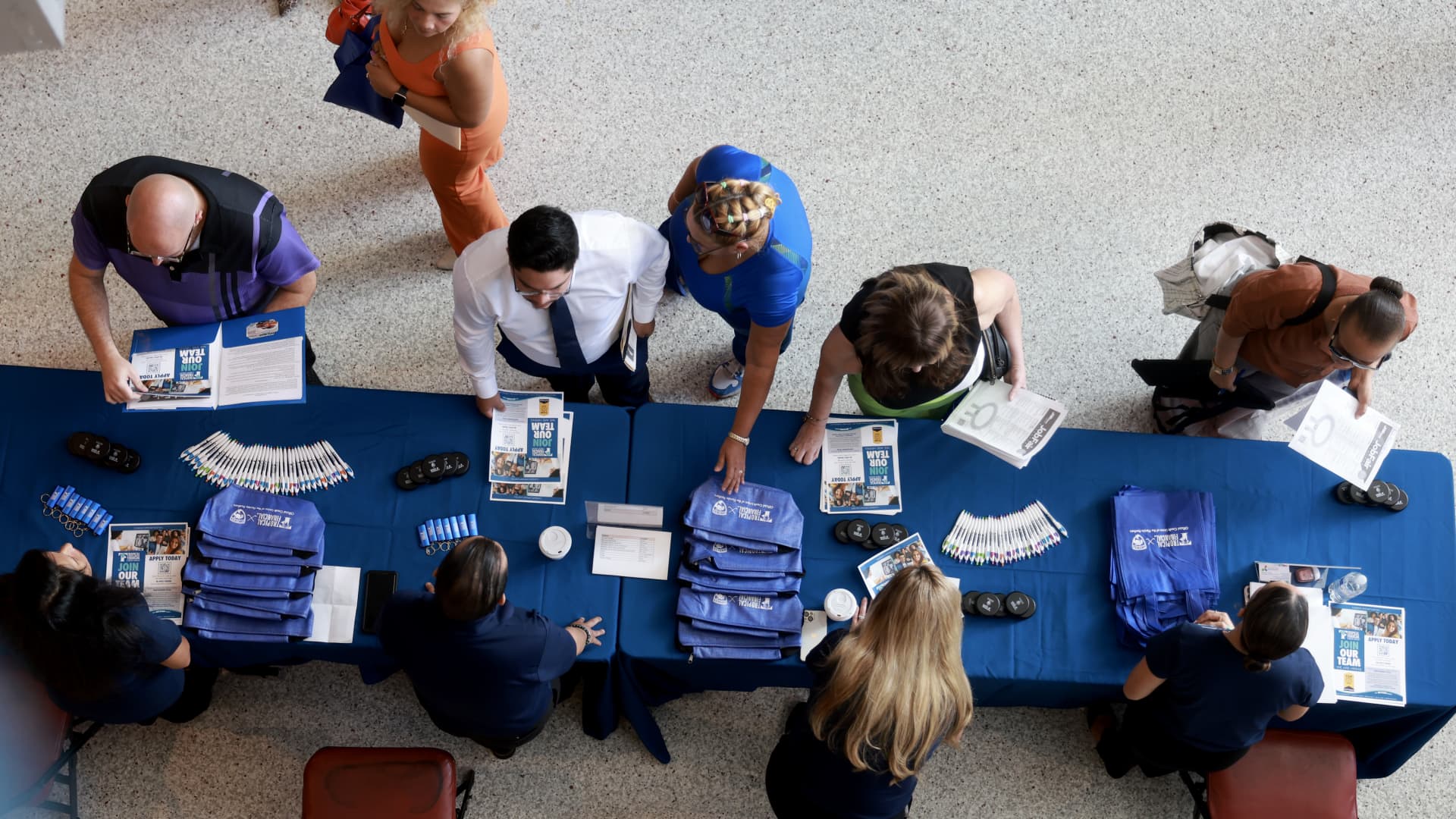
Job seekers attends the JobNewsUSA.com South Florida Job Fair on June 26, 2024 in Sunrise, Florida.
Joe Raedle | Getty Images
Renewed fears of a U.S. recession have put a spotlight on unemployment.
However, the system that workers rely on to collect unemployment benefits is at risk of buckling — as it did during the Covid-19 pandemic — if there’s another economic downturn, experts say.
“It absolutely isn’t” ready for the next recession, said Michele Evermore, senior fellow at the Century Foundation, a progressive think tank, and former deputy director for policy in U.S. Labor Department’s Office of Unemployment Insurance Modernization.
“If anything, we’re kind of in worse shape right now,” she said.
Unemployment insurance provides temporary income support to laid-off workers, thereby helping prop up consumer spending and the broader U.S. economy during downturns.
The pandemic exposed “major cracks” in the system, including “massive technology failures” and an administrative structure “ill equipped” to pay benefits quickly and accurately, according to a recent report issued by the National Academy of Social Insurance.
There’s also wide variation among states — which administer the programs — relative to factors like benefit amount, duration and eligibility, according to the report, authored by more than two dozen unemployment insurance experts.
“The pandemic exposed longstanding challenges to the UI program,” Andrew Stettner, the deputy director for policy in the Labor Department’s Office of UI Modernization, said during a recent webinar about the NASI report.
The U.S. unemployment rate, at 4.3% in July, remains a far cry from its pandemic-era peak and is low by historical standards. But it has gradually drifted upward over the past year, fueling rumblings about a potential recession on horizon.
Policymakers should address the system’s shortcomings when times are good “so it can deliver when times are bad,” Stettner said.
Why the unemployment insurance program buckled
Joblessness ballooned in the pandemic’s early days.
The national unemployment rate neared 15% in April 2020, the highest since the Great Depression, which was the worst downturn in the history of the industrialized world.
Claims for unemployment benefits peaked at more than 6 million in early April 2020, up from roughly 200,000 a week before the pandemic.
States were ill-prepared to handle the deluge, experts said.
Meanwhile, state unemployment offices were tasked with implementing a variety of new federal programs enacted by the CARES Act to enhance the system. Those programs raised weekly benefits, extended their duration and offered aid to a larger pool of workers, like those in the gig economy, for example.

Later, states had to adopt stricter fraud-prevention measures when it became clear that criminals, attracted by richer benefits, were pilfering funds.
The result of all this: benefits were extremely delayed for thousands of people, putting severe financial stress on many households. Others found it nearly impossible to reach customer service agents for help.
Years later, states haven’t fully recovered.
For example, the Labor Department generally considers benefit payments to be timely if issued within 21 days of an unemployment application. This year, about 80% of payments have been timely, compared to roughly 90% in 2019, according to agency data.
It’s imperative to build a system you need “for the worst part of the business cycle,” Indivar Dutta-Gupta, a labor expert and fellow at the Roosevelt Institute, said during the recent webinar.
Potential areas to fix
Experts who drafted the National Academy of Social Insurance outlined many areas for policymakers to fix.
Administration and technology were among them. States entered the pandemic at a 50-year low in funding, leading to “cascading failures,” the report said.
Today’s system is largely financed by a federal tax on employers, equivalent to $42 a year per employee. The federal government might opt to raise that tax rate, for example, the report said.
Raising such funding could help states modernize outdated technology, by optimizing mobile access for workers and allowing them to access portals 24 hours a day, seven days a week, for example. It would also make it easier to pivot in times of crisis, experts said.
Financing is the “biggest pitfall” that has allowed state systems to “really deteriorate,” Dutta-Gupta said.
More from Personal Finance:
This labor data trend is a ‘warning sign’
A ‘soft landing’ is still on the table
Average consumer now carries $6,329 in credit card debt
Additionally, policymakers might consider more uniform rules around the duration and amount of benefits, and who can collect them, said Evermore, a NASI report author.
States use different formulas to determine factors like aid eligibility and weekly benefit payments.
The average American received $447 a week in benefits in the first quarter of 2024, replacing about 36% of their weekly wage, according to U.S. Labor Department data.
But benefits vary widely from state to state. Those differences are largely attributable to benefit formulas instead of wage disparities between states, experts said.
For example, the average Mississippi recipient got $221 a week in June 2024, while those in Washington state and Massachusetts received about $720 a week, Labor Department data show.
Further, 13 states currently provide less than a maximum 26 weeks — or, six months — of benefits, the report said. Many have called for a 26-week standard in all states.
Various proposals have also called for raising weekly benefit amounts, to the tune of perhaps 50% or 75% of lost weekly wages, for example, and giving some additional funds per dependent.
There are reasons for optimism, Evermore said.
U.S. Senate Finance Committee Chair Ron Wyden, D-Oregon, ranking committee member Sen. Mike Crapo, R-Idaho, and 10 co-sponsors proposed bipartisan legislation in July to reform aspects of the unemployment insurance program.
“I’m pretty encouraged right now” by the bipartisan will, Evermore said. “We need something, we need another grand bargain, before another downturn.”


Personal Finance
Next-Generation Retirement Planning: Managing Longevity Risk and Variable Income Streams


S&P 500 September Outlook: Tech Rally Holds Index at 7,600

India Unveils ‘Saptadhara’ Reform Agenda Targeting Technology, Youth Skilling, and Growth

S&P 500 Outperforms Amid Strong Corporate Earnings as Treasury Yields Cap Equity Multiples

Armanino adds Strategic Accounting Outsourced Solutions

New 2023 K-1 instructions stir the CAMT pot for partnerships and corporations

Tax Strategy: Employee Retention Credit update
-

 Stock News1 week ago
Nvidia Q2 FY2027 Earnings beats Wall Street Expectation with Record $96.2 Billion Revenue
-

 Technology6 days ago
AI Infrastructure Boom Hits Physical Limits: Power, Financing, and Supply Chain Strain
-

 Economics4 days ago
U.S.- Canada Trade Talks Collapse; Carney Says Retaliatory Tariffs Begin September 8
-

 Technology4 days ago
Flock Cameras and the Future of Public Security
-

 Insights1 hour ago
Climate Resilience and Offshore Wind and Land Restoration Milestones
-
 Stock News2 minutes ago
S&P 500 September Outlook: Tech Rally Holds Index at 7,600
-
 Accounting1 hour ago
Mandatory ESG Reporting Standards Demand Standardized Non-Financial Audit Trails
-
 Finance39 minutes ago
S&P 500 Outperforms Amid Strong Corporate Earnings as Treasury Yields Cap Equity Multiples