
Personal Finance
What a federal trade court block on Trump tariffs means for consumers

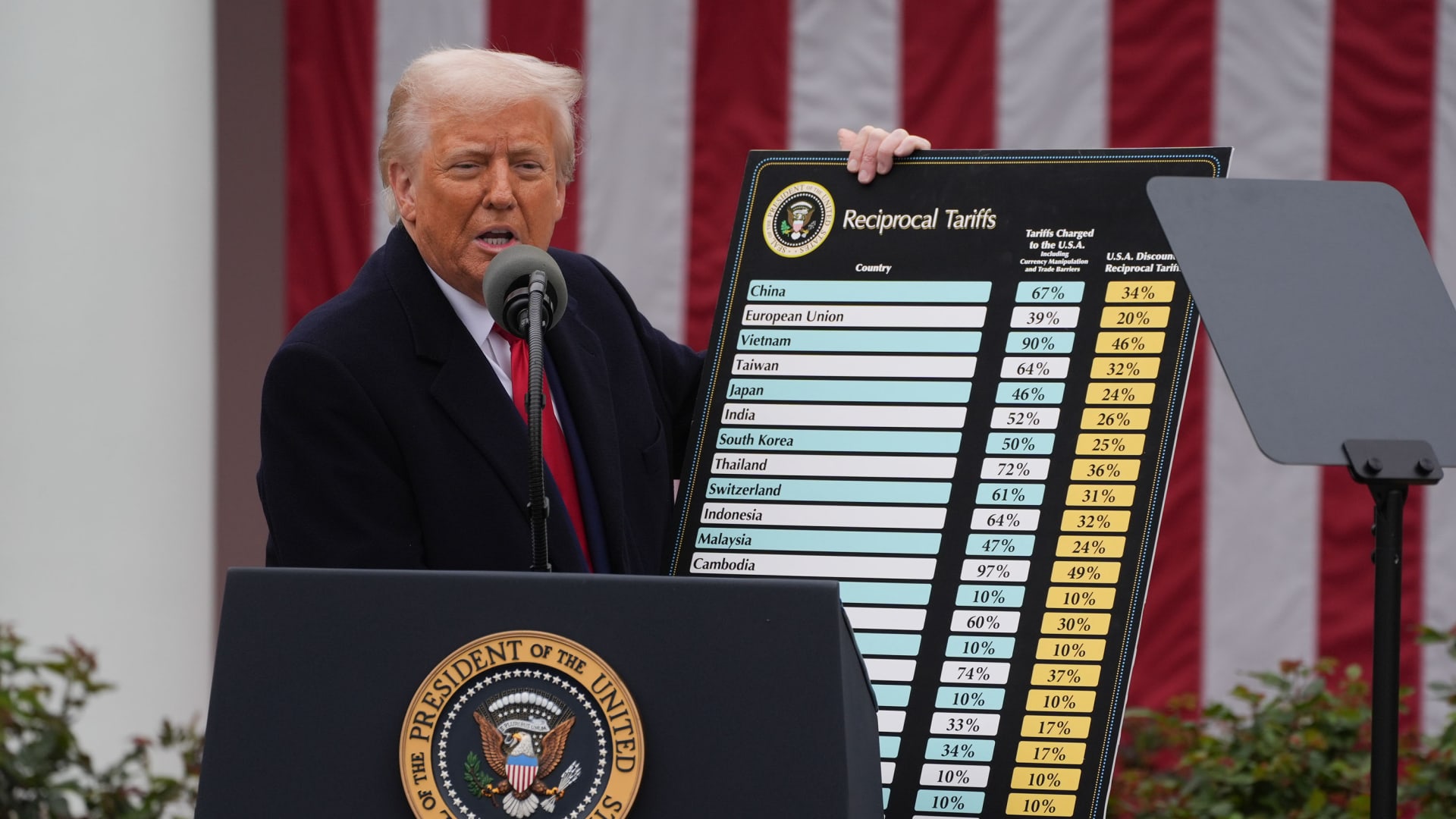
President Donald Trump holds a chart as he announces a plan for tariffs on imported goods during an event April 2, 2025, in the Rose Garden at the White House.
Demetrius Freeman/The Washington Post via Getty Images
The fate of many of President Trump’s tariffs is uncertain after a string of court rulings this week.
But even if a court block on country-specific tariffs is upheld, others that would remain on the books — for products like steel and automobiles — are still expected to cost consumers almost $1,000 a year, according to a new analysis by the Yale Budget Lab.
“It does pinch” consumers’ wallets, said Ernie Tedeschi, director of economics at the Yale Budget Lab and former chief economist at the White House Council of Economic Advisers during the Biden administration.
Tariffs are a tax paid on imports, paid by U.S. entities importing the good. Businesses are expected to pass on at least some of those costs to consumers.
However, the dollar impact of those remaining tariffs is “a far cry” from what it would be if the country-specific tariffs were to remain, he said.
The U.S. Court of International Trade on Wednesday blocked country-specific tariffs, including a 10% baseline tariff on most nations and separate levies on Canada, Mexico and China tied to allegations of fentanyl trafficking.
A three-judge panel found Trump exceeded his authority by invoking the International Emergency Economic Powers Act to impose those import duties.
An appeals court temporarily paused the order on Thursday as it reviews the case.

Steel, aluminum auto tariffs remain
However, 25% tariffs on steel, aluminum, automobiles and auto parts are still in place, with some carve-outs, as well as certain tariffs on China imposed during Trump’s first term and expanded during the Biden administration, Jennifer McKeown and Stephen Brown, economists at Capital Economists, wrote in a note Thursday.
Those tariffs were imposed using different legal authorities.
If the lower court’s order holds, those remaining tariffs would cost the average household $950 of purchasing power in 2025, according to the Yale Budget Lab analysis published Thursday. That amounts to a 0.6% increase in consumer prices, it found.
More from Personal Finance:
Trump administration axes Biden-era barrier for crypto in 401(k) plans
Trade schools may be a winner of battle between Trump, Harvard
Court order challenges Trump’s plan to move federal student loans
Another way consumers can view this legal development: The initial court ruling, if upheld, would save households more than $1,800 this year, said Tedeschi.
That’s because the average household would lose about $2,800 in 2025 if the country-specific tariffs were to stay on the books, Tedeschi said.
In that case, consumer prices would rise about 1.7% this year, he said.
McKeown and Brown estimate the court ruling would lower the effective tariff rate to 6.5% from 15%. It was 2.5% at the start of the year, they said.
“The most direct impact” of the remaining tariffs will be on car buying, Tedeschi said. Car prices would likely rise about 8% this year and 5% over the longer term, he said.
But steel and aluminum are inputs in a swath of consumer products, from homebuilding to household appliances.
Not necessarily ‘the end of things’ for tariffs
The Supreme Court may be the final arbiter for Trump’s country-specific tariffs, a process that may take “many months,” according to McKeown and Brown.
Additionally, “it would be unlikely to mark the end of the tariff war given the various other routes through which the Trump administration could impose tariffs,” they wrote.
The Trump administration has also signaled an intent to put duties on additional products like pharmaceuticals, semiconductors, copper and lumber.
Yesterday’s court decision was a “landmark ruling,” Tedeschi said. “I don’t expect it’ll be the end of things.”


Personal Finance
Next-Generation Retirement Planning: Managing Longevity Risk and Variable Income Streams


U.S.- Canada Trade Talks Collapse; Carney Says Retaliatory Tariffs Begin September 8

Flock Cameras and the Future of Public Security

AI Infrastructure Boom Hits Physical Limits: Power, Financing, and Supply Chain Strain

Armanino adds Strategic Accounting Outsourced Solutions

New 2023 K-1 instructions stir the CAMT pot for partnerships and corporations

Tax Strategy: Employee Retention Credit update
-

 Stock News1 week ago
Nvidia Earnings Preview: What Wall Street Expects From the AI Bellwether’s Q2 Report
-

 Accounting1 week ago
SEC’s Semiannual Reporting Proposal Faces Investor Pushback: What CFOs Need to Know
-

 Stock News1 week ago
Nvidia Q2 FY2027 Earnings beats Wall Street Expectation with Record $96.2 Billion Revenue
-

 Finance1 week ago
Treasury Bond Volatility Forces Bessent to Double Debt Buyback Size as Yields Swing
-
 Technology5 days ago
AI Infrastructure Boom Hits Physical Limits: Power, Financing, and Supply Chain Strain
-
 Technology3 days ago
Flock Cameras and the Future of Public Security
-
 Economics3 days ago
U.S.- Canada Trade Talks Collapse; Carney Says Retaliatory Tariffs Begin September 8