
Personal Finance
What a Harris presidency could mean for her LIFT Act proposal

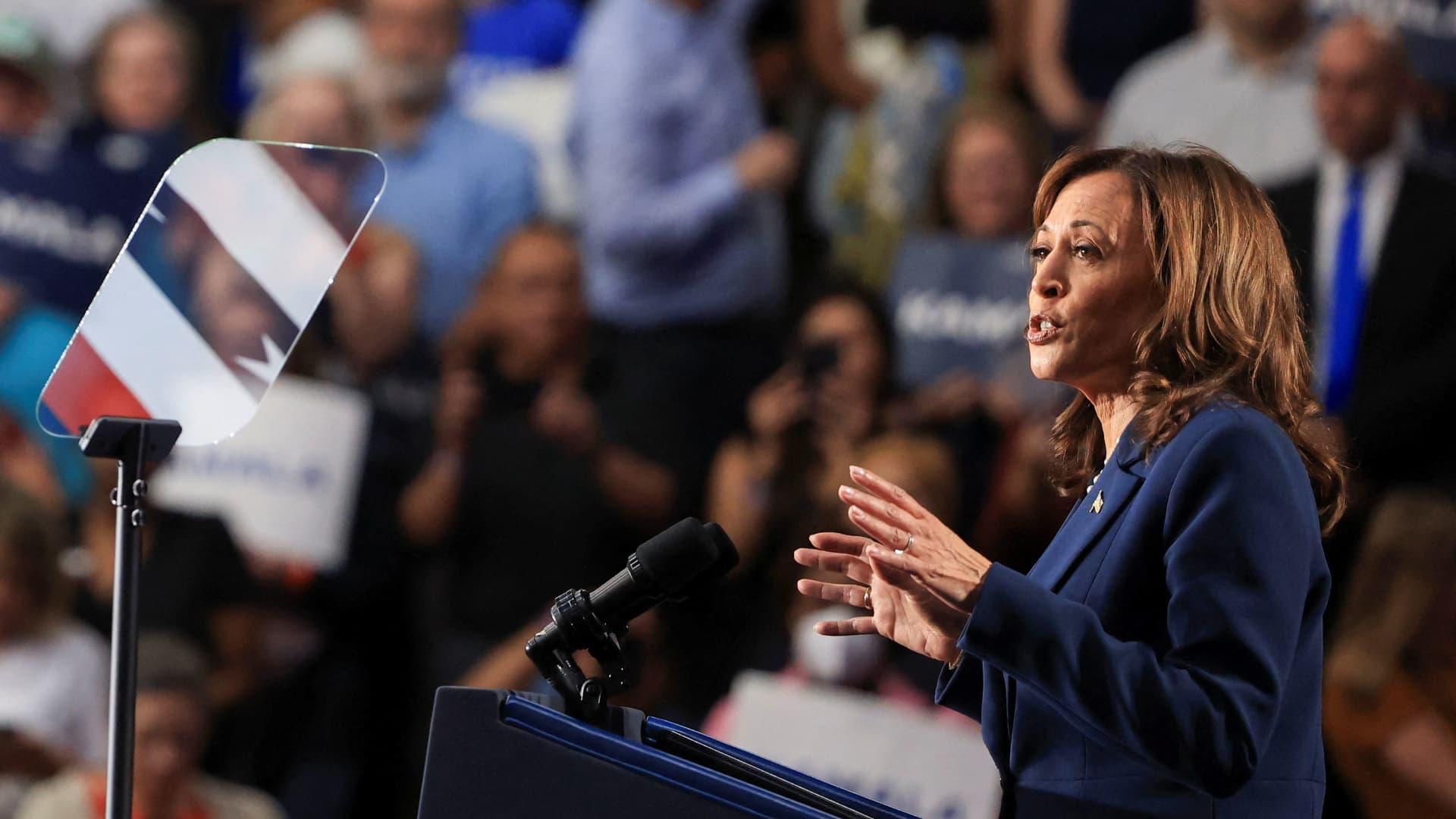
U.S. Vice President Kamala Harris delivers remarks during a campaign event at West Allis Central High School in West Allis, Wisconsin, on July 23, 2024.
Kevin Mohatt | Reuters
“Building up the middle class will be a defining goal of my presidency,” Vice President Kamala Harris said at a political event in West Allis, Wisconsin, on Tuesday — one of her first speeches since becoming the front-runner to replace President Joe Biden as the Democratic candidate for president.
As the Harris campaign takes shape, tackling the wealth gap is already front and center.
“When our middle class is strong, American is strong,” she said Tuesday.
That sentiment revisits an idea she has advocated for previously.
More from Personal Finance:
What a Kamala Harris administration could mean for you
Where Kamala Harris could stand on tax policy, experts say
JD Vance once called on GOP to fight student loan forgiveness
One of Harris’ signature proposals as senator — known as the LIFT the Middle Class Act, or Livable Incomes for Families Today — would have provided an annual tax credit of up to $3,000 per person (or $6,000 per couple) for lower- and middle-income workers, on top of the benefits they already receive.
The size of the credit would have amounted to “significant tax relief,” according to the Committee for a Responsible Federal Budget.
The Harris campaign did not immediately respond to CNBC’s request for comment.
How LIFT can help renters
In today’s climate, the LIFT Act could financially benefit renters, as many are part of the income category the tax credit is targeting, according to Francesco D’Acunto, an associate professor of finance at Georgetown University.
D’Acunto and other experts suggest the LIFT Act might even be a better aid for renters than the 5% rent cap proposal Biden unveiled on July 16. That proposal calls on Congress to cap rent increases from landlords with 50 existing units or more at 5% or risk losing federal tax breaks.

While the rent cap may lead consumers to believe prices will not increase significantly, it could have negative side effects, such as landlords taking their properties off the rental market, said Karl Widerquist, an economist and professor of philosophy at Georgetown University.
Plus, landlords who lose those federal tax breaks will still be able to raise rents, said Jacob Channel, a senior economist at LendingTree.
The advantage of the LIFT tax credit, said D’Acunto, is that it doesn’t create the same market distortions the rent cap would ignite. “But instead now on the side of the renter, we are actually very directly helping them to defray the effects of rent inflation,” he said.
Adds Widerquist: “We very often give tax benefits to all homeowners in the name of making it more affordable for people to become homeowners, and we don’t give a similar tax break to people who are paying rent. Those are the people who are struggling to become owners.”
What the LIFT Act would mean today
Since the LIFT Act was first proposed in 2018, the cost of living has only skyrocketed, hitting working-class Americans especially hard.
For these households, “real incomes have declined or remained flat due to inflation,” said Tomas Philipson, former chair of the White House Council of Economic Advisers. That makes many workers feel less confident about their financial standing — and less satisfied with Biden’s handling of the economy.
At the same time, the rise of artificial intelligence has stoked fears about long-term job security.
In that context, “there’s a good rationale” for refloating a tax credit for those making under a certain income threshold, according to Laura Veldkamp, a professor of finance and economics at Columbia University Business School.
“A lot of people are asking the question, ‘Will AI take my job?’ There are people whose hard-earned skills could be obsolete,” she said. “One way to deal with that is to have more social insurance.”
But a tax credit like LIFT would also be extremely costly, according to Tax Policy Center estimates from 2018 and 2019.
To help cover the tab for the additional financial support, Harris at the time proposed repealing provisions of the Tax Cuts and Jobs Act for taxpayers earning more than $100,000.
However, funding such a tax credit now could be tough amid growing concerns over the federal budget deficit. Harris will also need to address trillions of expiring tax cuts enacted by former President Donald Trump before 2025.
Focus on the child tax credit
LIFT was first proposed years before Congress temporarily expanded the child tax credit during the Covid-19 pandemic, which could now be a bigger priority, experts say.
The American Rescue Plan boosted the child tax credit to $3,000 from $2,000, with an extra $600 for children under age 6 for 2021, and families received up to half upfront via monthly payments.
The child poverty rate plunged to a historic low of 5.2% in 2021, largely due to the expansion, a Columbia University analysis found. Then in 2022, the rate more than doubled to 12.4% after pandemic relief expired, according to the U.S. Census Bureau.

“Whereas the last administration gave tax cuts to billionaires, we gave tax cuts to families through the child tax credit, which cut child poverty in America by half,” Harris said at a political event in North Carolina last week before the president left the race.
Biden’s fiscal year 2025 budget aimed to restore the 2021 child tax credit increase and House lawmakers in January passed a bipartisan tax package, which included a child tax credit expansion. However, the bill has been stuck in the Senate.
The enhanced tax break is “a huge priority for Democrats,” said Garrett Watson, senior policy analyst and modeling manager at the Tax Foundation.
Still, it’s unclear whether Harris will renew calls for LIFT or focus on the child tax credit, which has a different design but a similar goal, he said.
“It’s very hard to say whether they would revisit specific policy options from so long ago,” said Columbia Business School economics professor Brett House.
For now, “there are other cultural and political issues that are going to dominate.”


Personal Finance
Next-Generation Retirement Planning: Managing Longevity Risk and Variable Income Streams


U.S. Inflation Outlook for 2027

S&P 500 September Outlook: Tech Rally Holds Index at 7,600

India Unveils ‘Saptadhara’ Reform Agenda Targeting Technology, Youth Skilling, and Growth

Armanino adds Strategic Accounting Outsourced Solutions

New 2023 K-1 instructions stir the CAMT pot for partnerships and corporations

Tax Strategy: Employee Retention Credit update
-
 Stock News5 days ago
S&P 500 September Outlook: Tech Rally Holds Index at 7,600
-

 Economics1 week ago
U.S.- Canada Trade Talks Collapse; Carney Says Retaliatory Tariffs Begin September 8
-

 Finance5 days ago
S&P 500 Outperforms Amid Strong Corporate Earnings as Treasury Yields Cap Equity Multiples
-

 Technology1 week ago
Flock Cameras and the Future of Public Security
-

 Insights5 days ago
Climate Resilience and Offshore Wind and Land Restoration Milestones
-

 Accounting5 days ago
Mandatory ESG Reporting Standards Demand Standardized Non-Financial Audit Trails
-
 Leaders5 days ago
India Unveils ‘Saptadhara’ Reform Agenda Targeting Technology, Youth Skilling, and Growth
-
 Economics2 days ago
U.S. Inflation Outlook for 2027