
Finance
What ETFs are the best for those in or near retirement?


SlateStone Wealth chief market strategist Kenny Polcari discusses whether Nvidia can become a cash machine like Apple on ‘Making Money.’
Americans are retiring at a record-setting pace amid the aging of the baby boomer generation, and exchange-traded funds (ETFs) have become a popular way for retirees to invest in ways that align with their risk tolerance and diversification needs.
A recent report by the Alliance for Lifetime Income found that about 4.1 million Americans are projected to turn 65 on an annual basis from 2024 through 2025. That has pushed the number of Americans turning 65 each day from roughly 10,000 in the past decade to more than 11,200 this year.
ETFs can offer investors access to a variety of investment themes of interest to retirees, from equity ETFs optimized for dividend yields to bond ETFs yielding interest on government and corporate debt, as well as those modeled on broader indices like the S&P 500 or that have international exposure. Some can also include built-in hedging strategies to guard against downside risk.
IS A RETIREMENT SAVINGS CRISIS LOOMING?
“Investments are personal, and the ‘best’ ETFs for someone in or near retirement can vary widely, depending on their situation. Those in or near retirement should evaluate their situation in terms of their overall allocation, the time horizon for drawing down or growing their assets, and what level of risk they’re comfortable with,” said Lawrence Sprung, CFP and founder of Mitlin Financial.

Retirees can use ETFs to deliver income in retirement by targeting dividend or interest-paying ETFs, or use them to diversify their portfolios. (iStock / iStock)
“Investors that have a higher risk level and longer time horizon will be included to invest in more growth-oriented ETFs. On the other hand, investors who require income today from these assets with a lower risk tolerance will have their portfolios allocated more toward income-oriented investments,” Sprung added. “The ETFs that may be best for one investor may not be the best for another.”
IRS INCREASES 401(K), OTHER RETIREMENT PLAN CONTRIBUTION LIMITS FOR 2025
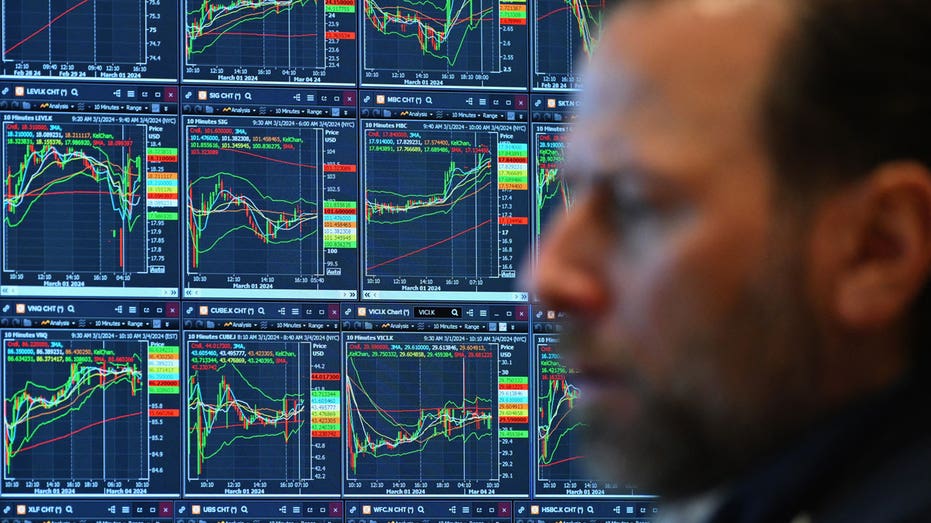
ETFs can be broadly diversified or may be narrowly focused on a certain part of the market. (Angela Weiss / AFP for Getty Images / Getty Images)
Some ETFs offer retirees and future retirees some downside risk protection, said Faron Daugs, the CEO of Harrison Wallace Financial Group.
“Often, these are referred to as buffered ETFs. They are generally tied to a stock market index and have various downside percentage protection in the event of a downturn in the market,” he said. “This type of ETF allows you to participate in potential growth opportunities but offers individuals a little bit of a parachute in the event of a downturn.”
“Another option to consider would be an ETF that invests in dividend-producing stocks. Typically, having a portfolio can generate you a return via a dividend, regardless of the stock performance, can serve as an attractive way to gain some growth potential and offer potential for return in some form – even if the price of the stock declines,” Daugs added.

ETFs can help investors diversify their portfolios by targeting specific types of assets more efficiently. (iStock / iStock)
ETF: WHAT THEY ARE AND HOW TO MAKE MONEY WITH THEM
If a retiree needs income during their golden years, an ETF that pays dividends or interest can be a wise investment, said Ted Jenkin, co-founder and consultant at oXYGen Financial.
“SPDR Portfolio S&P 500 High Dividend ETF (SPYD), Vanguard Dividend Appreciation Index Fund ETF Shares (VIG) and iShares Select Dividend ETF (DVY) are just a few to look at,” he said.
| Ticker | Security | Last | Change | Change % |
|---|---|---|---|---|
| SPYD | SPDR® PORTFOLIO S&P 500® HIGH DIVIDEND ETF – USD DIS | 46.40 | +0.53 | +1.16% |
| VIG | VANGUARD SPECIALIZED FUNDS DIVIDEND APPRECIATION ETF | 201.00 | +2.26 | +1.14% |
| DIVY | TIDAL ETF TRUST SOUND EQUITY DIV INC ETF | 26.88 | +0.11 | +0.40% |
Jared Levy, chief markets strategist at Peak American Financial, said that investors should be “extremely precise the closer they get to retirement” because they typically are shifting from “prioritizing growth to prioritizing protection.” Levy added that it’s “critical to have an all-weather portfolio that is not only balanced for your risk tolerance, but one that doesn’t become correlated if things start to fall apart.”
GET FOX BUSINESS ON THE GO BY CLICKING HERE
He said that one of his firm’s all-weather portfolios features the Protected S&P 500 ETF (BUFR) along with a mix of corporate and Treasury bond ETFs; bitcoin, gold and precious metal ETFs, a small-cap ETF based on the Russell 2000 and other investment instruments.





Treasury Bond Volatility Forces Bessent to Double Debt Buyback Size as Yields Swing

Nvidia Earnings Preview: What Wall Street Expects From the AI Bellwether’s Q2 Report

SEC’s Semiannual Reporting Proposal Faces Investor Pushback: What CFOs Need to Know

Armanino adds Strategic Accounting Outsourced Solutions

New 2023 K-1 instructions stir the CAMT pot for partnerships and corporations

Tax Strategy: Employee Retention Credit update
-

 Economics1 week ago
U.S. Retail Sales Fall for the First Time in Nine Months as Consumer Spending Slows
-

 Economics1 week ago
Nvidia’s Potential $3 Billion SB Energy Investment Could Reshape AI Infrastructure
-

 Economics4 days ago
Top 10 Largest Economies by 2030: IMF & World Bank GDP Projections for Global Powerhouses
-

 Stock News4 days ago
How to understand Intel $15B Stock Offering
-

 Technology1 week ago
U.S.-China AI Competition Intensifies as Washington Pushes Allies to Choose Sides
-
 Stock News21 hours ago
Nvidia Earnings Preview: What Wall Street Expects From the AI Bellwether’s Q2 Report
-

 Economics4 days ago
Economic Profile of the United States of America (2026–2030 Horizon)
-
 Leaders3 days ago
Jackson Hole 2026: What the First Symposium Under Fed Chair Kevin Warsh Means for Markets