
Personal Finance
What homeowners, renters need to do after a wildfire

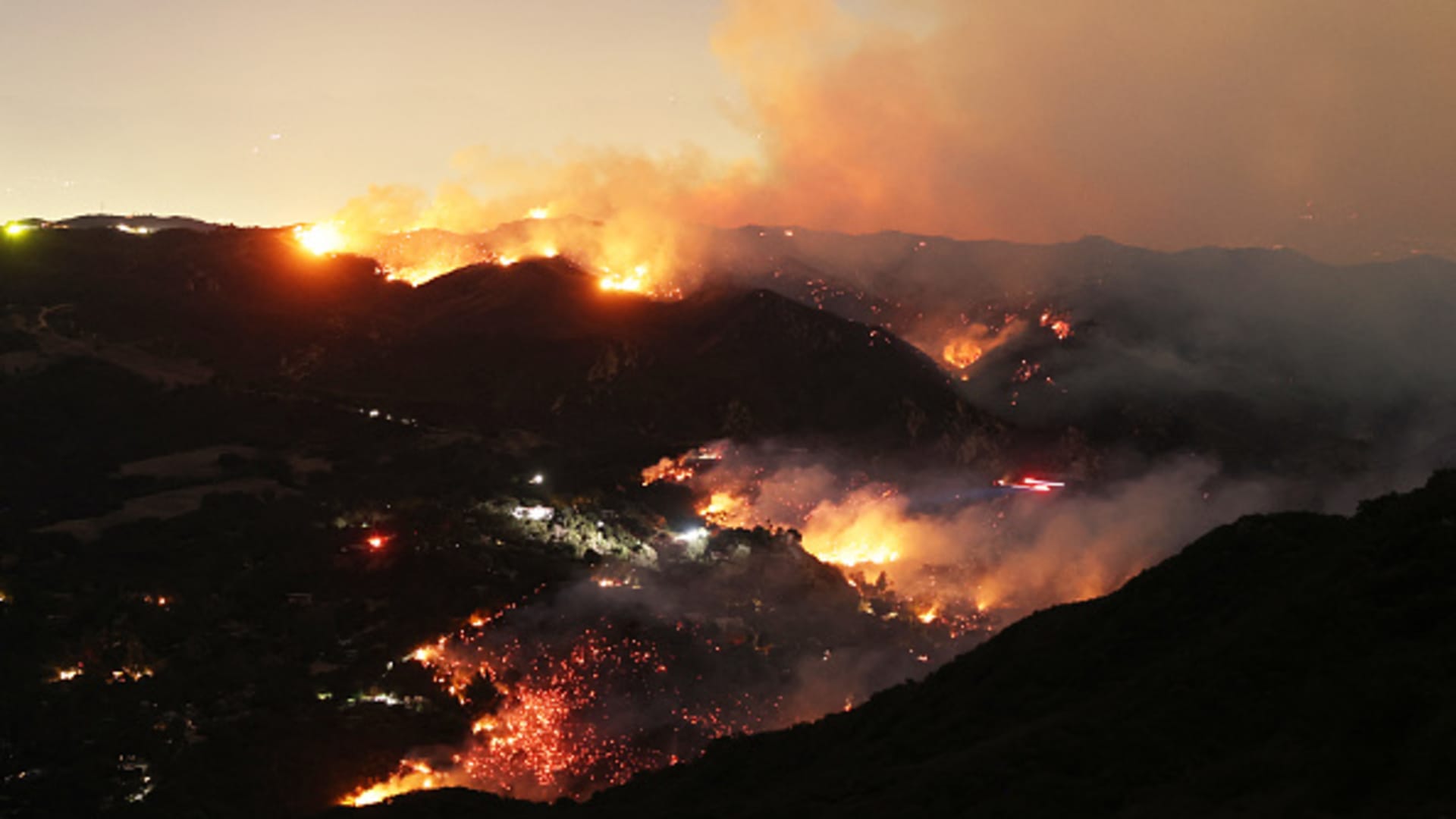
Flames and smoke from the Palisades Fire surround a home (C) in the community of Topanga, California, on January 9, 2025.
David Swanson | Afp | Getty Images
Firefighters are still working to contain the record-breaking fires that have been raging for more than a week in Southern California.
The fires in the Greater Los Angeles area have burned through 40,000 acres, destroying more than 12,300 structures, according to NBC News. About 88,000 L.A. residents are under evacuation orders and another 89,000 are in evacuation warning zones, meaning they may need to leave at a moment’s notice.
The insured losses from the early January wildfires may cost over $20 billion, according to estimates published last week by JPMorgan. Wells Fargo similarly estimated about $20 billion worth of insured losses with an approximate $60 billion economic loss.
As many affected residents are trying to figure out what’s next, one of the first things to do is kickstart the insurance process, according to Karl Susman, insurance broker and president of Susman Insurance Services in Los Angeles.
“Get your claim filed as quickly as you can,” he said. “You don’t have to have all of the information on hand.”
More from Personal Finance:
You may be paying to help make this industry more eco-friendly
IRS announces the start of the 2025 tax season
More than a million student loan borrowers got debt forgiven in 2024
Insurers are likely to take a longer time than usual to process claims because of the influx of applications, he said, so the sooner you get the ball rolling, the better.
If your primary residence has been affected by wildfire — whether you rent or own — experts advise taking these seven steps right away.
1. File the claim first, assess damage later
You don’t have to wait for firefighters to completely put out the fire to file an insurance claim.
Even if you’ve already evacuated and are unaware of the status of your home, you can still begin the claims process, Susman said.
Factors like the type and extent of the damage, the complexity of the claim and the volume of insured losses can affect the insurer’s processing time, experts say.
Renters have access to most of the same resources homeowners do, said Shannon Martin, a licensed insurance agent and analyst at Bankrate.com.
“For the most part, renters can follow the same process as homeowners,” she said. “You want to get yourself to safety, set up your insurance claim and then ask if you can get any additional living expenses in advance.”
2. Ask about ‘loss of use’ coverage
Ask your provider about “loss of use” coverage under your home insurance policy, said Jeremy Porter, head of climate implications research at First Street Foundation, an organization based in New York City that focuses on climate risk financial modeling.
The coverage would allow you to secure temporary housing or lodging while you’re out of your home, he said: “It’s there specifically to give people kind of a lifeline when they can’t move back into the dwelling.”
Tenants may have similar coverage — it’s generally known as Coverage D in renters insurance policies, Porter said.
3. Keep your receipts and document everything
If you have loss of use coverage, make sure to keep every receipt for any clothes, food and temporary housing or hotel stays you may need. Also keep track of your activities and document all of your conversations with insurers, according to Douglas Heller, director of insurance at the Consumer Federation of America.
“The better you document what you are doing as you go through this awful time, the easier it will be to demonstrate your claim for reimbursements,” he said.
4. Turn off your utilities
If the fire caused severe damage or you suffered a complete loss of your home, contact your utilities — such as electricity, water and trash collection companies — to temporarily shut off service. You may not have to pay for these services for the time being, Susman said.

5. Contact your auto insurer
If you lost a vehicle in the fire, the damage may be covered under your auto insurance policy, Susman said.
“It’s not going to be under your home [insurance policy] exactly, even if the car was in your driveway,” Susman said.
Look for what’s called comprehensive coverage under your auto insurance, he said.
If you have comprehensive coverage on your car, you’re typically covered for wildfire loss, and “you just have to pay your deductible,” Bankrate’s Martin said.
6. Don’t forget property taxes
If your home suffered damages, or was a total loss, go to your county assessor’s website and type in your address.
If you’ve sustained more than $10,000 in damages, or the home is a total loss, you can file for an application to reduce or eliminate your property tax while the dwelling is under construction or uninhabitable, insurance expert Susman said.
“That’s something that people tend to not know or they overlook it,” he said.
7. Tap local aid opportunities
If you were not previously covered or your coverage was canceled before the disaster hit, keep an eye out for aid that may become available for those affected by the wildfires, Susman said.
“For people that had zero insurance, [there will] probably be some type of assistance that will be available,” Susman said.
During a White House briefing, President Joe Biden announced a one-time payment of $770 through the Federal Emergency Management Agency is available for the wildfire victims. Nearly 6,000 survivors have registered for the aid and $5.1 million has gone out, according to The White House.
Those impacted can file for aid via DisasterAssistance.gov or FEMA’s hotline at 1-800-621-3362.
California’s Insurance Commission can be reached at 1-800-927-4357 to help individuals navigate the process as well as help uninsured victims.
FEMA is also providing assistance to those affected by the wildfires.
If you were not previously covered by an insurance plan, the agency’s Individuals and Households Program may provide funds for temporary housing.
Affected individuals can apply online at DisasterAssistance.gov or by calling 1-800-621-3362.
Seek out local support groups and workshops. The Insurance Commission of California will host its first workshop involving government representatives and insurers on Jan. 18-19 at Santa Monica College. Follow-up events are scheduled on Jan. 25- 26 at Pasadena College.
Some charities and nonprofits are actively accepting donations and are engaging in recovery efforts in the Pacific Palisades and surrounding areas.


Personal Finance
Next-Generation Retirement Planning: Managing Longevity Risk and Variable Income Streams


U.S.- Canada Trade Talks Collapse; Carney Says Retaliatory Tariffs Begin September 8

Flock Cameras and the Future of Public Security

AI Infrastructure Boom Hits Physical Limits: Power, Financing, and Supply Chain Strain

Armanino adds Strategic Accounting Outsourced Solutions

New 2023 K-1 instructions stir the CAMT pot for partnerships and corporations

Tax Strategy: Employee Retention Credit update
-

 Stock News1 week ago
Nvidia Q2 FY2027 Earnings beats Wall Street Expectation with Record $96.2 Billion Revenue
-
 Technology5 days ago
AI Infrastructure Boom Hits Physical Limits: Power, Financing, and Supply Chain Strain
-
 Technology3 days ago
Flock Cameras and the Future of Public Security
-
 Economics3 days ago
U.S.- Canada Trade Talks Collapse; Carney Says Retaliatory Tariffs Begin September 8