
Personal Finance
What it means for Social Security benefits

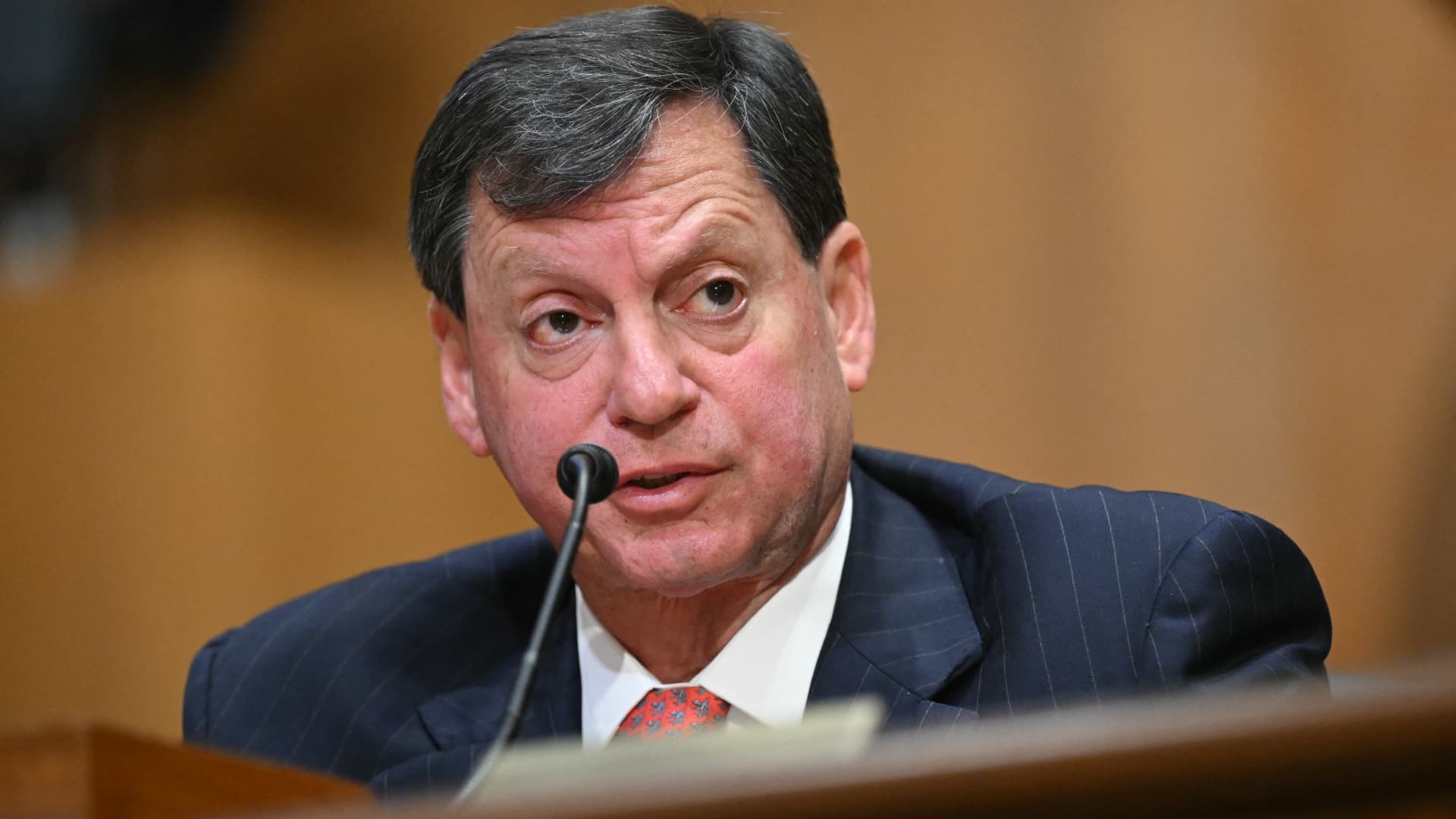
Frank Bisignano testifies before the Senate Finance Committee on his nomination to be Commissioner of the Social Security Administration, on Capitol Hill in Washington, DC, March 25, 2025.
Saul Loeb | AFP | Getty Images
The Senate has voted to confirm Frank Bisignano as the new commissioner of the Social Security Administration, ushering in new leadership at a federal agency that has already undergone many changes this year under the Trump administration’s Department of Government Efficiency.
Bisignano, the chairman and CEO of payments and financial technology company Fiserv Inc., was nominated to serve as Social Security commissioner in December by then President-elect Donald Trump. Trump started his second term on Jan. 20.
The Social Security Administration, which provides monthly benefit checks to more than 73 million beneficiaries, is currently operating under temporary leadership. Acting commissioner Leland Dudek took the helm in February, replacing Michelle King, who stepped down from the temporary role due to concerns about DOGE’s access to sensitive data.
A federal judge has since granted a preliminary injunction that prevents DOGE from accessing personally identifiable information including Social Security numbers, medical records, addresses, bank records, tax information and other sensitive data.
Bisignano’s confirmation vote on Tuesday was divided by party lines. Prior to the vote, Republicans had expressed support for Trump’s nominee, while Democrats raised concerns about Bisignano’s prospective leadership and his alleged ties to DOGE.
More from Personal Finance:
Social Security reduces benefit clawback rate
Trump administration restarts student loan collections
What experts say about claiming Social Security benefits early
On the eve of the Senate confirmation vote, Democrats including Sens. Elizabeth Warren of Massachusetts and Ron Wyden of Oregon held a rally outside the Senate building to oppose Bisignano’s nomination.
“We want Donald Trump to stand with working families and seniors and stop the attack on Social Security once and for all,” Wyden, ranking member of the Senate Finance Committee, said at the Monday event.
Following the Tuesday Senate vote, advocacy groups expressed concern about the new agency leadership.
“This vote was an opportunity for the Senate to reject the decimation of Social Security, and demand that Trump nominate a commissioner who will stop the bleeding,” Nancy Altman, president of Social Security Works, said in a statement. “Instead, every Senate Republican just signed off on the DOGE destruction of Social Security.”
Neither Fiserv nor the White House responded to CNBC’s requests for comment by press time.
Who is Frank Bisignano?
Bisignano currently serves as chairman and CEO of Fiserv, which processes more than $2.5 trillion in payments per day, according to his Senate testimony.
Bisignano came to that role after serving as chairman and CEO of First Data Corp., which went public in 2015 and combined with Fiserv in 2019.
Before that, Bisignano was co-chief operating officer for JPMorgan Chase and CEO of its mortgage banking unit. Prior to JPMorgan Chase, he held several roles at Citigroup.
Bisignano was raised in a working class, multigenerational immigrant household in Brooklyn, New York, according to his Senate testimony. Bisignano’s father was a 46-year Department of Treasury employee who worked in customs enforcement.
“He was the hardest working person I’ve known,” Bisignano said in his Senate testimony. “I view federal workers from that vantage point.”
What lawmakers said about Bisignano’s nomination
During the consideration of Bisignano’s nomination, Democrats repeatedly raised concerns about his viability to lead the agency.
Warren and Wyden sent a letter to Bisignano ahead of his March confirmation hearing to ask about his views on privatizing the agency. The efforts by DOGE to “hollow out” the agency and “deprive Americans of Social Security benefits they earned and need” may pave the way for a “private sector fix,” the Democratic leaders said.
In his Senate testimony, Bisignano said he did not intend to privatize the agency.
“I’ve never thought about privatizing,” Bisignano said. “It’s not a word that anybody’s ever talked to me about. I don’t see this institution as anything other than a government agency that gets run for the American public.”

During the Senate hearing, Bisignano also faced questions about his involvement with recent changes at the Social Security Administration and with DOGE.
Wyden introduced an anonymous whistleblower letter from a “senior Social Security Administration employee who recently left the agency,” who said Bisignano had been briefed on “key SSA operations, personnel and management decisions.”
In response to a question about whether he would “lock DOGE out,” Bisignano promised to protect personally identifiable information.
“I am going to do whatever is required to protect the information that is private,” Bisignano said.
However, during a February CNBC interview, Bisignano said he is “fundamentally a DOGE person.”
While Democrats have cast doubt on Bisignano’s nomination, the Fiserv CEO has received praise from Republicans and former Citigroup CEO Sandy Weill.
In a March CNBC interview, Weill praised Bisignano as a “great manager” and “terrific person.”
“He used to work for me, and I think he’s the best operations person I’ve ever met in my life,” Weill said, adding we would be “very lucky to have him in that job.”
What Bisignano has said about Social Security
During a March Senate confirmation hearing, as he fielded questions from senators on a host of issues facing the Social Security Administration, Bisignano said it will be important to “put the beneficiaries first.”
“The ability to receive payments on time and accurately is job one,” Bisignano said.
Among the priorities Bisignano said he would emphasize if confirmed include bringing the Social Security’s error rate down, citing an Office of the Inspector General report that put it at around 1%.
“That’s a very high payment processing error rate,” Bisignano said, calling it “five decimal places too high.”
Reducing the agency’s error rate will help eliminate overpayment issues, where beneficiaries receive too much money in their benefit checks. Those errors, which may take months or years to catch, typically leave beneficiaries owing large sums to the Social Security Administration.
From fiscal years 2015 through 2022, the Social Security Administration paid about $71.8 billion in improper payments out of almost $8.6 trillion in benefits, representing about 0.84%, according to a 2024 Office of the Inspector General report.
The agency is currently in the process of adjusting the default withholding rate to 50% for certain benefits affected by overpayments, such as retirement, survivors and disability insurance. Under President Joe Biden, the default rate had been lowered to 10% of monthly benefits or $10, whichever was greater.
“I’m going to make sure that we recover all the money we should recover, but on the other hand we have to be humans in the process, too,” Bisignano told the Senate about overpayment clawbacks.
Bisignano also said he planned to reduce the chronically long wait times Americans face when seeking help from the agency, including when calling its 800 number or when applying for disability benefits.
Having to wait for more than 20 minutes on the phone is not acceptable, Bisignano said. Social Security Administration data shows only about 46% of calls get answered, likely because people get discouraged and hang up, he said.
“I think we could get that to under a minute,” Bisignano said of the agency’s phone wait times, in part by making AI available to people answering the phones to more quickly prompt them with the information they need to answer individuals’ queries.
Bisignano also promised to investigate why it takes so much time to process disability applications. Initial eligibility determinations currently take around seven months, a wait time that has doubled since prior to the Covid-19 pandemic, according to the Urban Institute.


Personal Finance
Next-Generation Retirement Planning: Managing Longevity Risk and Variable Income Streams


U.S.- Canada Trade Talks Collapse; Carney Says Retaliatory Tariffs Begin September 8

Flock Cameras and the Future of Public Security

AI Infrastructure Boom Hits Physical Limits: Power, Financing, and Supply Chain Strain

Armanino adds Strategic Accounting Outsourced Solutions

New 2023 K-1 instructions stir the CAMT pot for partnerships and corporations

Tax Strategy: Employee Retention Credit update
-

 Stock News1 week ago
Nvidia Earnings Preview: What Wall Street Expects From the AI Bellwether’s Q2 Report
-

 Accounting1 week ago
SEC’s Semiannual Reporting Proposal Faces Investor Pushback: What CFOs Need to Know
-

 Stock News1 week ago
Nvidia Q2 FY2027 Earnings beats Wall Street Expectation with Record $96.2 Billion Revenue
-

 Finance1 week ago
Treasury Bond Volatility Forces Bessent to Double Debt Buyback Size as Yields Swing
-
 Technology5 days ago
AI Infrastructure Boom Hits Physical Limits: Power, Financing, and Supply Chain Strain
-
 Technology3 days ago
Flock Cameras and the Future of Public Security
-
 Economics3 days ago
U.S.- Canada Trade Talks Collapse; Carney Says Retaliatory Tariffs Begin September 8