
Personal Finance
What that means for you

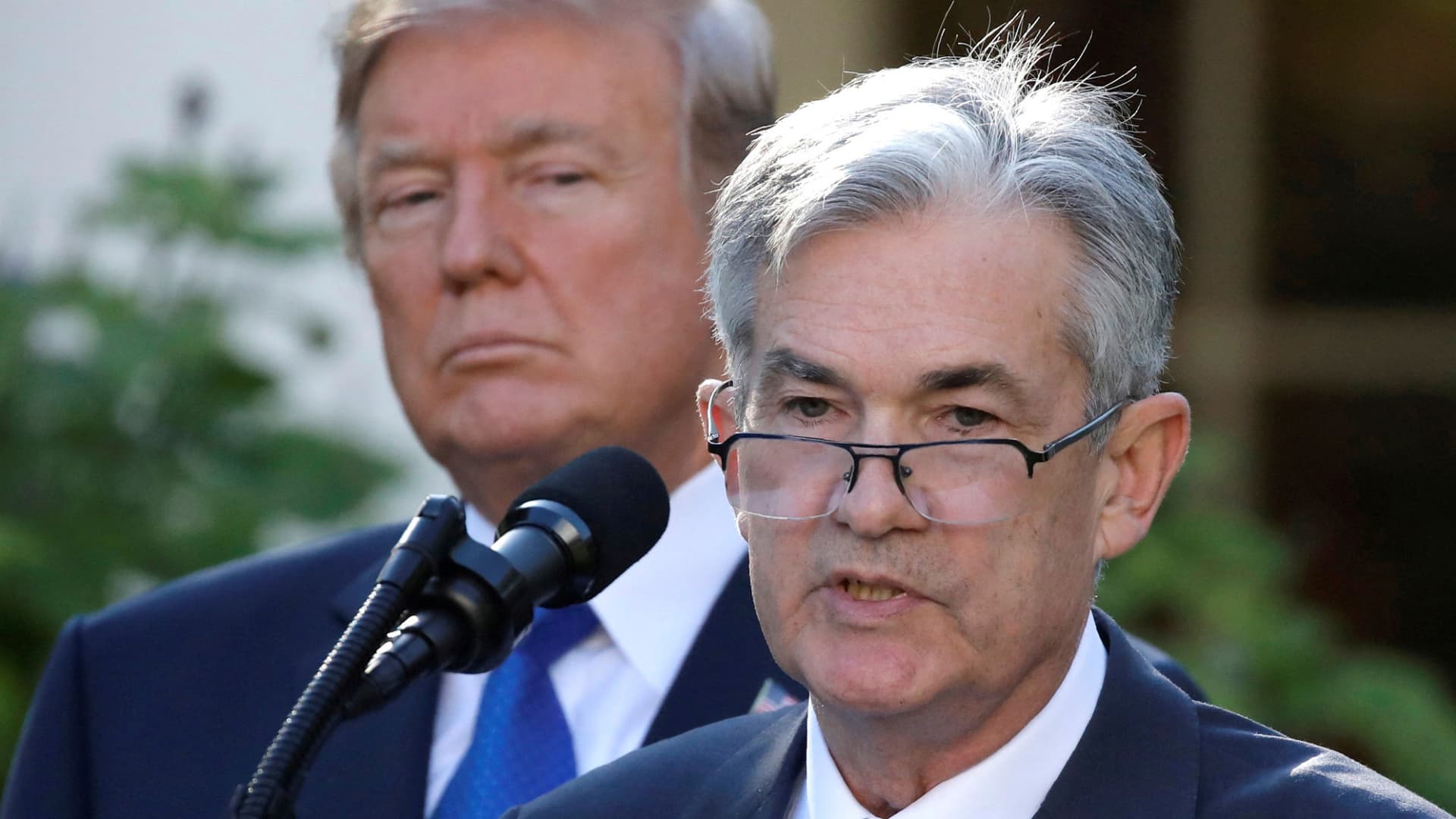
U.S. President Donald Trump looks on as Fed Chair Jerome Powell speaks at the White House in Washington on Nov. 2, 2017.
Carlos Barria | Reuters
Political pressure is mounting against the Federal Reserve Chair Jerome Powell, and yet the Federal Reserve is expected to hold interest rates steady at the end of its two-day meeting this week.
Despite a wave of recent attacks on Powell from President Donald Trump, futures market pricing is implying virtually no chance of an interest rate cut, according to the CME Group’s FedWatch gauge.
The president has argued that maintaining a fed funds rate that is too high makes it harder for businesses and consumers to borrow, adding more strain to the U.S. economy. The federal funds rate sets what banks charge each other for overnight lending, but also affects many of the borrowing and savings rates most Americans see every day.
More from Personal Finance:
Here’s the inflation breakdown for May 2025
What’s happening with unemployed Americans — in five charts
The economic cost of Trump, Harvard battle over student visas
With a rate cut likely postponed until at least September, consumers struggling under the weight of high prices and high borrowing costs aren’t getting much relief, experts say.
“The combination of high interest rates, stubborn inflation and economic uncertainty is a pretty challenging one,” said Matt Schulz, chief credit analyst at LendingTree. “Most Americans don’t have a ton of wiggle room and today they have even less.”
From credit cards and mortgage rates to auto loans and savings accounts, here’s a look at how the Fed plays a role in your finances.
Credit cards
Credit card debt continues to be a pain point for consumers struggling to keep up with high prices. Since most credit cards have a variable rate, there’s a direct connection to the Fed’s benchmark.
But even with the Fed on the sidelines, credit card rates have edged higher. The average annual percentage rate is currently just over 20%, according to Bankrate, not far from last year’s all-time high.
“This is a sign of banks trying to protect themselves from the risk that is out there in these uncertain times,” Schulz said. However, in this case, there is something consumers can do about higher APRs.

“The truth is that people have way more power over the rates they pay than they think they do, especially if they have good credit,” Schulz said.
Rather than wait for a rate cut that may be months away, borrowers could switch now to a zero-interest balance transfer credit card or consolidate and pay off high-interest credit cards with a lower-rate personal loan, he said.
Mortgages
Since 15- and 30-year mortgages are largely tied to Treasury yields and the economy, those rates haven’t moved much — and that hasn’t helped would-be buyers.
The average rate for a 30-year, fixed-rate mortgage has stayed within the same narrow range for months and is currently near 6.9%, according to Bankrate. Tack on the nationwide problem of limited inventory and housing affordability remains a key issue, regardless of the Fed’s next move.
“I don’t see any major changes coming in the immediate future, meaning that those shopping for a home this summer should expect rates to remain relatively high,” Schulz said.
Auto loans
Auto loan rates are fixed, and not directly tied to the Fed. But payments are getting bigger because car prices are rising, in part due to impacts from Trump’s trade policy.
Currently, the average rate on a five-year new car loan is 7.24%, according to Bankrate.
The growth in median car payments is outpacing both new and used car prices, according to separate data from Bank of America. Now, of those households with a monthly car payment, 20% pay more than $1,000 a month.
“Combine that with the potential for tariffs to drive auto prices even higher, and it adds up to a really challenging time to buy a car,” Schulz said. “However, shopping for the best rate and getting approved for financing before you ever set foot in the dealership can bring significant savings,” he added.
Student loans
Federal student loan rates are set once a year, based in part on the last 10-year Treasury note auction in May and fixed for the life of the loan, so most borrowers are somewhat shielded from Fed moves and recent economic turmoil.
Current interest rates on undergraduate federal student loans made through June 30 are at 6.53%. Starting July 1, the interest rates will be 6.39%.
Although borrowers with existing federal student debt balances won’t see their rates change, many are now facing other headwinds and fewer federal loan forgiveness options.
Savings
On the upside, top-yielding online savings accounts still offer above-average returns and currently pay more than 4%, according to Bankrate.
While the central bank has no direct influence on deposit rates, the yields tend to be correlated to changes in the target federal funds rate — so holding that rate unchanged has kept savings rates elevated, for now.
“The thing that is lost in this, is that savers, including millions of retirees, are actually earning good income on their savings, provided they have their money parked in a competitive place,” said Greg McBride, Bankrate’s chief financial analyst.


Personal Finance
Next-Generation Retirement Planning: Managing Longevity Risk and Variable Income Streams


U.S.- Canada Trade Talks Collapse; Carney Says Retaliatory Tariffs Begin September 8

Flock Cameras and the Future of Public Security

AI Infrastructure Boom Hits Physical Limits: Power, Financing, and Supply Chain Strain

Armanino adds Strategic Accounting Outsourced Solutions

New 2023 K-1 instructions stir the CAMT pot for partnerships and corporations

Tax Strategy: Employee Retention Credit update
-

 Stock News1 week ago
Nvidia Earnings Preview: What Wall Street Expects From the AI Bellwether’s Q2 Report
-

 Accounting1 week ago
SEC’s Semiannual Reporting Proposal Faces Investor Pushback: What CFOs Need to Know
-

 Stock News1 week ago
Nvidia Q2 FY2027 Earnings beats Wall Street Expectation with Record $96.2 Billion Revenue
-

 Finance1 week ago
Treasury Bond Volatility Forces Bessent to Double Debt Buyback Size as Yields Swing
-
 Technology5 days ago
AI Infrastructure Boom Hits Physical Limits: Power, Financing, and Supply Chain Strain
-
 Technology3 days ago
Flock Cameras and the Future of Public Security
-
 Economics3 days ago
U.S.- Canada Trade Talks Collapse; Carney Says Retaliatory Tariffs Begin September 8