
Personal Finance
What the VP picks could mean for your wallet

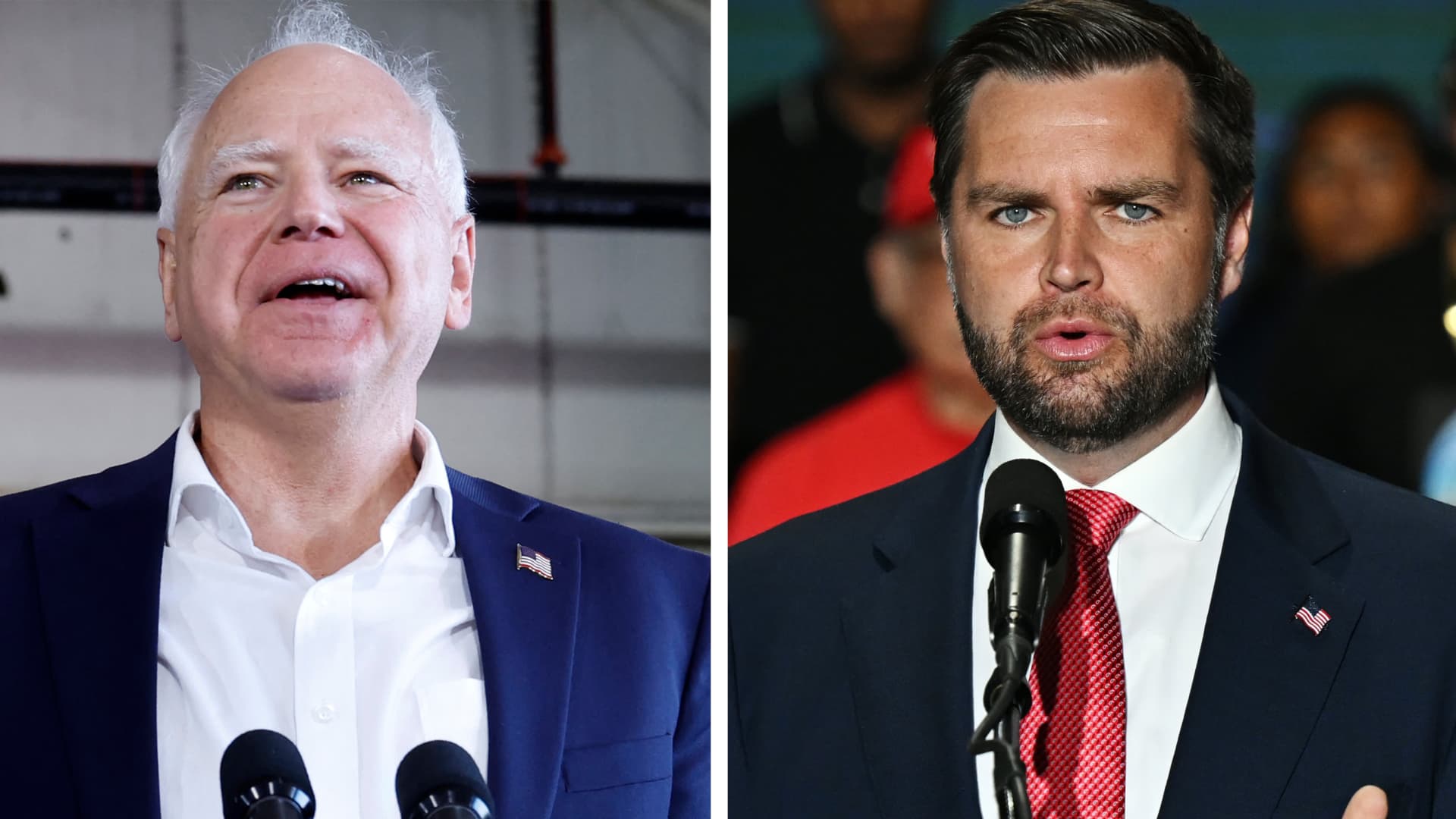
Democratic vice presidential candidate and Minnesota Governor Tim Walz (L), and Republican Vice Presidential candidate Sen. JD Vance (R-OH).
Getty Images
Housing
Affordable housing is an important topic for many Americans and both Walz and Vance have addressed the issue.
In May 2023, Walz signed housing legislation that included $200 million in down payment assistance. The bill also had $200 million for housing infrastructure and $40 million for workforce housing.
“We expect Walz to be an advocate for demand-side approaches to housing,” Jaret Seiberg, analyst at TD Cowen wrote in a July statement. “These are the type of housing ideas we would expect in a Harris administration,” she wrote.
Demand-side approaches to housing aim to help individual households by improving housing quality or reducing monthly housing costs.
Meanwhile, Vance, who is also a proponent of affordable housing, highlighted the issue in his Republican National Convention acceptance speech and along the campaign trail.
“Prior to running for Senate, Vance argued that one key to tackling poverty is to address affordable housing,” and he has opposed institutional ownership of rental homes and Chinese buyers for U.S. real estate, Seiberg wrote.
Child tax credit
Without action from Congress, trillions of tax breaks enacted by Trump are scheduled to expire after 2025, including the child tax credit, which will drop from $2,000 to $1,000 per child.
Congress in 2021 approved a temporary expansion of the child tax credit, including upfront monthly payments, which reduced the child poverty rate to a historic low of 5.2% for 2021, according to a Columbia University analysis.
Following the federal policy, Minnesota enacted a refundable state-level child tax credit in 2023, which Walz described as “signature accomplishment.”
Minnesota’s new child tax credit is unusual in its narrowness, but it is the most generous in the nation for low-income households.
Jared Walczak
Vice president of state projects at the Tax Foundation
“Minnesota’s new child tax credit is unusual in its narrowness,” said Jared Walczak, vice president of state projects at the Tax Foundation. “But it is the most generous in the nation for low-income households.”
However, a permanent federal child tax credit expansion could be difficult, particularly amid a divided Congress and increasing concerns over the federal budget deficit.
Walz’s campaign did not respond to CNBC’s request for comment.
Senate Republicans blocked a federal child tax credit expansion last week, and Sen. Mike Crapo, R-Idaho, the ranking member of the Senate Finance Committee, described the vote as a “blatant attempt to score political points.”
Despite the failed procedural vote, Crapo voiced openness to negotiating a “child tax credit solution that a majority of Republicans can support.”
Democrats scheduled the vote partially in response to Vance, who has positioned himself as a pro-family candidate. Vance was not present for the Senate vote, but has expressed support for the child tax credit.
Vance’s campaign did not respond to CNBC’s request for comment.
Student loans
Vance has spoken out against student loan forgiveness policies.
“Forgiving student debt is a massive windfall to the rich, to the college educated, and most of all to the corrupt university administrators of America,” Vance, a Yale Law School graduate wrote on X in April 2022. “Republicans must fight this with every ounce of our energy and power.”
Outstanding education debt in the U.S. stands at around $1.6 trillion. Nearly 43 million people — or 1 in 6 adult Americans — carry student loans. Women and people of color are most burdened by the debt.

Vance does seem to approve of loan forgiveness in extreme cases. In May, he helped introduce legislation that would excuse parents from student loans they took on for a child who became permanently disabled.
Jane Fox, chapter chair of the Legal Aid Society Attorneys union, UAW local 2325, said it was hypocritical and incorrect of Vance to frame debt relief as a benefit to those who are well off.
“Student debt forgiveness is a working-class issue,” Fox said. “Those in the 1% who went to elite institutions and then worked in private equity as Senator Vance did rarely need debt relief.”
Vance’s campaign did not respond to CNBC’s request for comment.
Meanwhile, Walz, a former school teacher, has supported programs to alleviate the burden of student debt on people, said higher education expert Mark Kantrowitz.
He signed a student loan forgiveness program for nurses into law in Minnesota, Kantrowitz said, as well as a free tuition initiative for low-income students.
“As my daughter prepares to head off to college next year, affordability and student loan debt are at the front of our minds,” Walz wrote on Facebook in 2018. “Every Minnesotan deserves a shot at a great education without being held back by soaring costs and student loan debt.”


Personal Finance
Next-Generation Retirement Planning: Managing Longevity Risk and Variable Income Streams


S&P 500 September Outlook: Tech Rally Holds Index at 7,600

India Unveils ‘Saptadhara’ Reform Agenda Targeting Technology, Youth Skilling, and Growth

S&P 500 Outperforms Amid Strong Corporate Earnings as Treasury Yields Cap Equity Multiples

Armanino adds Strategic Accounting Outsourced Solutions

New 2023 K-1 instructions stir the CAMT pot for partnerships and corporations

Tax Strategy: Employee Retention Credit update
-

 Stock News1 week ago
Nvidia Q2 FY2027 Earnings beats Wall Street Expectation with Record $96.2 Billion Revenue
-

 Technology6 days ago
AI Infrastructure Boom Hits Physical Limits: Power, Financing, and Supply Chain Strain
-

 Economics4 days ago
U.S.- Canada Trade Talks Collapse; Carney Says Retaliatory Tariffs Begin September 8
-

 Technology4 days ago
Flock Cameras and the Future of Public Security
-

 Insights1 hour ago
Climate Resilience and Offshore Wind and Land Restoration Milestones
-
 Stock News2 minutes ago
S&P 500 September Outlook: Tech Rally Holds Index at 7,600
-

 Accounting1 hour ago
Mandatory ESG Reporting Standards Demand Standardized Non-Financial Audit Trails
-
 Finance39 minutes ago
S&P 500 Outperforms Amid Strong Corporate Earnings as Treasury Yields Cap Equity Multiples