
Finance
Why Italy could see big M&A deals in banking

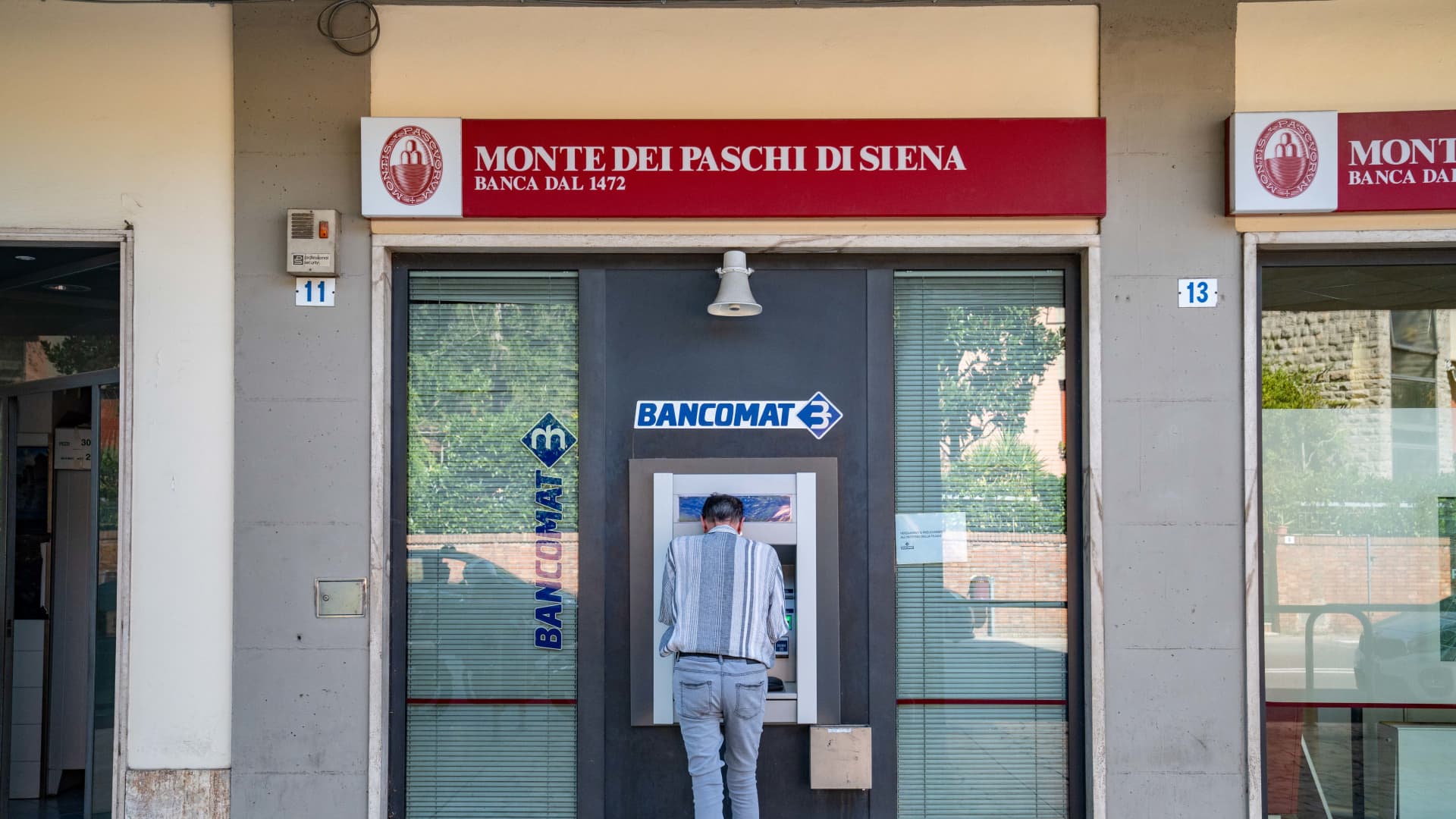
Banking analysts assess the possibility of a banking merger in Italy.
Bloomberg | Bloomberg | Getty Images
MILAN, Italy — European policymakers have longed for bigger banks across the continent.
And Italy might be about to give them their wish with a bumper round of M&A, according to analysts.
Years after a sovereign debt crisis in the region and a government rescue for Banca Monte dei Paschi (BMPS) that saved it from collapse, many are looking at Italy’s banking sector with fresh eyes.
“If you assess individual banks in Italy, it’s difficult not to believe that something will happen, I would say, over the next 12 months or so,” Antonio Reale, co-head of European banks at Bank of America, told CNBC.
Reale highlighted that BMPS had been rehabilitated and needed re-privatization, he also said UniCredit is now sitting on a “relatively large stack of excess of capital,” and more broadly that the Italian government has a new industrial agenda.
UniCredit, in particular, continues to surprise markets with some stellar quarterly profit beats. It earned 8.6 billion euros last year (up 54% year-on-year), pleasing investors via share buybacks and dividends.
Meanwhile, BMPS, which was saved in 2017 for 4 billion euros, has to eventually be out back into private hands under an agreement with European regulators and the Italian government. Speaking in March, Italy’s Economy Minister Giancarlo Giorgetti said “there is a specific commitment” with the European Commission on the divestment of the government stake on BMPS.

“In general, we see room for consolidation in markets such as Italy, Spain and Germany,” Nicola De Caro, senior vice president at Morningstar, told CNBC via email, adding that “domestic consolidation is more likely than European cross-border mergers due to some structural impediments.”
He added that despite recent consolidation in Italian banking, involving Intesa-Ubi, BPER-Carige and Banco-Bpm, “there is still a significant number of banks and fragmentation at the medium sized level.”
“UniCredit, BMPS and some medium sized banks are likely to play a role in the potential future consolidation of the banking sector in Italy,” De Caro added.
Speaking to CNBC in July, UniCredit CEO Andrea Orcel indicated that at current prices, he did not see any potential for deals in Italy, but said he is open to that possibility if market conditions were to change.
“In spite our performance, we still trade at a discount to the sector […] so if I were to do those acquisitions, I would need to go to my shareholders and say this is strategic, but actually I am going to dilute your returns and I am not going to do that,” he said.

“But if it changes, we are here,” he added.
Paola Sabbione, an analyst at Barclays, believes there would be a high bar for Italian banking M&A if it does occur.
“Monte dei Paschi is looking for a partner, UniCredit is looking for possible targets. Hence from these banks, in theory several combinations could arise. However, no bank is in urgent need,” she told CNBC via email.
European officials have been making more and more comments about the need for bigger banks. French President Emmanuel Macron, for example, said in May in an interview with Bloomberg that Europe’s banking sector needs greater consolidation. However, there’s still some skepticism about supposed mega deals. In Spain, for instance, the government opposed BBVA’s bid for Sabadell in May.
“Europe needs bigger, stronger and more profitable banks. That’s undeniable,” Reale from Bank of America said, adding that there are differences between Spain and Italy.
“Spain has come a long way. We’ve seen a big wave of consolidation happen[ing] right after the Global Financial Crisis and continued in recent years, with a number of excess capacity that’s exited the market one way or the other. Italy is a lot more fragmented in terms of banking markets,” he added.





S&P 500 September Outlook: Tech Rally Holds Index at 7,600

India Unveils ‘Saptadhara’ Reform Agenda Targeting Technology, Youth Skilling, and Growth

S&P 500 Outperforms Amid Strong Corporate Earnings as Treasury Yields Cap Equity Multiples

Armanino adds Strategic Accounting Outsourced Solutions

New 2023 K-1 instructions stir the CAMT pot for partnerships and corporations

Tax Strategy: Employee Retention Credit update
-

 Technology6 days ago
AI Infrastructure Boom Hits Physical Limits: Power, Financing, and Supply Chain Strain
-

 Economics4 days ago
U.S.- Canada Trade Talks Collapse; Carney Says Retaliatory Tariffs Begin September 8
-
 Stock News7 hours ago
S&P 500 September Outlook: Tech Rally Holds Index at 7,600
-

 Technology4 days ago
Flock Cameras and the Future of Public Security
-
 Finance8 hours ago
S&P 500 Outperforms Amid Strong Corporate Earnings as Treasury Yields Cap Equity Multiples
-

 Insights8 hours ago
Climate Resilience and Offshore Wind and Land Restoration Milestones
-

 Accounting8 hours ago
Mandatory ESG Reporting Standards Demand Standardized Non-Financial Audit Trails
-
 Leaders8 hours ago
India Unveils ‘Saptadhara’ Reform Agenda Targeting Technology, Youth Skilling, and Growth