
Personal Finance
Why parents will pay $500,000 for Ivy League admissions consulting


Ivy League architecture at Princeton University.
Loop Images | Getty Images
At the nation’s top schools, including many in the Ivy League, acceptance rates hover near all-time lows.
“College admissions only ever gets more competitive and there’s a lot of stress from families about the stakes and how to get in,” said Thomas Howell, the founder of Forum Education, a New-York based tutoring company.
For some families, getting their child into a top school is an investment, and to that end there is almost no limit to what they will spend on tutors, college counselors and test prep.
‘Top 20% or bust’
Meanwhile, as the sticker price at some private colleges nears six figures a year, some students have opted for less expensive public schools or alternatives to a degree altogether. For those willing to pay for a four-year, private college, it should be worthwhile, the sentiment often goes.
“The value proposition of higher education is splitting,” Howell said, “it’s either a top school or a real value.”
For this crop of college applicants, it’s “top 20% or bust,” he added.
As a result, universities in the so-called “Ivy Plus” are experiencing a record-breaking increase in applications, according to a report by the Common Application.
The “Ivy Plus” is a group that generally includes the eight private colleges that comprise the Ivy League — Brown, Columbia, Cornell, Dartmouth, Harvard, University of Pennsylvania, Princeton and Yale — plus the University of Chicago, Duke, Massachusetts Institute of Technology and Stanford.
To get into this elite group of schools, many families look for outside help to get a leg up.
More from Personal Finance:
More colleges set to close in 2025
These are the top 10 highest-paying college majors
The sticker price at some colleges is now nearly $100,000 a year
“The consensus is it’s only worth going to college if it’s a life changing college,” said Hafeez Lakhani, founder and president of Lakhani Coaching in New York.
“What hasn’t changed is people with enormous resources willing to invest over $100,000, which is about 20% of our clients,” Lakhani said. “This might be the single largest thing they’ve spent on other than a car.”
Lakhani Coaching’s clients spend an average of $58,000 on counseling, but some have spent as much as $800,000 over the course of several years, according to Lakhani.
At that price point, students receive “essentially a ‘SEAL-team’ level tutor through almost every class,” he said. Lakhani was equating the academic support with the highest level of organization and execution that epitomizes the training of a Navy Seal, the special operation force that stands for sea, air and land teams.
Lakhani charges $1,600 an hour for his services, the top rate at his company, and still, families often choose to work with him over the less senior coaches there, some of whom charge about $290 an hour, he said.
Even if he charged more, that dynamic likely would not change, he added.
Parents often say, “it’s worth the investment,” he added. “That word investment comes up over and over again.”
Christopher Rim, founder and CEO of college consulting firm Command Education.
Courtesy: Christopher Rim
At Command Education in New York, counselors meet with students weekly starting in eight or ninth grade. Families are charged $120,000 per year, not including the Standards Admission Test (SAT) or American College Test (ACT) test prep. By graduation, they’ve spent roughly half a million dollars.
Command caps the clientele at 200 students worldwide, mostly on a first-come, first-served basis, although they will turn students away if they don’t think they can deliver the desired outcome, according to Christopher Rim, the founder and CEO.
“At the end of the day, results are most important,” he said.
‘This is not a neighborhood tutor’
Ten years ago, Howell started Forum Education in New York City, but his business ballooned since the pandemic, he said.
“Two things happened after Covid, the normal learning environment disintegrated, there was more time in the day for tutoring — and a greater need for it,” Howell said.
In the face of increased demand, rates are also rising, to the tune of roughly 30% a year, he said.
His tutors now charge up to $1,250 an hour for academic help, which does not include college counseling.
The vast majority of students come from New York City private schools with household incomes over $1,500,000 according to Howell’s account. Last year, these families spent around $38,0000, on average, on tutoring, often in addition to a college consultant.
“This is not a neighborhood tutor picking up a side gig,” Howell said. These academic tutors work full-time in the field and make well into the six-figures, he said, and two tutors on his staff earned more than $1,000,000 last year.
To be sure, the business of college counseling is growing year after year, driven in part by increased concerns about college’s return on investment, which is making these specialists a worthwhile expense, according to IBISWorld, a market research firm. In 2024, total revenue reached $3 billion.
‘An imperfect meritocracy’
Of course, many high schools have tutors and counselors who serve the same purpose at no cost at all.
However, depending on the number of students in a class, it can be difficult to get personalized advice about college planning.
Plus, the number of counselors available to students has been steadily dwindling for years. Currently, the national student-to-counselor ratio is 405 to 1, according to the National Association for College Admission Counseling.
Those that can afford outside help do have an advantage.
Children from families in the top 1% are more than twice as likely to attend an “Ivy Plus” college as those from middle-class families with comparable SAT or ACT scores, according to the National Bureau of Economic Research.
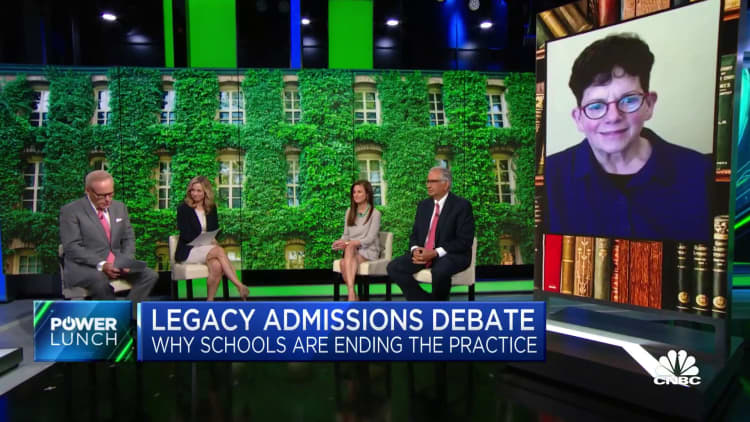
“Higher education is an imperfect meritocracy,” Lakhani said.
However, the wealthiest students hailing form the country’s top private schools are primarily competing amongst themselves as schools look to build a diversified class.
“When you are applying from an affluent family, the people you are competing against are people in a similar bucket,” Lakhani said.
The irony is most don’t want to admit that they’ve received private help, even if they are fortunate enough to get it.
“Every parent wants to say their child does it on their own,” Rim said.
Is an Ivy League degree worth it?
A study by Harvard University-based non-partisan, non-profit research group Opportunity Insights compared the estimated future income of waitlisted students who ultimately attended Ivy League schools with those who went to public universities instead.
In the end, the group of Harvard University- and Brown University-based economists found that attending an Ivy League college has a “statistically insignificant impact” on earnings.
However, there are other advantages beyond income.
For instance, attending a college in the “Ivy-plus” category rather than a highly selective public institution nearly doubles the chances of attending an elite graduate school and triples the chances of working at a prestigious firm, according to Opportunity Insights.
Leadership positions are disproportionately held by graduates of a few highly selective private colleges, the Opportunity Insights report found.
Further, it increases students’ chances of ultimately reaching the top 1% of the earnings distribution by 60%.
“Highly selective private colleges serve as gateways to the upper echelons of society,” the researchers said.
“Because these colleges currently admit students from high-income families at substantially higher rates than students from lower-income families with comparable academic credentials, they perpetuate privilege,” they added.


Personal Finance
Next-Generation Retirement Planning: Managing Longevity Risk and Variable Income Streams


U.S.- Canada Trade Talks Collapse; Carney Says Retaliatory Tariffs Begin September 8

Flock Cameras and the Future of Public Security

AI Infrastructure Boom Hits Physical Limits: Power, Financing, and Supply Chain Strain

Armanino adds Strategic Accounting Outsourced Solutions

New 2023 K-1 instructions stir the CAMT pot for partnerships and corporations

Tax Strategy: Employee Retention Credit update
-

 Stock News1 week ago
Nvidia Q2 FY2027 Earnings beats Wall Street Expectation with Record $96.2 Billion Revenue
-
 Technology6 days ago
AI Infrastructure Boom Hits Physical Limits: Power, Financing, and Supply Chain Strain
-
 Technology4 days ago
Flock Cameras and the Future of Public Security
-
 Economics4 days ago
U.S.- Canada Trade Talks Collapse; Carney Says Retaliatory Tariffs Begin September 8