
Personal Finance
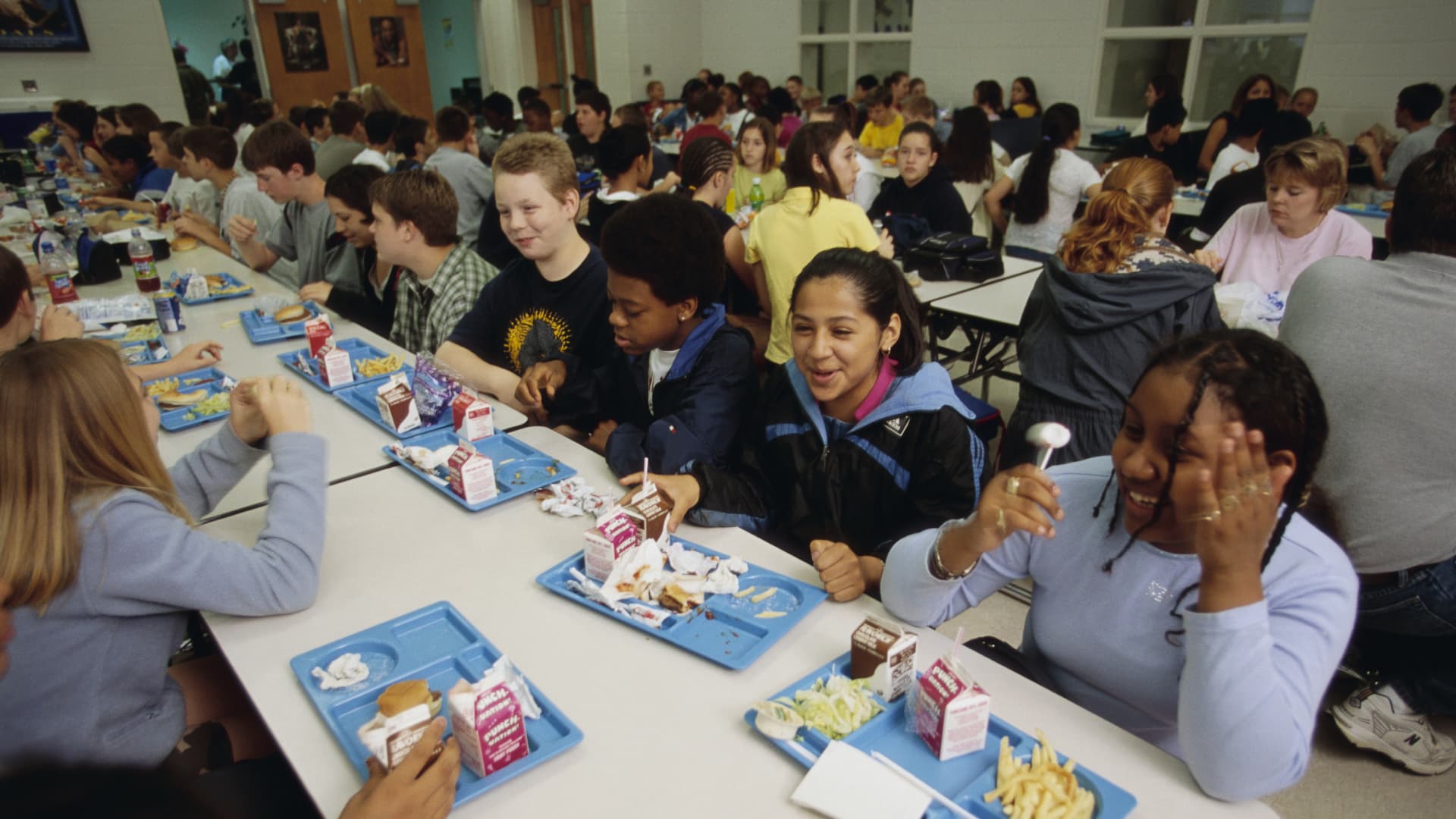
Why universal free school lunches may become a campaign issue

Will & Deni Mcintyre | Corbis Documentary | Getty Images
The notion of offering free school meals could become a policy issue in the U.S. presidential race, experts say — especially given Vice President Kamala Harris’ choice of Minnesota Gov. Tim Walz as her running mate on the Democratic ticket.
The federal government offered K-12 students free school meals — regardless of income — for two years during the Covid-19 pandemic.
That policy has since ended. However, eight states have passed laws to continue offering free meals.
Among them is Minnesota. Walz, a former teacher, signed a bill in 2023 to provide breakfast and lunch to the state’s public-school students at no charge, regardless of household income.

“Should Harris and Walz win the election, his role as vice president and his potential influence on universal school meals could be profound,” wrote Alexina Cather, policy director at Wellness in the Schools, an advocacy group for public school nutrition.
Harris, the Democratic presidential nominee, unveiled some details about her economic policy platform Friday.
School meals weren’t among them. But children and food feature in a few proposals: one to restore and enhance the value of a pandemic-era child tax credit, and another to enact the first-ever federal ban on “corporate price-gouging” on food and groceries.
A spokesperson for the Harris campaign didn’t respond to a request for comment.
How the federal school lunch program works
The typical student pays $1.75 or $1.80 for a full-price breakfast at a school cafeteria, varying by grade level, according to the School Nutrition Association. Lunch typically costs $2.83 to $3.05, according to the group.
(Its data reflects the median price. Prices may be higher or lower based on school district.)
The federal government currently subsidizes meal cost for certain students — based on criteria like annual income — via initiatives like the National School Lunch Program.
Under the NSLP, students in families with income at or below 130% of the federal poverty line qualify for a free meal.
More from Personal Finance:
Why the election may matter for the minimum wage
Trump plan to end taxes on Social Security may be misguided
Trump and Harris both want no taxes on tips
A family of three would need to make less than about $34,000 a year to qualify for free meals, according to Alexis Bylander, interim director of child nutrition programs and policy at the Food Research & Action Center.
Those at 130% to 185% of the poverty line are eligible for reduced-price meals. Such students don’t pay more than 30 cents for breakfast or 40 cents for lunch.
On average, about 20 million students — roughly 71% — ate free or reduced price lunches in 2023, according to the U.S. Department of Agriculture.
Former President Donald Trump signed legislation in March 2020 that allowed the U.S. Department of Agriculture to issue nationwide waivers that effectively made meals free for all kids in participating school districts.
That expansion was in place for the 2020-21 and 2021-22 school years.
The “vast majority” — about 90% — of U.S. school districts participated, according to the USDA. (Schools were allowed to serve meals or deliver them even if they were closed during the pandemic.)
Congress didn’t extend the policy for the 2022-23 school year.
Since then, eight states — California, Colorado, Maine, Massachusetts, Michigan, Minnesota, New Mexico and Vermont — have passed laws to create universal-free-school-meal programs, according to the Hunter College New York City Food Policy Center.
All of those states are headed by Democrats, with the exception of Vermont Gov. Phil Scott, who is a Republican.
Many other states are “currently planning, drafting, discussing, or negotiating” such legislation for the “near future,” the Food Policy Center added.
“This isn’t a new idea, but it really picked up speed during the pandemic,” FRAC’s Bylander said. “I think there’s a lot of momentum around this issue,” she added.
Some groups dislike universal free school meals
The policy of offering universal free school meals doesn’t seem to have buy-in across conservative circles.
For example, the blueprint for Project 2025 — a collection of policy plans developed by right-leaning groups and spearheaded by the Heritage Foundation — would “reject efforts” around universal free school meals, according to its text.
Democrats have pointed to Project 2025 as an example of what a second Trump term could look like.
The former president made statements distancing himself from the policy blueprint. But several people who formerly worked for Trump were involved in creating the playbook, and a recently resurfaced video from April 2022 shows Trump speaking at a Heritage Foundation gala about the group’s plans.
While in office, the Trump administration had extended the USDA waivers to offer universal free school meals.
A spokesperson for the Trump campaign didn’t respond to a request for comment.

Project 2025 would also “restore” the National School Lunch Program to its “original goal” of providing food to K-12 students of low-income families who’d otherwise forgo a meal, and not also to middle and higher earners.
“Federal school meals increasingly resemble entitlement programs that have strayed far from their original objective and represent an example of the ever-expanding federal footprint in local school operations,” according to the text.
Advocates say the universality of free meals is essential, though.
It helps school districts by reducing administrative burdens and, for students, eliminates “the stigma and shame tied to free and reduced-price meals, creating a level playing field for every child in the cafeteria,” Bylander said.

Personal Finance
Next-Generation Retirement Planning: Managing Longevity Risk and Variable Income Streams


S&P 500 Outperforms Amid Strong Corporate Earnings as Treasury Yields Cap Equity Multiples

Climate Resilience and Offshore Wind and Land Restoration Milestones

Mandatory ESG Reporting Standards Demand Standardized Non-Financial Audit Trails

Armanino adds Strategic Accounting Outsourced Solutions

New 2023 K-1 instructions stir the CAMT pot for partnerships and corporations

Tax Strategy: Employee Retention Credit update
-

 Stock News1 week ago
Nvidia Q2 FY2027 Earnings beats Wall Street Expectation with Record $96.2 Billion Revenue
-

 Technology6 days ago
AI Infrastructure Boom Hits Physical Limits: Power, Financing, and Supply Chain Strain
-

 Economics4 days ago
U.S.- Canada Trade Talks Collapse; Carney Says Retaliatory Tariffs Begin September 8
-

 Technology4 days ago
Flock Cameras and the Future of Public Security
-
 Insights42 minutes ago
Climate Resilience and Offshore Wind and Land Restoration Milestones
-
 Accounting42 minutes ago
Mandatory ESG Reporting Standards Demand Standardized Non-Financial Audit Trails
-
 Finance15 minutes ago
S&P 500 Outperforms Amid Strong Corporate Earnings as Treasury Yields Cap Equity Multiples