
Finance
Xpeng releases mass-market EV with basic driver-assist for less than $20,000

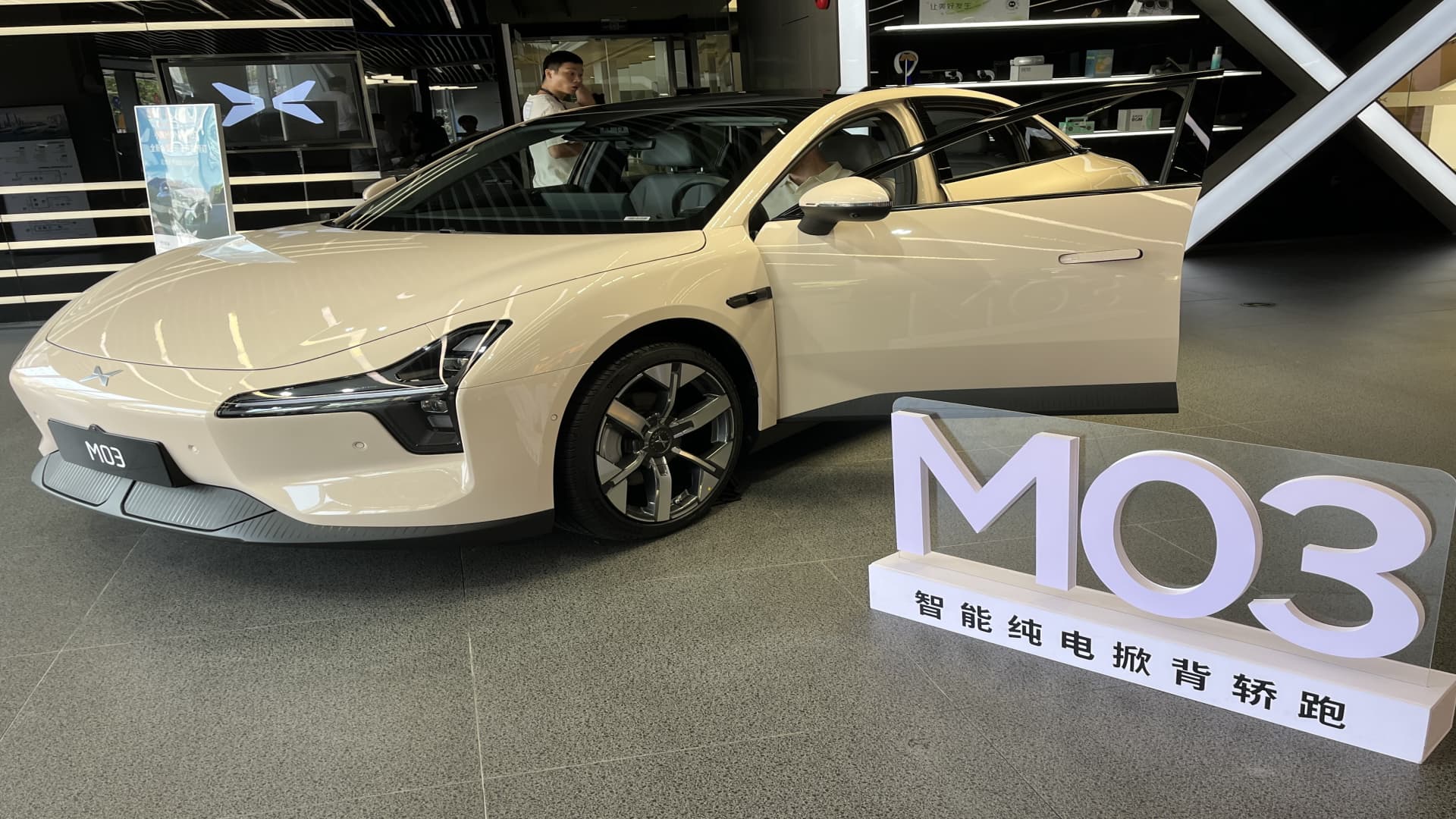
Chinese electric car company Xpeng displays its mass-market Mona M03 coupe inside a headquarters’ showroom in Guangzhou, China, on Aug. 26, 2024.
CNBC | Evelyn Cheng
BEIJING — Chinese electric car company Xpeng on Tuesday announced that its mass-market brand Mona will start selling some models for less than $17,000.
The basic version of the Mona M03 electric coupe will be listed at 119,800 yuan ($16,812), with a driving range of 515 kilometers (320 miles) and some parking assist features.
A version of the Mona M03 with the more advanced “Max” driver assist features and a driving range of 580 kilometers will sell for 155,800 yuan.
In comparison, Tesla’s cheapest car — the Model 3 — costs 231,900 yuan in China, after a price cut in April.
Xpeng CEO He Xiaopeng did not specify a launch date for the standard version of the car in his presentation on Tuesday. The company told investors last week on an earnings call that mass deliveries would begin shortly after Tuesday’s announcement.
Presales of the Mona M03 began on Aug. 8.

The Mona M03 standard driver-assist supports parking, including parallel parking. The company says it uses a range of automatic sensors, cameras and light detection and ranging sensors.
The Max version of driver assist includes features such as automatically backing up a car to a designated position in a dead-end street with the push of a button. Xpeng also plans for it to support the remote control of entering and exiting a narrow parking spot.
That Max version is set to begin deliveries after the Lunar New Year holiday in 2025, CEO He said. The Chinese holiday runs from late January to early February next year.
Xpeng’s driver-assist technology is widely considered one of the best currently available in China. Tesla‘s version, marketed as “full self-driving,” isn’t fully accessible in China, although it is widely expected to be released in the coming months.
The Xpeng CEO’s presentation on Tuesday also commemorated the 10th anniversary of Xpeng’s founding. Chinese smartphone company Xiaomi’s founder Lei Jun was among those in attendance
CEO He said the brand name Mona stands for “Made of new AI.” He emphasized that over the next decade, Xpeng would focus on developing artificial intelligence for cars.
The company also said Tuesday that it plans to reveal its second-generation humanoid robot in October. It also revealed its own chip, but did not specify what nanometer process — or level of production technology — is used in its manufacturing.
Premium Chinese electric car startup Nio in late July said it had finished designing a five nanometer automotive-grade chip, the NX9031. The company had teased the chip in December, and plans to use it in its high-end ET9 sedan, set for delivery in 2025.
Collaboration with Didi
Xpeng built Mona using tech it acquired from ride-hailing company Didi in August 2023.
Wu Zhefeng, a Mona project manager, told reporters Monday that the basic version of driver-assist technology in the M03 comes from Didi, while the more advanced version was made by Xpeng.
Since the battery is the priciest component of an electric car, he said Xpeng was able to bring the cost down for Mona thanks in part to efforts to boost energy efficiency. The coupe uses BYD‘s popular “blade battery,” Wu said.
He said the brand is focused on young people, two or three years after graduation.
Nearly half of similar cars available in China within this price range are used for ride-hailing, according to Wu. While electric car companies such as BYD have worked with Didi to promote their cars among drivers on the ride-hailing platform, he said Mona would remain focused on consumer drivers.
BYD, which has quickly become a giant in China’s electric car industry, sells cars across a range of prices and models, including many hybrid-powered versions. Consumers in China have increasingly preferred hybrids to battery-only cars as anxiety persists over how far they can drive on a single charge.
Geely-owned electric car company Zeekr announced earlier this month that it would launch its first hybrid car next year.
Other Chinese companies have launched cars this year in direct competition with Tesla.
Nio, which has focused on premium electric cars, in May announced a lower-priced brand Onvo. Its first car, the L60 SUV, is set to begin deliveries in September. The L60 starts at 219,900 yuan (US$30,439) versus the Model Y’s 249,900 yuan (US$34,617), according to prices shared in May.
Chinese smartphone company Xiaomi, meanwhile, in March released its first electric car, the SU7 sedan for 215,900 yuan.
— CNBC’s Sonia Heng contributed to this report.





Treasury Bond Volatility Forces Bessent to Double Debt Buyback Size as Yields Swing

Nvidia Earnings Preview: What Wall Street Expects From the AI Bellwether’s Q2 Report

SEC’s Semiannual Reporting Proposal Faces Investor Pushback: What CFOs Need to Know

Armanino adds Strategic Accounting Outsourced Solutions

New 2023 K-1 instructions stir the CAMT pot for partnerships and corporations

Tax Strategy: Employee Retention Credit update
-

 Economics1 week ago
U.S. Retail Sales Fall for the First Time in Nine Months as Consumer Spending Slows
-
 Economics1 week ago
Nvidia’s Potential $3 Billion SB Energy Investment Could Reshape AI Infrastructure
-

 Economics4 days ago
Top 10 Largest Economies by 2030: IMF & World Bank GDP Projections for Global Powerhouses
-
 Stock News4 days ago
How to understand Intel $15B Stock Offering
-

 Technology1 week ago
U.S.-China AI Competition Intensifies as Washington Pushes Allies to Choose Sides
-

 Economics4 days ago
Economic Profile of the United States of America (2026–2030 Horizon)
-
 Economics3 days ago
U.S. National Debt Surpasses $40 Trillion for the First Time: What It Means for the Economy
-

 Leaders3 days ago
Jackson Hole 2026: What the First Symposium Under Fed Chair Kevin Warsh Means for Markets