Connect with us

Accounting

Jimmy Carter, the longest-living US President, has died at 100

Published

on

Jimmy Carter, the former Georgia peanut farmer who as U.S. president brokered a historic and lasting peace accord between Israel and Egypt in a single term marred by soaring inflation, an oil shortage and Iran’s holding of American hostages, has died. He was 100.

Carter died Sunday at his home in Plains, Georgia, surrounded by his family, the Carter Center said Sunday in a statement. Public observances are planned in Atlanta and Washington, followed by a private interment in Plains. 

The longest-living former U.S. president ever, Carter had opted in early 2023 to spend his remaining time at his home in Plains receiving hospice care. He was there alongside Rosalynn, his wife of 77 years, when she died in November 2023 at age 96. And he lived long enough to fulfill a final wish — to cast a ballot for Kamala Harris in the 2024 presidential election.

A Democrat who rose from running his family’s peanut-farming and seed-supply businesses to serving as Georgia governor, Carter won the White House in 1976 over incumbent Gerald Ford by promising to bring honesty to an office tainted two years earlier by the resignation of Richard Nixon in the culmination of the Watergate scandal.

Ascetic, humble and deeply religious, Carter was skeptical of the pomp surrounding the presidency and came to Washington with fewer allies and fixed positions than most who hold the job. 

His allegiance to an inner moral compass, his vow to support societies that “share with us an abiding respect for individual human rights” and his tendency to speak his mind collided at times with political realities during his four years in office, from 1977 to 1981, and served as a preview of what was to come in a service-filled post-presidency that lasted decades.

Carter “assembled a new front line on nearly every issue, with no inherited party game plan or ideological playbook to fall back on,” Jonathan Alter wrote in a 2020 biography that painted him as often right in his instincts but flawed in executing government responses. The book was among several in recent years that offered a revised and sunnier view of Carter’s crisis-plagued tenure.

Though Carter “left the White House a widely unpopular president,” his achievements “shine brighter over time, few more than his unique determination to put human rights at the forefront of his foreign policy from the start of his presidency,” his chief domestic policy advisor, Stuart Eizenstat, wrote in a 2018 biography of his former boss.

State funeral

In a statement on Sunday, President Joe Biden eulogized Carter as “an extraordinary leader, statesman and humanitarian” who touched the lives of people around the world with “his compassion and moral clarity.” Biden said he’ll be ordering a state funeral for Carter in Washington, and he designated Jan. 9 as a national day of mourning.

President-elect Donald Trump, who often brought up Carter’s presidency during this year’s election campaign to needle Biden, said Carter faced challenges at a pivotal time in U.S. history. He “did everything in his power to improve the lives of all Americans,” Trump said on his Truth Social platform. “For that, we all owe him a debt of gratitude.”

The signature achievement of the Carter presidency, the Camp David Accords between Israel and Egypt, led to peaceful co-existence between the Middle East neighbors even as it fell short of resolving the conflict between Israel and the Palestinians. 

That and other foreign policy breakthroughs, including the establishment of formal ties with China and a treaty granting Panama ownership of the U.S.-built Panama Canal, were overshadowed by the plight of American hostages held in Iran during the last 444 days of his presidency. They were finally released the day Carter turned over the Oval Office to Republican Ronald Reagan.

On the domestic front, the Carter presidency was dogged by economic woes. Inflation reached 13.3% at the end of 1979 compared with 5.2% when he took office in January 1977. The Federal Reserve’s actions to stem price increases pushed home-mortgage rates to almost 15%, and Carter had to take emergency action to stem a slide in the dollar. There were energy shortages, and oil prices more than doubled.

Malaise speech

A speech to the nation on July 15, 1979, became emblematic of Carter’s presidency.

With fuel prices skyrocketing and lines at gas stations lengthening, Carter told Americans that solving the energy mess “can also help us to conquer the crisis of the spirit in our country.” He said many Americans “now tend to worship self-indulgence and consumption.”

Though Carter never uttered the word, the address became known as the “malaise” speech and contributed to a sense that Carter was powerless to change the nation’s course.

“Our memory of the speech comes from those who reworked it, who twisted its words into a blunt instrument that helped them depose a president,” historian Kevin Mattson wrote

Carter’s words, he noted, “received immediate applause and yet wound up ensuring his defeat” to Reagan in the 1980 election.

Just weeks after delivering the speech, Carter tapped Paul Volcker, president of the Federal Reserve Bank of New York, to take over as chair of the Federal Reserve, replacing G. William Miller, who became Treasury secretary. Volcker made it clear to Carter that he would deal head-on with inflation by pursuing tighter monetary policies than Miller. Volcker’s policies — which sent interest rates as high as 20% — came at a high price, the fallout contributing to Reagan’s landslide victory over Carter in the 1980 election. 

Though some of Volcker’s policies “were politically costly, they were the right thing to do,” Carter commented upon Volcker’s death in 2019.

Nobel Prize

Carter made some of his biggest imprints on the world in the years after he left the White House. He “reinvented the post-presidency,” observed Julian Zelizer, a professor of history at Princeton University and a Carter biographer. 

In four-plus decades as an ex-president — the longest such tenure in American history — Carter waged a worldwide campaign against war, disease and the suppression of human rights through the Atlanta-based Carter Center, which he founded with his wife. The center made particular strides against Guinea worm disease, a parasite spread through contaminated water that can render victims non-functional for months. Worldwide cases dropped to just 14 in 2023 from an estimated 3.5 million in 1986, according to the center.

Carter was awarded the 2002 Nobel Peace Prize for “decades of untiring effort to find peaceful solutions to international conflicts, to advance democracy and human rights, and to promote economic and social development.” 

His post-presidential causes were not without backlash. Fourteen advisers to the Carter Center resigned in protest of his best-selling 2007 book, Palestine: Peace Not Apartheid, which compared Israel to the White governments of South Africa that systematically oppressed Black citizens.

Carter’s longevity defied the odds. He revealed in 2015 that he had melanoma, a type of cancer, and that it had spread to his brain. He received treatment, recovered and on March 22, 2019, became the longest-living chief executive in U.S. history. In 2021, Jimmy and Rosalynn Carter celebrated their 75th wedding anniversary.

His Christian faith, he said, made him “absolutely and completely at ease with death.”

Peanut farm

James Earl Carter Jr. was born on Oct. 1, 1924, in Plains, Georgia, the first of four children born to Earl Carter, a farmer, and the former Lillian Gordy, a nurse. He grew up in the nearby hamlet of Archery, where the family owned a peanut farm and a general store. He traveled two miles each day to Plains to attend an all-White school. 

Electricity and indoor plumbing didn’t reach the Carter farm until 1935.

Carter attended the U.S. Naval Academy in Annapolis, Maryland, from 1943 to his graduation in 1946. He began dating a girl from Plains, Rosalynn Smith, when home on breaks. They married in July 1946 and would have four children — sons Jack, Chip and Jeff, and daughter Amy.

While serving in the Navy for seven years, Carter worked on the development of the nuclear submarine program and rose to the rank of lieutenant. When his father died in 1953, Carter resigned his commission to return to his family’s peanut-farming business.

In 1962, he was elected to the Georgia Senate and in 1970 was elected governor, having lost his first bid in 1966. His work to end racial discrimination in the state made him a symbol of the “New South.”

At the start of his campaign for the presidency, Carter was not widely known outside of Georgia and was viewed by analysts as a long shot for the Democratic nomination. He began traveling the country before many other candidates had started their campaigns, pitching his outsider status to voters who had endured the revelations of Watergate and Nixon’s resignation.

Carter emphasized his religious upbringing — he was a Southern Baptist who often described himself as a “born again” Christian — and promised the American people that he would never lie to them. He won the New Hampshire primary, proving his viability in the North, and defeated Alabama Governor George Wallace in Florida to establish himself as the strongest candidate in the South, on the way to clinching the Democratic nomination.

With Minnesota Democrat Walter Mondale as his running mate, Carter narrowly beat Ford, with 50.1% of the vote, and was sworn into office in January 1977 as the 39th U.S. president. Starting what has become a tradition for new presidents, he stepped out of his limousine during the inauguration parade and walked down Washington’s Pennsylvania Avenue to the White House.

Billy Brew

Carter’s family included colorful characters such as his sister Ruth, a faith healer, and brother Billy, a gas-station operator whose enjoyment of drinking led to the creation of the short-lived Billy Beer brand during his brother’s presidency.

The president’s mother also grabbed media attention. A nurse who tended to Black and White families in the segregated South, she joined the Peace Corps at age 68 and always had a ready quip for the press. 

“When I look at my children,” she once cracked, “I say, ‘Lillian, you should have stayed a virgin.'”

As president, Carter signed legislation creating the cabinet-level Department of Education. He appointed women, Black people and Hispanic people to federal posts in large numbers. He stunned the defense contracting industry by killing the Air Force’s expensive B-1 bomber project, a step later reversed by Reagan. He signed the law that created the federal Superfund program to clean up hazardous-waste sites.

Carter won praise after his presidency for the steps he had taken toward deregulation, particularly of the airline industry, where the removal of government control of fares and routes promoted competition. 

One of his longest battles with Congress involved his proposal to scrap 18 dam and irrigation projects, most of them in the West and South. His “hit list” pleased many environmentalists while angering Westerners, including some fellow Democrats. Congress restored funding for most of the projects.

From his presidency’s earliest days, Carter sought to highlight and utilize energy shortages to raise support for his domestic agenda. The cabinet-level Department of Energy was created in his administration’s first year, and he had solar panels installed on the roof of the White House. In a televised address to the nation two weeks into his term, Carter called for a new emphasis on conservation, mirroring the White House’s own push for frugality.

At Camp David, the presidential retreat in Maryland, Carter guided Egyptian President Anwar Sadat and Israeli Prime Minister Menachem Begin to the 1978 accord that led the next year to the first peace treaty between Israel and an Arab country. The treaty committed Israel to remove its troops and civilian settlements from the Sinai Peninsula and led to billions of dollars in U.S. aid to Israel and Egypt. 

The Camp David breakthrough didn’t lead to a broader Mideast peace, however, and Carter through the years didn’t hide his disappointment. In Palestine: Peace, Not Apartheid, he focused on Israel’s occupation of Arab land as the root cause of continued hostilities. 

In a 2010 book based on his White House diaries, Carter said the U.S. had “defaulted in carrying out one unchallenged and unique responsibility: mediating a peace agreement between Israel and its neighbors.”

Olympics boycott

In response to the Soviet Union’s invasion of Afghanistan in December 1979, Carter imposed a trade embargo and organized the boycott of the 1980 Summer Olympic Games in Moscow. Rosalynn Carter said she tried and failed to persuade her husband to wait until after the Iowa presidential caucuses of 1980 to impose the embargo, which hurt U.S. farmers.

“I am much more political than Jimmy and was more concerned about popularity and winning reelection,” Rosalynn wrote in her 1984 memoir, “but I have to say that he had the courage to tackle the important issues, no matter how controversial — or politically damaging — they might be.”

The biggest external crisis of his presidency was precipitated by the Islamic Revolution in Iran that overthrew the shah and installed a theocratic government headed by formerly exiled cleric Ayatollah Ruhollah Khomeini.

On Nov. 4, 1979, radical students overran the U.S. Embassy in Tehran and took more than 60 Americans hostage. Fifty-two of them were held for the last 444 days of Carter’s term.

In April 1980, Carter gave the go-ahead for a military assault on the embassy to rescue the hostages. Of the eight helicopters from the USS Nimitz that headed to a desert staging area, from which the raid on Tehran was to commence, three had problems. The mission was aborted, and during preparations for retreat, a helicopter flew into a C-130 transport plane and exploded. Eight American servicemen died.

Stymied by crisis on the domestic and foreign fronts, Carter lost his bid for reelection in a landslide, with Reagan winning 44 states. The hostages were released on Jan. 20, 1981, the day Reagan was sworn into office.

One more helicopter

“Over the years, in various classrooms and public forums, I have often been asked if there was one substantive action or decision I made as president that I would have changed,” Carter wrote in White House Diary. “Somewhat facetiously, I have answered, ‘I would have sent one more helicopter to ensure the success of the hostage rescue effort in April 1980.’ But I truly believe that if I had done so, I would have been reelected.”

The Carters returned to Plains after leaving the White House, and Carter taught scripture at the Maranatha Baptist Church as recently as 2020.

In his brimming post-presidency, Carter helped arrange peace talks between North and South Korea and a cease-fire in Bosnia. Through the Carter Center, he helped monitor elections around the world to help ensure that they were fair. He traveled to Haiti in 1994 to negotiate the restoration of constitutional government, averting a threatened U.S.-led invasion.

Accepting his Nobel Peace Prize in 2002, as the U.S. under President George W. Bush was preparing to invade Iraq, Carter made his disapproval clear. “For powerful countries to adopt a principle of preventive war may well set an example that can have catastrophic consequences,” he said.

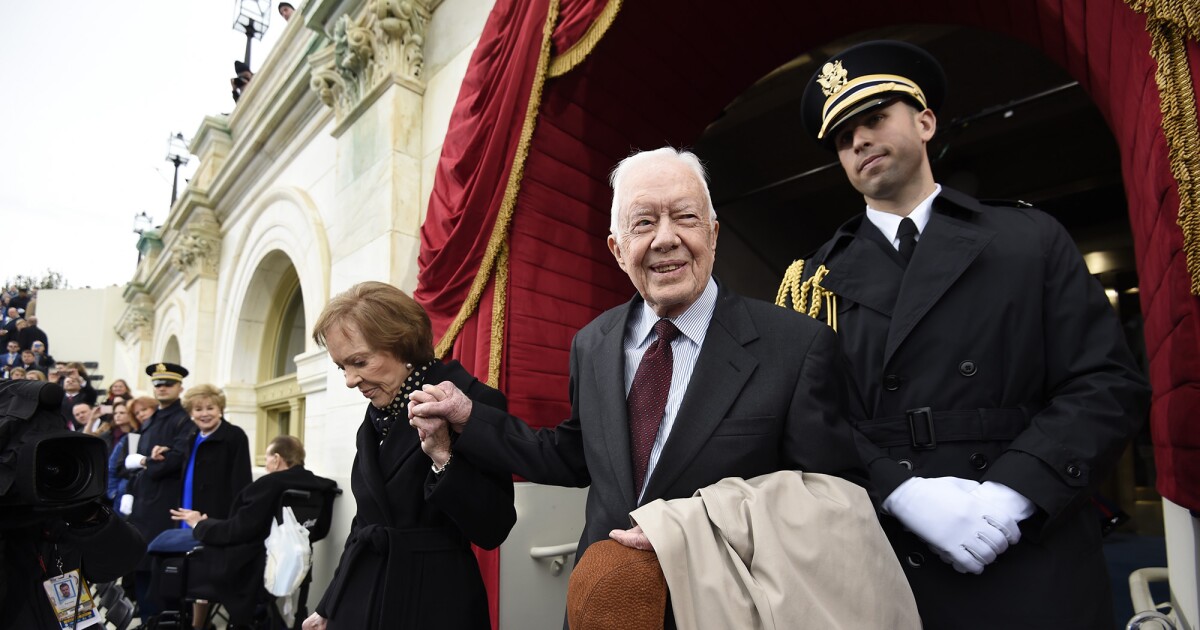
Carter attended Trump’s inauguration in 2017, the sixth and final presidential swearing-in he witnessed after leaving office. Days earlier, he had told congregants at his hometown church that of 22 voters in his family, none had voted for Trump. But he had been the first former president to accept an invitation to the inauguration, determined to show support for the new U.S. leader.

Trump “has never been involved in politics before,” Carter explained, according to an account by Voice of America. “He has a lot to learn. He’ll learn — sometimes the hard way, like I did.”

Continue Reading
Click to comment

Leave a Reply

Your email address will not be published. Required fields are marked *

Accounting

FASB plans changes in crypto accounting

Published

on

The Financial Accounting Standards Board met this week to discuss its projects on accounting for transfers of cryptocurrency assets and enhancing the disclosures around certain digital assets, such as stablecoins.

Processing Content

During Wednesday’s meeting, FASB’s board made certain tentative decisions, according to a summary posted to FASB’s website. FASB began deliberating the Accounting for transfers of crypto assets project and decided to expand the scope of its guidance in  Subtopic 350-60, Intangibles—Goodwill and Other—Crypto Assets, to address crypto assets that provide the holder with a right to receive another crypto asset. FASB decided to clarify the existing disclosure guidance by providing an example of a tabular disclosure illustrating that wrapped tokens, if they’re significant, would be disclosed separately from other significant crypto asset holdings.

At a future meeting, the board plans to consider clarifying the derecognition guidance for crypto transfer arrangements to assess whether the control of a crypto asset has been transferred.

FASB also began deliberations on the Cash equivalents—disclosure enhancement and classification of certain digital assets project and made a number of decisions.

The board decided to provide illustrative examples in Topic 230, Statement of Cash Flows, to clarify whether certain digital assets such as stablecoins can meet the definition of cash equivalents. It also decided to include the following concepts in the illustrative examples:

  1. Interpretive explanations that link to the current cash equivalents definition;
  2. The amount and composition of reserve assets; and,
  3. The nature of qualifying on-demand, contractual cash redemption rights directly with the issuer.

FASB plans to clarify that an entity should consider compliance with relevant laws and regulations when it’s creating a policy concerning which assets that satisfy the Master Glossary definition of the term “cash equivalents will be treated as cash equivalents.

“I agree with the staff suggestion to look at examples,” said FASB vice chair Hillary Salo. “From my perspective, I think that is going to help level the playing field. People have been making reasonable judgments. I agree with that. And I think that this is really going to help show those goalposts or guardrails of what types of stablecoins would be in the scope of cash equivalents, and which ones would not be in the scope of cash equivalents. I certainly appreciate that approach, and I think it has the least potential impact of unintended consequences, because I do agree with my fellow board members that we shouldn’t be changing the definition of cash equivalents, and it’s a high bar to get into the cash equivalent definition.”

“I’m definitely supportive of not changing the definition of cash equivalents,” said FASB chair Richard Jones. “I believe that’s settled GAAP in a way, and we’re not really seeing a call to change it for broader issues. I am supportive of the example-based approach. The challenge with examples, though, is everybody’s going to want their exact pattern, but that’s not what we’re doing.”

The examples will explain the rationale for how digital assets such as stablecoins do or do not qualify as cash equivalents and give a roadmap for other types of digital assets with varying fact patterns to be able to apply.

“We really don’t want to be as a board facing a situation where something was a cash equivalent and then no longer is at a later date,” said Jones. “That’s not good for anyone, so keeping it as a high bar with certain rigid criteria, I think, is fine.”

Stablecoins are supposed to be pegged to fiat currencies such as U.S. dollars and thus provide more stability to investors. “In my view, while a stablecoin may meet the accounting definition established for cash equivalents, not every one of those stablecoins in the cash equivalent classification represents the same level of risk,” said FASB member Joyce Joseph.

She noted that the capital markets recognize the distinctions and have established a Stablecoin Stability Assessment Framework to evaluate a stablecoin’s ability to maintain its peg to a fiat currency. Such assessments look at the legal and regulatory framework associated with the stablecoin, and provide investors with information that could enable them to do forward-looking assessments about the stability of the stablecoin.

“However, for an investor to consider and utilize such information for a company analysis the financial statement disclosures would need to include information about the stablecoin itself,” Joseph added. “In outreach, the staff learned that investors supported classifying certain stablecoins as cash equivalents when transparent information is available about the entities at which the reserve assets are held. Therefore, in my view, taking all of this into consideration a relevant and informative company disclosure would include providing investors with the name of the stablecoin and the amount of the stablecoin that is classified as a cash equivalent, so investors can independently assess the liquidity risks more meaningfully and more comprehensively by utilizing broader information that is available in the capital markets and its emerging information.”

Such information could include the issuer, reserves, governance and management, she noted, so investors would get a more holistic look at the risks that holding the stablecoin would entail for a given company.

The board decided to require all entities to disclose the significant classes and related amounts of cash equivalents on an annual basis for each period that a statement of financial position is presented.

Entities should apply the amendments related to the classification of certain digital assets as cash equivalents on a modified prospective basis as of the beginning of the annual reporting period in the year of adoption.

FASB decided that entities should apply the amendments related to the disclosure of the significant classes and amounts of cash equivalents on a prospective basis as of the date of the most recent statement of financial position presented in the period of adoption.

The board will allow early adoption in both interim and annual reporting periods in which financial statements have not been issued or made available for issuance.

FASB also decided to permit entities to adopt the amendments to be illustrated in the examples related to the classification of certain digital assets as cash equivalents without the need to perform a preferability assessment as described in Topic 250, Accounting Changes and Error Corrections.

The board directed the staff to draft a proposed accounting standards update to be voted on by written ballot. The proposed update will have a 90-day comment period.

Continue Reading

Accounting

Lawmakers propose tax and IRS bills as filing season ends

Published

on

Senators introduced several pieces of tax-related legislation this week, including measures aimed at improving customer service at the Internal Revenue Service, cracking down on tax evasion and curbing the carried interest tax break, in addition to efforts in the House to repeal the Corporate Transparency Act.

Processing Content

Senators Bill Cassidy, R-Louisiana, and Mark Warner, D-Virginia, teamed up on introducing a bipartisan bill, the Improving IRS Customer Service Act, which would expand information on refunds available to taxpayers online and help taxpayers with payment plans if they need it.

The bill would establish a dashboard to inform taxpayers of backlogs and wait times; expand electronic access to information and refunds; expand callback technology and online accounts; and inform individuals facing economic hardship about collection alternatives.

“Taxpayers deserve a simple, stress-free experience when dealing with the IRS,” Cassidy said in a statement Wednesday. “This bill makes the process quicker and easier for taxpayers to get the information they need.”

He also mentioned the bill during a Senate Finance Committee hearing about tax season when questioning IRS CEO Frank Bisignano. During the hearing, Cassidy secured a commitment from Bisignano that the IRS would work with Congress to implement these reforms if the legislation were signed into law.

“I’m happy to meet with the team … and do all I can to make it as good as you want it to be,” said Bisignano.

“My bill would equip the IRS with the legislative mandate to create an online dashboard so that taxpayers can monitor average call wait time and budget time accordingly,” said Cassidy. He noted that the bill would allow a callback for taxpayers that might need to wait longer than five minutes to speak to a representative, and establish a program to identify and support taxpayers struggling to make ends meet by providing information about alternative payment methods, such as installments, partial payments and offers in compromise. 

“I know people are kind of desperate and don’t know where to turn for cash, so I think this could really ease anxiety,” he added. “This legislation is bipartisan and is likely to pass this Congress.”

Cassidy and Warner introduced the Improving IRS Customer Service Act in 2024. Last year, Warner wrote to National Taxpayer Advocate Erin Collins at the IRS regarding the underperforming Taxpayer Advocate Service office in Richmond, Virginia, and advocated against any harmful personnel decisions that would negatively impact taxpayers.

“Taxpayers shouldn’t have to jump through hoops to get basic answers from the IRS — and in the last year, those challenges have only gotten worse,” Warner said in a statement. “I am glad to reintroduce this bipartisan legislation on Tax Day to ease some of this frustration by increasing clear communication and making IRS resources more readily available.”

Stop CHEATERS Act

Also on Tax Day, a group of Senate Democrats and an independent who usually caucuses with Democrats teamed up to introduce the Stop Corporations and High Earners from Avoiding Taxes and Enforce the Rules Strictly (Stop CHEATERS) Act.

Senate Finance Committee ranking member Ron Wyden, D-Oregon, joined with Senators Angus King, I-Maine, Elizabeth Warren, D-Massachusetts, Tim Kaine, D-Virginia, and Sheldon Whitehouse, D-Rhode Island. The bill would provide additional funding for the IRS to strengthen and expand tax collection services and systems and crack down on tax cheating by the wealthy.

“Wealthy tax cheats and scofflaw corporations are stealing billions and billions from the American people by refusing to pay what they legally owe, and far too many of them are getting a free pass because Republicans gutted the enforcement capacity of the IRS,” Wyden said in a statement. “A rich tax cheat who shelters mountains of cash among a web of shell companies and passthroughs is likelier to be struck by lightning than face an IRS audit, and Republicans want to keep it that way. This bill is about making sure the IRS has the resources it needs to go after wealthy tax cheats while improving customer service for the vast majority of American taxpayers who follow the law every year.”

Earlier this week. Wyden also introduced two other pieces of legislation aimed at cracking down on the use of grantor retained annuity trusts and private placement life insurance contracts to avoid or minimize taxes.

The Stop CHEATERS Act would provide the IRS with additional funding for tax enforcement focused upon high-income tax evasion, technology operations support, systems modernization, and taxpayer services like free tax-payer assistance.

“As Congress seeks ways to fund much-needed policy priorities and address our growing national debt, there is one common sense solution that should have unanimous bipartisan support: let’s enforce the tax laws already on the books,” said King in a statement. “Our legislation will make sure the IRS has the resources it needs to confront the gap between taxes owed and taxes paid – while ensuring that our tax enforcement professionals are focused on the high-income earners who account for the most tax evasion. This is a serious problem with an easy solution; let’s pass this legislation and make sure every American pays what they owe in taxes.”

Carried interest

Wyden, King and Whitehouse also teamed up on another bill Thursday to close the carried interest tax break for hedge fund managers that Democrats as well as President Trump have pledged for years to curtail. The tax break mainly benefits hedge fund managers, private equity firm partners and venture capitalists, who have lobbied heavily to defeat attempts to end the lucrative tax break. The tax break was scaled back somewhat under the Tax Cuts and Jobs Act of 2017.

Carried interest is a form of compensation received by a fund manager in exchange for investment management services, according to a summary of the bill. A carried interest entitles a fund manager to future profits of a partnership, also known as a “profits interest.” Under current law, a fund manager is generally not taxed when a profits interest is issued and only pays tax when income is realized by the partnership, often in connection with  the sale of an investment that happens years down the road. Not only does this allow a fund manager to defer paying tax, but the eventual income from the partnership almost always takes the form of capital gain income, taxed at a preferential rate of 23.8% compared to the top rate of 40.8% for wage-like income.  

Under the bill, the Ending the Carried Interest Loophole Act, fund managers would be required to recognize deemed compensation income each year and to pay annual tax on that amount, preventing them from deferring payment of taxes on wage-like income. A fund manager’s compensation income would be taxed similar to wages on an employee’s W-2, subject to ordinary income rates and self-employment taxes.   

“Our tax code is rigged to favor ultra-wealthy investors who know how to game the system to dodge paying a fair share, and there is no better example of how it works in practice than the carried interest loophole,” Wyden said in a statement. “For several decades now we’ve had a tax system that rewards the accumulation of wealth by the rich while punishing middle-class wage earners, and the effect of that system has been the strangulation of prosperity and opportunity for everybody but the ultra-wealthy. There are a lot of problems to fix to restore fairness and common sense to our tax code, and closing the carried interest loophole is a great place to start.”

Repealing Corporate Transparency Act

The House Financial Services Committee is also planning to markup a bill next Tuesday that would fully repeal the Corporate Transparency Act, which has already been significantly scaled back under the Trump administration to only require beneficial ownership information reporting by foreign companies to FinCEN, the Treasury Department’s Financial Crimes Enforcement Network. 

If enacted, the repeal would eliminate beneficial ownership reporting requirements, removing a transparency measure designed to help law enforcement and national security officials identify who is behind U.S. companies. 

“This repeal would turn the United States back into one of the easiest places in the world to set up anonymous shell companies, something Congress worked for years to fix,” said Erica Hanichak, deputy director of the FACT Coalition, in a statement. “These entities are routinely used to facilitate corruption, financial crime, and abuse. Rolling back the CTA doesn’t just weaken transparency, it signals to bad actors around the world that the U.S. is once again open for illicit business.”

Continue Reading

Accounting

IRS struggles against nonfilers with large foreign bank accounts

Published

on

The Internal Revenue Service rarely penalizes taxpayers who have high balances in foreign bank accounts and fail to file the proper forms, according to a new report.

Processing Content

The report, released Tuesday by the Treasury Inspector General for Tax Administration, examined Foreign Account Tax Compliance Act, also known as FATCA, which was included as part of a 2010 law in an effort to tax income held by U.S. citizens in foreign bank accounts by requiring financial institutions abroad to share information with the tax authorities. 

Taxpayers with specified foreign financial assets that meet a certain dollar threshold are also required to report the information to the IRS by filing Form 8938. Failure to file the form can result in penalties of up to $60,000. However, TIGTA’s previous reports have demonstrated that the IRS rarely enforces these penalties. 

The IRS created an Offshore Private Banking Campaign initiative to address tax noncompliance related to taxpayers’ failure to file Form 8938 and information reporting associated with offshore banking accounts, but it’s had limited success.

Even though the initiative identified hundreds of individual taxpayers with significant foreign bank account deposits who failed to file Forms 8938, the campaign only resulted in relatively few taxpayer examinations and a small number of nonfiling penalties. The campaign identified 405 taxpayers with significant foreign account balances who appeared to be noncompliant with their FATCA reporting requirements.

The IRS used two ways to address the 405 noncompliant taxpayers: referral for examinations and the issuance of letters to them.

  • 164 taxpayers (who had an average unreported foreign account balance of $1.3 billion) were referred for possible examination, but only 12 of the 164 were examined, with five having $39.7 million in additional tax and $80,000 in penalties assessed.
  • 241 noncompliant taxpayers (who had an average unreported account balance of $377 million) received a combination of 225 educational letters (requiring no response from the taxpayers) and 16 soft letters (requiring taxpayers to respond). None of the 241 taxpayers were assessed the initial $10,000 FATCA nonfiling penalty.

“While taxpayers can hold offshore banking accounts for a number of legitimate reasons, some taxpayers have also used them to hide income and evade taxes,” said the report. 

Significant assets and income are factors considered by the IRS when assessing whether taxpayers intentionally evaded their tax responsibilities, the report noted. Given the large size of the average unreported foreign account balances, these taxpayers probably have higher levels of sophistication and an awareness of their obligation to comply with the law. 

TIGTA believes the IRS needs to establish specific performance measures to determine the effectiveness of the FATCA program. “If the IRS does not plan to enforce the FATCA provisions even where obvious noncompliance is identified, it should at least quantify the enforcement impact of its efforts,” said the report. “This will ensure that IRS decision makers have the information they need to determine if the FATCA program is worth the investment and improves taxpayer compliance. 

TIGTA made three recommendations in the report, including revising Campaign 896 processes to include assessing FATCA failure to file penalties; assessing the viability of using Form 1099 data to identify Form 8938 nonfilers; and implementing additional performance measures to give decision makers comprehensive information about the effectiveness of the FATCA program. The IRS disagreed with two of TIGTA’s recommendations and partially agreed with the remaining recommendation. IRS officials didn’t agree to assess penalties in Campaign 896 or with implementing performance measures to assess the effectiveness of the FATCA program. 

“From our perspective, TIGTA’s conclusions regarding IRS Campaign 896 are based, in part, on a misguided premise and overgeneralizations, including the treatment of ‘potential noncompliance’ as tantamount to ‘egregious noncompliance’ that warrants a monetary penalty without contemplating the variety of justifications that may exempt a taxpayer from having to file Form 8938,” wrote Mabeline Baldwin, acting commissioner of the IRS’s Large Business and International Division, in response to the report. 

Continue Reading

Trending