Maybe you are in the habit of applying a hefty discount to claims by Donald Trump; no one could blame you. But he really does have the chance to lead America into the golden age he proclaimed in his second inaugural address. Historic circumstances, political dynamics and his own audacity could also enable him to achieve the legacy he wants as “a peacemaker and a unifier”. His party has fallen into lockstep; his adversaries at home are confounded and enervated, and America’s opponents abroad are preoccupied with their own troubles. Mr Trump has battled for ten years against anyone he perceived to have crossed him. His most formidable adversary still standing is probably himself.
As he assumes office again, Mr Trump has embarked on a marketing offensive, a familiar routine, albeit this time with a twist: rather than having to persuade people something is grander than it is—that the Trump Tower in Manhattan has 68 floors rather than 58—he has to assign himself credit for things that are truthfully better than Americans may yet realise. America’s economy is the envy of the world. America is already exporting record amounts of gas and oil, and its biggest obstacle to pumping more is global demand. But Mr Trump’s declaration in his inaugural address of a “national energy emergency” may help him vault to the head of the kind of parade celebrating American glory that poor President Joe Biden lacked the wherewithal to summon.
Similar gamesmanship explains Mr Trump’s inaugural commitment that Americans would now “be able to buy the car of your choice”, which was equally true under Mr Biden (and equally untrue for those who chose a Ferrari but could not afford one), and his pledge to use troops to “repel the disastrous invasion of our country” at the southern border, where arrests for illegal crossings are below the level when Mr Trump left office.
Yet Mr Trump’s initial executive orders are meant to do more than gild the lily. In some cases they call for drastic action, particularly on immigration. As with Mr Trump’s promises of tariffs and his exhumation of “manifest destiny”, no one knows how far he may go with his deportation initiative. But there is also a bigger, more hopeful possibility: Could his showy crackdown be part of a grand plan for the golden age?
In Mr Trump’s first term some of his aides saw the potential of linking enhanced border security to broader reform of America’s immigration system. For all his harsh oratory about immigrants, Mr Trump has sometimes sounded sympathetic, particularly about people brought as children. Last October, he told the editorial board of the Wall Street Journal he had a practical reason for his tough talk about illegal immigration: “The nicer I become, the more people that come over illegally.” (The Biden administration learned that lesson to its sorrow.) But, Mr Trump said, “We have a lot of good people in this country, and we have to do something about it.” In general, said Mr Trump, who is married to an immigrant, and not for the first time, “I want a lot of people to come in, but I want them to come in legally.”
Mr Trump tries to win over any room he walks into, and that may explain his comments to the Journal editors. But he may also recognise that he has amassed more credibility with immigration hardliners than any president in memory, and thus has an opening to achieve what his recent predecessors could not. Comprehensive immigration reform has eluded presidents since 1986, when Ronald Reagansigned into law heightened border security along with amnesty for almost 3m people in America illegally.
Other grand, bipartisan bargains are possible for Mr Trump. He has not displayed interest in the kind of far-reaching tax reform that Reagan achieved, but in his first term he showed a flash of ambition for the sort of gun-safety legislation that polls show a majority of Americans want. “It’s not going to be talk like it has been in the past,” he told grieving parents and students after a 19-year-old gunman killed 17 people at a Florida high school in 2018. “It’s been going on too long, too many instances, and we’re going to get it done.” He scolded Republican lawmakers for being “scared” of the National Rifle Association (but then, after talking to NRA officials himself, backed off).
Such deals at home would realise Mr Trump’s vision of being a unifier. His opportunities to prove himself a peacemaker, extending America’s golden aura beyond its shores, await not in Panama but in Eastern Europe and the Middle East, where war may have wearied America’s allies but has surely weakened its adversaries, Russia and Iran. The test for Mr Trump is whether he can insist on fair deals for Ukraine, and for the Palestinians.
With malice toward some
From Abraham Lincoln to Franklin Roosevelt to Reagan, presidents who accomplished great things appear more as unifiers in the eyes of history than they did in those of their contemporaries. They were all dividers, too. They were also subjected to vicious criticism and even violent attack.
But Mr Trump has yet even to hint at the grandeur of spirit that those presidents brought to the job. The petty partisanship of his inaugural address, along with his pardons of even violent January 6th convicts, bode poorly for the chances he will ever overcome the weaknesses likely to cast a shadow over what could be a golden age: self-pity, a flickering attention span, a vulnerability to flattery and a reverence for strongmen. “Trump’s sense of aggrievement reinforced his penchant for seeking affirmation from his most loyal supporters rather than broadening his base of support,” General H.R. McMaster concludes in “At War With Ourselves”, his memoir about his time as Mr Trump’s national security adviser during the first term. “Trump’s indiscipline made him the antagonist in his own story.” And in America’s. ■
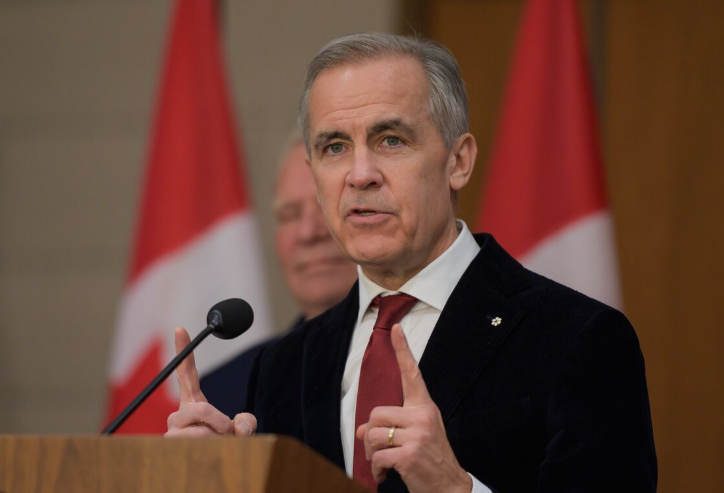
Trade negotiations between the United States and Canada collapsed this week, with Canadian Prime Minister Mark Carney announcing that retaliatory tariffs on U.S. goods will take effect September 8, 2026. The breakdown follows the Trump administration’s imposition of 50% tariffs on certain Canadian goods, according to reporting from CNBC and the Washington Post.
What Happened
CNBC reported the collapse of talks as part of its ongoing business news coverage on August 22, 2026, noting the story as one of the week’s most significant developments for cross-border trade. The Washington Post’s business desk, in coverage also published August 22-23, quoted Carney characterizing President Trump’s 50% tariffs as “a miscalculation,” and confirmed the September 8 date for Canada’s retaliatory measures.
As of this writing, specific details on which categories of U.S. goods will be subject to Canadian retaliatory tariffs have not been fully reported. This article will be updated with additional specifics as they become available from primary government sources.
Why This Matters for Markets and Consumers
Trade disputes between the U.S. and its largest trading partners tend to have ripple effects across supply chains, consumer prices, and specific industry sectors with cross-border exposure. A Washington Post analysis accompanying the coverage noted that other countries unhappy with existing U.S. trade arrangements are likely watching the U.S.-Canada breakdown closely, suggesting the dispute could have implications beyond the immediate bilateral relationship.
Broader Context: A Volatile Week for Cross-Border and Fiscal News
The trade breakdown arrived during an already turbulent week for U.S. economic news. The same week saw the national debt cross $40 trillion for the first time, a sharp rise in Treasury bond market volatility, and the Treasury Department doubling the size of its debt buyback program. Whether the trade dispute has any direct connection to these fiscal and monetary developments has not been established in current reporting, but the concentration of major economic stories in the same week has drawn attention from market commentators tracking overall macroeconomic risk.
How This Fits the Broader Trade Policy Pattern
The U.S.-Canada breakdown is not occurring in isolation. Trade policy has been an active area of U.S. economic policymaking throughout 2026, with tariff actions and negotiations affecting multiple trading partners over the course of the year. Canada has historically been among the United States’ largest trading partners by total trade volume, meaning a prolonged dispute carries more direct economic exposure for both economies than a similar breakdown with a smaller trading partner would.
Industries with integrated North American supply chains — including automotive manufacturing, agriculture, and energy — have historically been among the most exposed to U.S.-Canada trade friction, given the degree to which components and raw materials cross the border multiple times during production. Businesses in these sectors should treat the September 8 deadline as a planning point regardless of whether it ultimately takes effect as announced.
What We Don’t Yet Know
Several material details remain unconfirmed or unreported as of this writing:
– The specific list of U.S. product categories subject to Canadian retaliatory tariffs
– Whether any further negotiations are scheduled between the September 8 deadline and the present
– Potential exemptions for critical supply chains, such as energy or auto parts, which have historically received special treatment in prior U.S.-Canada trade disputes
What to Watch Next
Businesses with cross-border exposure to Canadian suppliers or customers should monitor official statements from the U.S. Trade Representative’s office and Canada’s Department of Global Affairs for detailed tariff schedules ahead of the September 8 implementation date. Given the fluid nature of trade negotiations, a resumption of talks or a modified agreement before that date remains possible and would supersede current retaliatory tariff plans.
The U.S. gross national debt crossed $40 trillion for the first time this week, according to Treasury Department data reported by NPR on August 20, 2026. The milestone caps a period of rapid fiscal expansion: the debt has doubled since 2017, and the federal government now spends more than $1 trillion a year just servicing interest on what it owes.
Why the Debt Load Is Accelerating
The debt has not grown at a steady pace. Instead, a combination of pandemic-era spending, tax policy changes, and elevated interest rates has compounded the federal government’s borrowing costs. As older Treasury bonds issued at lower rates mature, they are being refinanced at today’s higher prevailing rates, which pushes up the government’s annual interest bill even without any new borrowing.
That interest bill is no longer a minor line item. At more than $1 trillion annually, debt servicing now competes directly with discretionary spending on defense, infrastructure, and social programs. Economists watching the trend note that this dynamic can become self-reinforcing: higher interest costs widen the deficit, which requires more borrowing, which in turn raises future interest costs.
Bond Market Reaction
The debt milestone arrived during a volatile week for Treasury bonds. Bond prices fell even as equity markets touched record highs, a divergence that market analysts describe as bond investors signaling concern about the sustainability of federal borrowing, even as stock investors remain focused on corporate earnings and AI-driven growth.
U.S. Treasury Secretary Scott Bessent responded to the bond market pressure by expanding the Treasury’s debt buyback program, telling CNBC the size of buyback operations had been doubled to at least $4 billion per operation, with room to increase further. Buybacks are intended to support demand for existing Treasury securities and help stabilize yields during periods of market stress.
What Rising Debt Means for Ordinary Households
For everyday consumers, the national debt level itself is abstract, but its downstream effects are not. Elevated Treasury yields tend to push up borrowing costs across the economy, including mortgage rates, auto loans, and business credit. The same week the $40 trillion milestone was confirmed, average 30-year mortgage rates moved sharply, illustrating how bond market volatility connects directly to household borrowing costs.
Rising federal interest costs also narrow the government’s fiscal flexibility. As a larger share of the federal budget goes toward servicing debt rather than funding programs, policymakers face growing pressure to either cut spending, raise revenue, or both — choices that carry direct economic consequences for households and businesses alike.
What to Watch Next
The debt trajectory is expected to remain a central topic at the Federal Reserve’s Jackson Hole Economic Symposium, scheduled for August 27–29, 2026 — the first such gathering under new Fed Chair Kevin Warsh, who was confirmed by the Senate in a 54-45 vote in May 2026. While the symposium’s stated theme is financial innovation and payments policy, fiscal sustainability and its interaction with monetary policy are likely to feature in sideline discussions given the scale of the debt milestone.
Investors and households should watch upcoming Treasury auction results and any further changes to the buyback program as early indicators of how markets are digesting the government’s borrowing needs. A weak auction — one that requires higher yields to attract sufficient buyers — would be a signal that investor appetite for U.S. debt is softening further.
The $40 trillion figure is a threshold, not a crisis in itself. But combined with a bond market already showing signs of strain, it adds urgency to a fiscal conversation that has largely been deferred by successive Congresses and administrations.
The United States enters the 2026–2030 macroeconomic window as the unquestioned heavyweight of nominal economic output, retaining its status as the primary engine of global financial liquidity, private enterprise innovation, and high-margin technological deployment. According to multi-year projections from the International Monetary Fund (IMF)World Economic Outlook and complementary datasets from the World Bank, the US nominal Gross Domestic Product (GDP) is projected to reach $32.38 trillion by 2026, accounting for approximately 25% of global nominal output and roughly 14.5% of world GDP measured at Purchasing Power Parity (PPP).
Unlike many of its advanced-economy peers across Western Europe and East Asia—which are grappling with acute demographic contraction and structural energy shocks—the United States demonstrates remarkable macroeconomic resilience. The IMF projects a real GDP Compound Annual Growth Rate (CAGR) of 2.1% to 2.3% through 2030. This expansion is sustained by three structural anchors: unmatched capital depth driving massive private-sector investment in Artificial Intelligence (AI) infrastructure, complete energy independence as a net exporter of hydrocarbons and liquefied natural gas (LNG), and high labor productivity gains that cushion the economy against rising debt-servicing costs.
Macroeconomic Data Matrix (2026–2030 Projections)
Economic Metric
IMF / World Bank Baseline (2026–2030)
Global Benchmark & Context
Nominal GDP (2026 Projection)
~$32.38 Trillion
Rank #1 Globally
GDP at Purchasing Power Parity (PPP)
~$32.40 Trillion
Rank #2 Globally (Behind China’s ~$38.5T PPP)
Projected Real GDP CAGR (2026–2030)
2.1% – 2.3%
Top decile among G7 advanced economies
Gross Public Debt (% of GDP)
~122.5% – 128.0%
Structural fiscal deficit trajectory
Core Inflation Rate (PCE Target)
Stabilizing at 2.0% – 2.2%
Federal Reserve inflation target alignment
Current Account Balance (% of GDP)
-2.8% to -3.2%
Persistent capital import & reserve currency demand
Deep Structural Growth Drivers
1. The AI Infrastructure Hyper-Cycle & TFP Expansion
The defining growth catalyst for the US economy over the 2026–2030 horizon is the unprecedented scale of private capital expenditure (Capex) poured into artificial intelligence infrastructure, enterprise software integration, and advanced computing hardware.
Major technology mega-caps and private equity funds are directing hundreds of billions of dollars annually into hyper-scale data centers, domestic semiconductor fabrication, high-voltage electrical grid upgrades, and AI-driven workflow platforms. According to World Bank economic research, technological adoption across American service and manufacturing sectors is driving a notable uptick in Total Factor Productivity (TFP). This productivity surge allows US companies to expand profit margins and output even in an environment characterized by higher structural real interest rates and tight skilled-labor markets.
2. Deep Capital Markets and Private Sector Liquidity
The structural backbone of US economic outperformance remains its financial system. US capital markets represent over 40% of global equity market capitalization and a vast majority of global venture capital and private credit assets.
This liquidity creates an efficient mechanism for capital allocation: high-potential emerging industries (such as quantum computing, synthetic biology, and advanced defense technology) receive early-stage funding at a scale that no other national market can match. When global monetary conditions tighten, global capital flees toward safety and yield, reinforcing US capital depth and lowering the relative cost of equity capital for American corporations.
3. Net Energy Independence & Industrial Cost Advantages
Unlike industrial hubs in Germany, Japan, or South Korea—which remain highly vulnerable to volatile sea-lane logistics and imported fuel price spikes—the United States operates as a major net exporter of petroleum, natural gas, and refined chemical products.
Access to abundant, cheap domestic natural gas provides US heavy industry, advanced manufacturing, and electricity-hungry data centers with a persistent structural cost advantage. Furthermore, federal policy frameworks (including the CHIPS and Science Act and clean energy tax provisions) continue to catalyze domestic private manufacturing investment, re-shoring high-value supply chains from East Asia back to the American Sunbelt and Midwest.
Macroeconomic Vulnerabilities & Downside Risks
1. Structural Sovereign Debt Trajectory
The most significant medium-term threat to US macroeconomic stability is the path of federal public debt. With gross national debt exceeding 120% of GDP and annual federal deficits running between 5% and 7% of GDP, the US fiscal baseline faces increasing structural pressure.
As older legacy low-yield Treasury bonds mature, they are refinanced at higher prevailing interest rates. According to IMF fiscal monitor assessments, federal net interest payments are absorbing an expanding share of total fiscal revenue, crowding out discretionary spending and narrowing the government’s capacity to deploy counter-cyclical fiscal stimulus during future downturns.
2. Commercial Real Estate (CRE) & Banking Sector Realignment
The structural transformation toward hybrid work models has permanently altered office space utilization across major US metropolitan areas. Regional and community banks, which hold a disproportionate share of commercial real estate debt, face ongoing balance-sheet pressure as legacy office loans mature and require refinancing at lower property valuations and higher interest rates. While systemic money-center banks remain well-capitalized, localized credit tightening from regional lenders presents a headwind for small-and-medium enterprise (SME) borrowing.
High-Outperformance Sector Matrix (2026–2030)
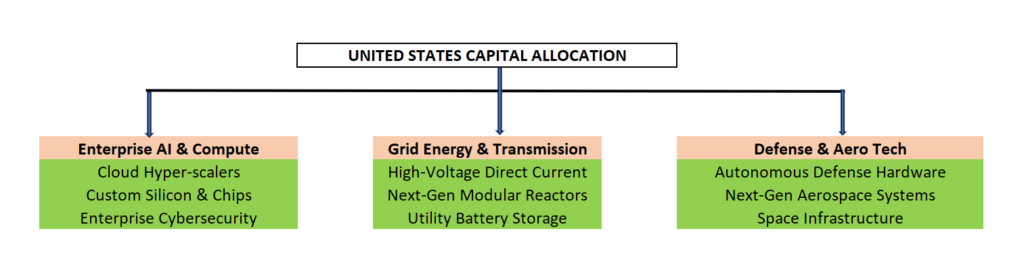
Enterprise AI, Cloud Compute, & Cybersecurity: Companies building enterprise-grade software, AI agents, cloud architectures, and specialized hardware protection layers.
Next-Generation Energy & Grid Modernization: Power generation utilities, high-voltage electrical equipment makers, small modular nuclear reactor (SMR) developers, and energy storage systems catering to exponential data center energy demands.
Advanced Defense Technology & Aerospace: Autonomous systems, satellite networks, hypersonic defense, and advanced materials supplying both domestic security needs and global allied demand.
Strategic Summary for Global Investors & Executives
The United States through 2030 remains the ultimate high-volume, high-yield destination for institutional capital. While fiscal debt risks require long-term monitoring, the immediate 5-year outlook is defined by strong technology-driven productivity, resilient private consumption, and unmatched market liquidity. For global corporations and institutional allocators, exposure to the US economy remains an indispensable pillar of long-term growth strategy.