
Finance
Where ‘Made in China 2025’ missed the mark

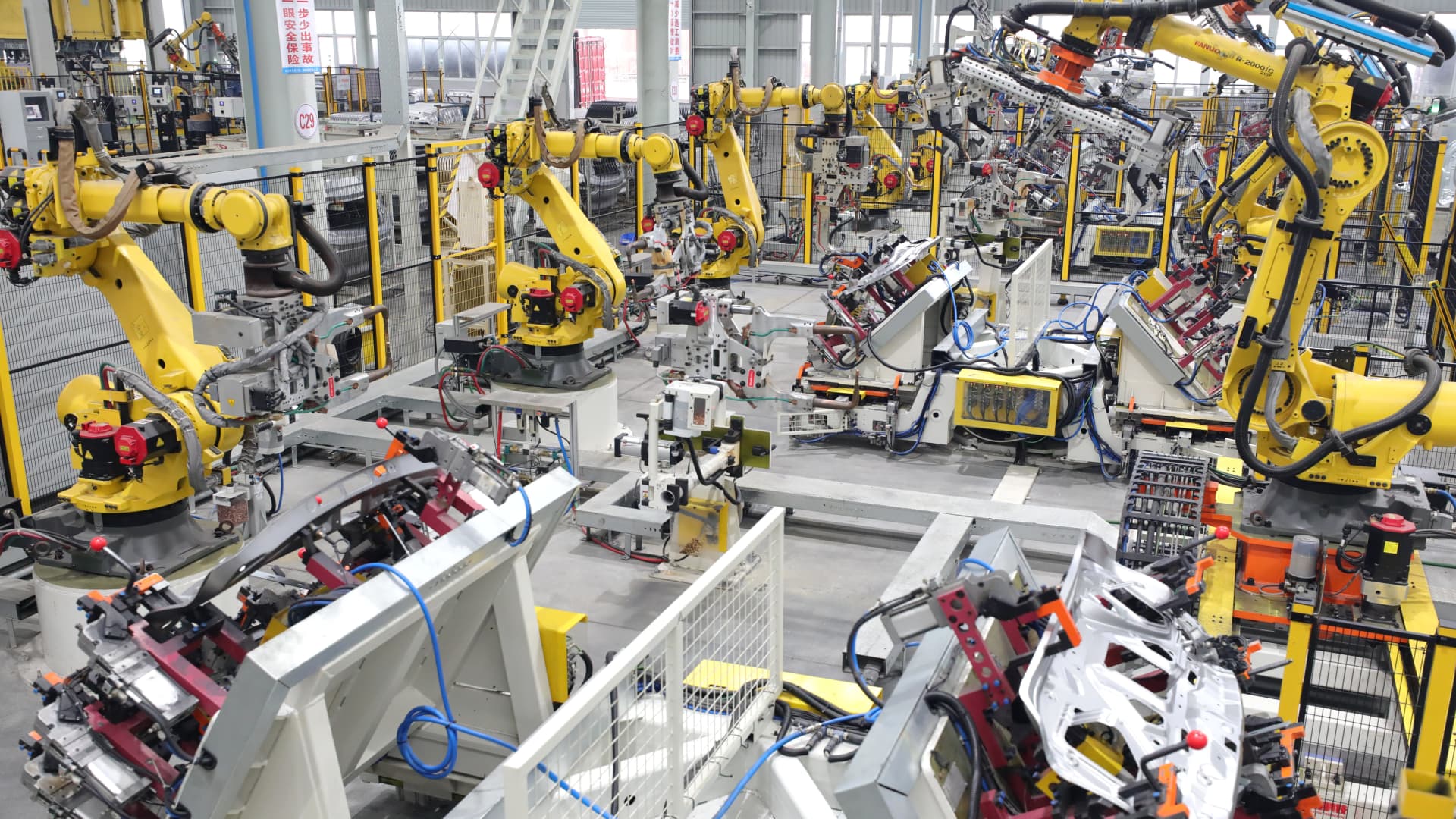
Smart robotic arms work on the production line at the production workshop of Changqing Auto Parts Co., LTD., located in Anqing Economic Development Zone, Anhui Province, China, on March 13, 2025. (Photo by Costfoto/NurPhoto via Getty Images)
Nurphoto | Nurphoto | Getty Images
BEIJING — China missed several key targets from its 10-year plan to become self-sufficient in technology, while fostering unhealthy industrial competition which worsened global trade tensions, the European Chamber of Commerce in China said in a report this week.
When Beijing released its “Made in China 2025” plan in 2015, it was met with significant international criticism for promoting Chinese business at the expense of their foreign counterparts. The country subsequently downplayed the initiative, but has doubled-down on domestic tech development given U.S. restrictions in the last several years.
Since releasing the plan, China has exceeded its targets on achieving domestic dominance in autos, but the country has not yet reached its targets in aerospace, high-end robots and the growth rate of manufacturing value-added, the business chamber said, citing its research and discussions with members. Out of ten strategic sectors identified in the report, China only attained technological dominance in shipbuilding, high-speed rail and electric cars.
China’s targets are generally seen as a direction rather than an actual figure to be achieved by a specific date. The Made In China 2025 plan outlines the first ten years of what the country called a ‘multi-decade strategy’ to become a global manufacturing powerhouse.
The chamber pointed out that China’s self-developed airplane, the C919, still relies heavily on U.S. and European parts and though industrial automation levels have “increased substantially,” it is primarily due to foreign technology. In addition, the growth rate of manufacturing value add reached 6.1% in 2024, falling from the 7% rate in 2015 and just over halfway toward reaching the target of 11%.
“Everyone should consider themselves lucky that China missed its manufacturing growth target,” Jens Eskelund, president of the European Union Chamber of Commerce in China, told reporters Tuesday, since the reverse would have exacerbated pressure on global competitors. “They didn’t fulfill their own target, but I actually think they did astoundingly well.”

Even at that slower pace, China has transformed itself over the last decade to drive 29% of global manufacturing value add — almost the same as the U.S. and Europe combined, Eskelund said. “Before 2015, in many, many categories China was not a direct competitor of Europe and the United States.”
The U.S. in recent years has sought to restrict China’s access to high-end tech, and encourage advanced manufacturing companies to build factories in America.
Earlier this week, the U.S. issued exporting licensing requirements for U.S.-based chipmaker Nvidia’s H20 and AMD’s MI308 artificial intelligence chips, as well as their equivalents, to China. Prior to that, Nvidia said that it would take a quarterly charge of about $5.5 billion as a result of the new exporting licensing requirements. The chipmaker’s CEO Jensen Huang met with Chinese Vice Premier He Lifeng in Beijing on Thursday, according to Chinese state media.
The U.S. restrictions have “pushed us to make things that previously we would not have thought we had to buy,” said Lionel M. Ni, founding president of the Guangzhou campus of the Hong Kong University of Science and Technology. That’s according to a CNBC translation of his Mandarin-language remarks to reporters on Wednesday.
Ni said the products requiring home-grown development efforts included chips and equipment, and if substitutes for restricted items weren’t immediately available, the university would buy the second-best version available.
In addition to thematic plans, China issues national development priorities every five years. The current 14th five-year plan emphasizes support for the digital economy and wraps up in December. The subsequent 15th five-year plan is scheduled to be released next year.
China catching up
It remains unclear to what extent China can become completely self-sufficient in key technological systems in the near term. But local companies have made rapid strides.
Chinese telecommunications giant Huawei released a smartphone in late 2023 that reportedly contained an advanced chip capable of 5G speeds. The company has been on a U.S. blacklist since 2019 and released its own operating system last year that is reportedly completely separate from Google’s Android.
“Western chip export controls have had some success in that they briefly set back China’s developmental efforts in semiconductors, albeit at some cost to the United States and allied firms,” analysts at the Washington, D.C.,-based think tank Center for Strategic and International Studies, said in a report this week. However, they noted that China has only doubled down, “potentially destabilizing the U.S. semiconductor ecosystem.”
For example, the thinktank pointed out, Huawei’s current generation smartphone, the Pura 70 series, incorporates 33 China-sourced components and only 5 sourced from outside of China.
Huawei reported a 22% surge in revenue in 2024 — the fastest growth since 2016 — buoyed by a recovery in its consumer products business. The company spent 20.8% of its revenue on research and development last year, well above its annual goal of more than 10%.
Overall, China manufacturers reached the nationwide 1.68% target for spending on research and development as a percentage of operating revenue, the EU Chamber report said.
“‘Europe needs to take a hard look at itself,” Eskelund said, referring to Huawei’s high R&D spend. “Are European companies doing what is needed to remain at the cutting edge of technology?”
Dutch semiconductor equipment firm ASML spent 15.2% of its net sales in 2024 on R&D, while Nvidia’s ratio was 14.2%.
Overcapacity and security concerns
However, high spending doesn’t necessarily mean efficiency.
The electric car race in particular has prompted a price war, with most automakers running losses in their attempt to undercut competitors. The phenomenon is often called “neijuan” or “involution” in China.
“We also need to realize [China’s] success has not come without problems,” Eskelund said. “We are seeing across a great many industries it has not translated into healthy business.”
He added that the attempt to fulfill “Made in China 2025” targets contributed to involution, and pointed out that China’s efforts to move up the manufacturing value chain from Christmas ornaments to high-end equipment have also increased global worries about security risks.

Subscribe now
In an annual government work report delivered in March, Chinese Premier Li Qiang called for efforts to halt involution, echoing a directive from a high-level Politburo meeting in July last year. The Politburo is the second-highest circle of power in the ruling Chinese Communist Party.
Such fierce competition compounds the impact of already slowing economic growth. Out of 2,825 mainland China-listed companies, 20% reported a loss for the first time in 2024, according to a CNBC analysis of Wind Information data as of Thursday. Including companies that reported yet another year of losses, the share of companies that lost money last year rose to nearly 48%, the analysis showed.
China in March emphasized that boosting consumption is its priority for the year, after previously focusing on manufacturing. Retail sales growth have lagged behind industrial production on a year-to-date basis since the beginning of 2024, according to official data accessed via Wind Information.
Policymakers are also looking for ways to ensure “a better match between manufacturing output and what the domestic market can absorb,” Eskelund said, adding that efforts to boost consumption don’t matter much if manufacturing output grows even faster.
But when asked about policies that could address manufacturing overcapacity, he said, “We are also eagerly waiting in anticipation.”





Nvidia Q2 FY2027 Earnings beats Wall Street Expectation with Record $96.2 Billion Revenue

Treasury Bond Volatility Forces Bessent to Double Debt Buyback Size as Yields Swing

Nvidia Earnings Preview: What Wall Street Expects From the AI Bellwether’s Q2 Report

Armanino adds Strategic Accounting Outsourced Solutions

New 2023 K-1 instructions stir the CAMT pot for partnerships and corporations

Tax Strategy: Employee Retention Credit update
-
 Economics1 week ago
Nvidia’s Potential $3 Billion SB Energy Investment Could Reshape AI Infrastructure
-

 Economics4 days ago
Top 10 Largest Economies by 2030: IMF & World Bank GDP Projections for Global Powerhouses
-
 Stock News4 days ago
How to understand Intel $15B Stock Offering
-
 Technology1 week ago
U.S.-China AI Competition Intensifies as Washington Pushes Allies to Choose Sides
-
 Stock News24 hours ago
Nvidia Earnings Preview: What Wall Street Expects From the AI Bellwether’s Q2 Report
-

 Economics4 days ago
Economic Profile of the United States of America (2026–2030 Horizon)
-

 Leaders3 days ago
Jackson Hole 2026: What the First Symposium Under Fed Chair Kevin Warsh Means for Markets
-
 Economics3 days ago
U.S. National Debt Surpasses $40 Trillion for the First Time: What It Means for the Economy