Connect with us

Finance

Democrat senators question what Elon Musk plans to do with CFPB data

Published

on

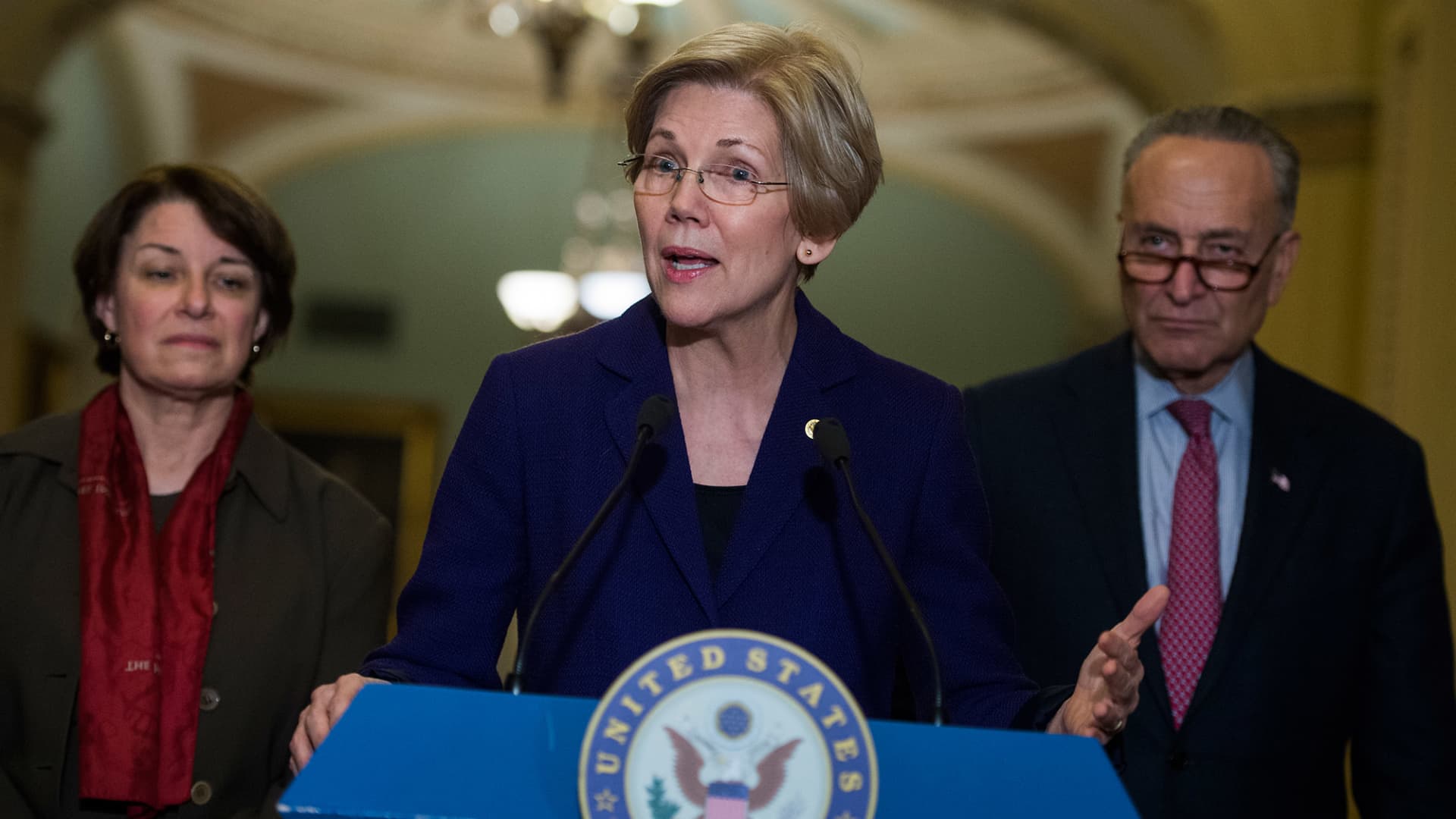
Sens. Elizabeth Warren, D-Mass., center, Amy Klobuchar, D-Minn., and Senate Minority Leader Charles Schumer, D-N.Y., conduct a news conference after the Senate Policy luncheons in the Capitol, March 14, 2017.

Tom Williams | CQ Roll Call | Getty Images

Democrat lawmakers led by Massachusetts Sen. Elizabeth Warren on Tuesday held a forum pushing back against the moves that the Trump administration and Elon Musk have taken to neutralize the Consumer Financial Protection Bureau.

Guests at the event included a retired military veteran helped by the agency, a mortgage broker who said the CFPB has helped curb industry abuses, and the bureau’s former head for supervision.

But the focus of the senators’ attention was Elon Musk, the driving force behind the so-called Department of Government Efficiency. While Musk was invited to the Washington, D.C, event, according to Warren, he didn’t make an appearance.

The lawmakers questioned whether Musk was conflicted in his efforts to dismantle the CFPB, highlighting his recent plan to launch a digital payments service within X, the social media network he owns.

“By seizing control of the agency, Musk can now root through all of the CFPB’s confidential data that DOGE has accessed on these potential competitors,” Warren said. “As Musk launches his new app, he faces oversight from the CFPB. His plan seems to be to eliminate the watchdog.”

A representative for Musk and X didn’t immediately respond to request for comment.

Earlier this month, operatives from DOGE gained access to CFPB systems, shortly before the bureau’s new leadership shuttered the agency’s headquarters, froze nearly all activities and laid off roughly 200 employees. A CFPB union has alleged in a lawsuit that acting CFPB Director Russell Vought intends to fire more than 95% of the agency’s staff.

“Elon, how do you justify shutting down the agency that’s going to be looking at your peer-to-peer payment plan?” Sen. Amy Klobuchar, D.-Minn., asked rhetorically during the hearing Tuesday. “How do you justify shutting down the agency that has jurisdiction and oversight over many of the other financial issues that you are going to make money from doing?”

‘Secret sauce’

Responding to a question from Sen. Chris Van Hollen, D.-Md., about what Musk could do with CFPB data, Lorelei Salas, the former CFPB supervision director, said the regulator kept “very sensitive trade secret information,” including from payments services PayPal, CashApp and Zelle, as well as online lenders.

“We’ve been looking at a number of digital wallet companies, payments companies, and we have information… on the technologies that they’re using,” Salas said. “We have information on the secret sauce of the credit models that people used with artificial intelligence to make decisions about whether you get a loan or not.”

Late last year, the CFPB took steps to supervise tech giants and payments firms that dominate the market, including Apple and PayPal, and sued the operator of the Zelle payments network and the three biggest U.S. banks using it for allegedly failing to properly investigate fraud complaints.

Besides confidential data on companies examined by the CFPB, the agency has “very sensitive data” from consumers filing complaints, Salas added. Consumers often leave account numbers and other personal data in their complaints, agency sources have said.

Now, with the CFPB and its employees in a state of limbo, the question is how far Musk and Vought can take their campaign to minimize the watchdog. A federal judge has halted their efforts, saying that they cannot fire employees or purge bureau data for the time being.

“The CFPB has been sidelined, but it is not dead,” Warren said, asserting that only Congress can shut down the bureau. “Advocates are in court right now asking judges to enforce the law, and I am confident they are going to win.”

Continue Reading

Finance

Treasury Bond Volatility Forces Bessent to Double Debt Buyback Size as Yields Swing

Published

on

Bessent

A turbulent week in the U.S. Treasury market prompted the Treasury Department to sharply increase the size of its long-term debt buyback program, as bond prices fell even while equity markets pushed toward record highs. The divergence has drawn attention from fixed-income strategists who see it as a signal of underlying investor unease about federal borrowing levels.

What Happened This Week

U.S. Treasury Secretary Scott Bessent told CNBC on Thursday, August 20, 2026, that the Treasury had doubled the size of its long-term debt buyback operations, moving from roughly $2 billion to at least $4 billion per operation. Bessent indicated the figure could climb further, saying “we’re going to increase the size of the buyback,” and noted the accelerated pace could exceed the announced $4 billion threshold per issue.

Buybacks allow the Treasury to repurchase outstanding government bonds directly from the market, which can help support prices and dampen yield volatility during periods of stress. The expanded program came as stocks staged a late-week recovery: the S&P 500 and Russell 2000 both advanced on Friday, August 21, even as Treasuries logged mild losses, according to Bloomberg market data.

Why Bond and Equity Markets Are Diverging

Capital.com senior market analyst Daniela Hathorn described the week’s dynamic as markets “ending the week on a softer tone after the relative calm of early August was disrupted by renewed pressure in global bond markets, another rise in oil prices, and growing uncertainty around the Federal Reserve’s next move.” She noted that higher long-term borrowing costs are increasingly challenging elevated equity valuations, even as U.S. equities pull back modestly from record highs.

This divergence — equities near record levels while bonds sell off  is unusual and reflects two different sets of investor concerns. Equity investors have remained focused on corporate earnings strength, particularly from large technology companies ahead of Nvidia’s closely watched August 26 earnings report. Bond investors, by contrast, are more directly exposed to concerns about the scale of federal borrowing, highlighted this week by the national debt crossing the $40 trillion threshold for the first time.

The Fed and Treasury “Working in Opposite Directions”

Wilmington Trust senior bond portfolio manager Wil Stith told Yahoo Finance that current conditions reflect “the Fed and the Treasury basically working in sort of opposite directions,” adding that the imbalance will likely require the Federal Reserve  which he described as having “the larger sandbox”  to adjust the federal funds rate rather than relying on Treasury market interventions alone to manage yields.

Notably, the bond market’s reaction to the Treasury’s buyback expansion was relatively muted; strategists described the move as being largely absorbed without a major rally, suggesting the underlying pressure on yields stems from factors, such as inflation persistence and debt sustainability concerns, that a buyback program alone cannot resolve.

What Comes Next

Markets are now looking to two major events in the days ahead: Nvidia’s earnings report on Wednesday, August 26, and the Federal Reserve’s Jackson Hole Economic Symposium, running August 27-29. This will be the first Jackson Hole gathering under new Fed Chair Kevin Warsh, whose public communication style and policy signals remain less established than his predecessors’, according to market commentary from Regards of Wall Street.

For investors, the key metrics to watch are the size and frequency of future Treasury buyback operations, movements in the 10-year Treasury yield, and any policy signals from Warsh’s keynote address. Continued yield volatility alongside record equity valuations would suggest the market imbalance identified this week has not yet been resolved.


Continue Reading

Finance

Cross-Border Settlement Innovation and Real-Time Payment Architecture

Published

on

The global banking system is undergoing a comprehensive modernization of cross-border payment infrastructure. Driven by real-time settlement networks, open banking APIs, and interoperable messaging standards, financial institutions and multinational corporations are eliminating multi-day delays and reducing transaction costs associated with legacy international wire transfers.

Transition to Real-Time Gross Settlement Networks
Historically, international business-to-business (B2B) payments relied on complex correspondent banking relationships involving intermediary fees and processing delays. In 2026, the widespread adoption of ISO 20022 messaging protocols alongside interconnected Real-Time Gross Settlement (RTGS) systems allows direct, end-to-end processing of cross-border transfers.

Commercial banks are providing corporate clients with continuous, 24/7 payment clearing capabilities. Real-time transaction confirmation and automated FX rate locking allow international businesses to settle cross-border trade obligations within minutes, significantly reducing counterparty risk.

Central Bank Digital Currency (CBDC) Interoperability
Wholesale Central Bank Digital Currency (CBDC) pilot initiatives are reaching operational maturity across several key financial centers. Collaborative multi-CBDC platforms enable participating central banks and commercial institutions to settle foreign exchange and international trade transactions directly on shared distributed ledgers.

These wholesale digital currency networks eliminate traditional clearinghouse delays and minimize foreign exchange slippage. Enterprise treasury departments benefit from enhanced liquidity management, as cross-border cash balances can be deployed and repatriated instantaneously.

Corporate Treasury Transformation
For enterprise treasurers, instant cross-border settlement transforms cash management strategies:
– Working Capital Optimization: Reduced transaction float allows companies to lower precautionary cash reserves and optimize short-term liquidity investments.
– Automated Reconciliation: Enriched data formats embedded in ISO 20022 payment messages streamline automated general ledger posting and invoice matching.
– Reduced Processing Overhead: Account-to-account (A2A) real-time clearing bypasses costly intermediary correspondent banking fees.

Strategic Financial Priorities
1. Upgrade Treasury Systems: Ensure internal core enterprise software supports real-time ISO 20022 payment messaging standards.
2. Leverage Instant Clearing Rails: Utilize direct payment networks to lower cross-border transaction fees and eliminate settlement delays.
3. Evaluate Multi-Currency Liquidity: Modernize liquidity management frameworks to capitalize on 24/7 real-time settlement capabilities.

Continue Reading

Finance

Private Credit Expansion and Regulatory Oversight in 2026 Capital Markets

Published

on

The global private credit market has solidified its role as a fundamental pillar of enterprise finance, expanding rapidly across middle-market lending, asset-backed finance, and infrastructure financing. As non-bank financial institutions capture a larger share of corporate debt origination, global regulatory bodies are increasing oversight to evaluate market transparency and systemic risk interconnections.

Growth Drivers in Direct Lending
Direct lending platforms have continued to attract substantial institutional allocations from pension funds, sovereign wealth entities, and insurance companies seeking attractive risk-adjusted yields. Private debt funds offer corporate borrowers customized financing structures, faster execution timelines, and confidentiality compared to syndicated loan markets.

In 2026, private credit managers are increasingly financing larger corporate transactions, providing multi-billion-dollar credit facilities for buyout deals and corporate restructurings. The flexibility of private debt contracts—featuring unitranche pricing and tailored covenant packages—has made direct lending the preferred capital source for middle-market enterprise sponsors.

Regulatory Scrutiny and Systemic Risk Assessment
The rapid growth of non-bank intermediation has drawn heightened scrutiny from financial regulators in North America and Europe. Because private debt agreements are negotiated privately without public exchange disclosures, central banks are evaluating potential vulnerabilities related to asset valuation consistency and fund liquidity profiles.

Regulatory agencies are introducing guidelines aimed at improving reporting standards for private investment vehicles managing institutional assets. Key focus areas include monitoring leverage ratios within private credit funds and evaluating indirect credit exposures between commercial banking institutions and private debt funds.

Navigating Elevated Refinancing Costs
With benchmark interest rates remaining elevated, private debt borrowers face higher debt service obligations on floating-rate credit facilities. Financial advisory firms report an increase in proactive liability management strategies, including payment-in-kind (PIK) interest options, equity infusions from sponsors, and covenant modifications.

Private credit managers with deep operational capabilities are actively working alongside portfolio companies to optimize working capital and maintain cash flow coverage ratios during periods of higher borrowing costs.

Key Financial Takeaways
1. Mainstream Asset Class: Private credit has expanded beyond niche alternative asset status into a core corporate finance solution.
2. Enhanced Transparency Standards: Regulatory frameworks are evolving toward greater disclosure requirements for private debt managers.
3. Proactive Risk Management: Lenders and sponsors must prioritize debt sustainability and active portfolio monitoring amid high benchmark rates.

Continue Reading

Trending